

Budgeting on a variable income in Singapore comes with a challenge that salaried friends rarely face: you do not know exactly what will land in your account next month. Whether you drive, freelance, sell, take on commission-based work, or juggle several gigs, your pay can swing from a bumper month to a quiet one. That uncertainty makes the usual “spend a fixed slice on this and that” advice feel out of reach. The fix is not to earn a steady salary. It is to build a system that turns lumpy income into steady, predictable spending.
Start with your baseline, not your best month
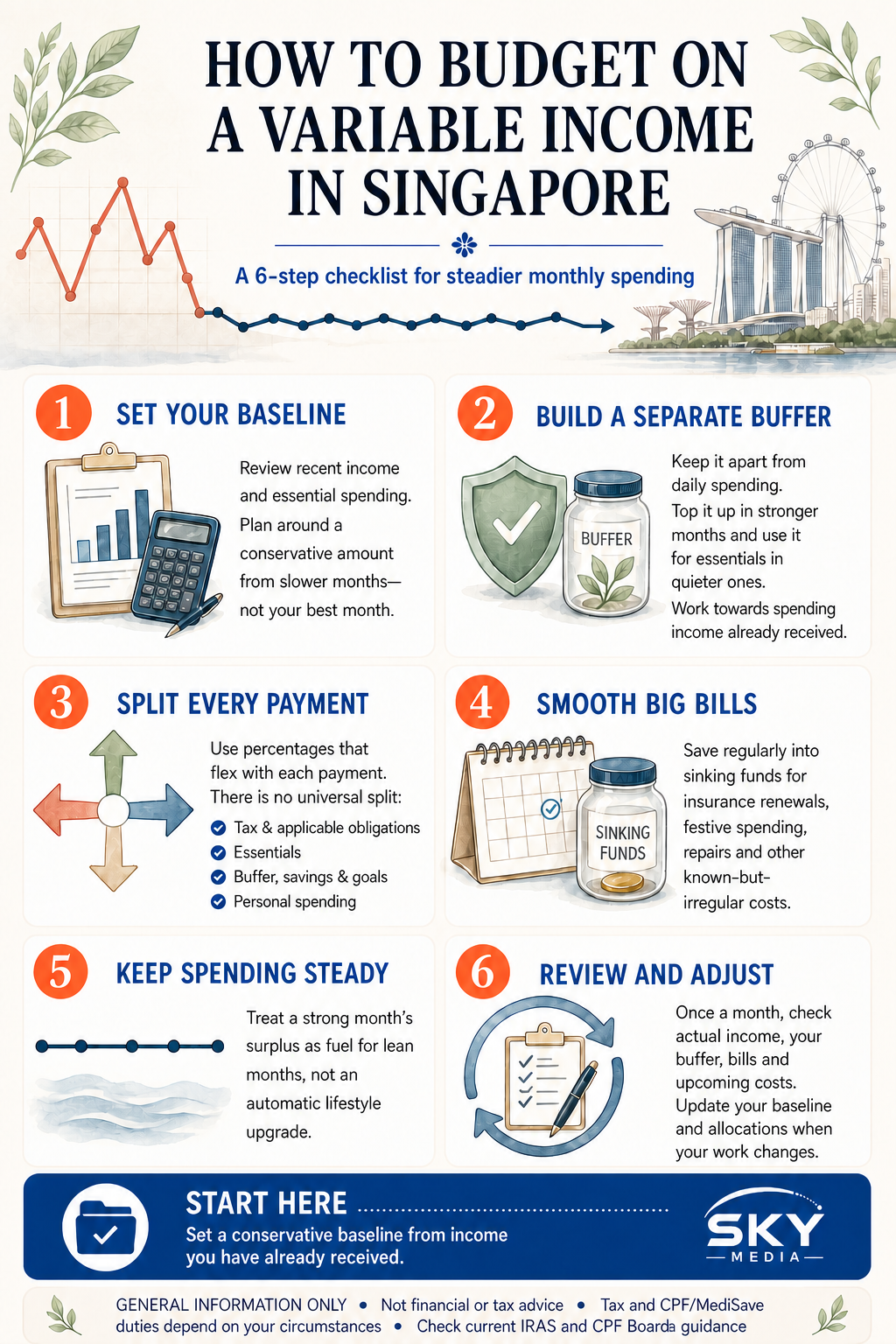
The most common trap is budgeting around a good month and then scrambling when a lean one arrives. Flip it around. Look back over the last several months of income and find your baseline, roughly the amount you can reasonably count on even in a slower period. Be honest and a little conservative here. This baseline becomes the number your everyday life runs on: rent or home costs, food, transport, bills, family support, and basic savings.
Anything you earn above the baseline is not “extra to spend”. It is fuel for the months when you earn below it. Once you see your income this way, the swings stop feeling like emergencies and start feeling like a rhythm you can manage. If you are not sure what your true baseline is, spend a little time first on tracking your spending so you know the real floor your life needs.
Build a buffer so a slow month is boring
A buffer is the single most powerful tool for an irregular income. It is a pool of money that sits between your unpredictable earnings and your predictable bills, so that a quiet month becomes a non-event rather than a crisis. The goal is simple: aim to keep enough set aside to cover a stretch of essential expenses, then top it up in the strong months.
How you fill it matters. In a good month, resist the urge to lift your lifestyle to match. Instead, pay your buffer first, the way a salaried person pays into savings. Over time you want to reach the point where you are living on last month’s income, not this month’s. When the money you spend in August was actually earned in July, the guessing disappears and you gain a calm that is hard to describe until you have felt it.
Keep the buffer somewhere separate from your daily account so you are not tempted to treat it as spending money. Our guide on organising your bank accounts pairs well with this idea.
Give every payday a simple rule
When income arrives in unpredictable chunks, you need a repeatable way to split each payment so decisions do not depend on your mood. A percentage approach works better than fixed dollar amounts, because it flexes with the size of each payment. The moment money lands, move set shares into their jobs before you spend a cent.
Here is how the same money can be handled very differently depending on the approach.
| Approach | What happens in a big month | What happens in a slow month |
|---|---|---|
| Spend as it comes | Lifestyle rises, little is saved | Panic, borrowing, or cutting essentials |
| Fixed dollar transfers | Works until a payment is smaller than the transfer | Transfers bounce or drain the buffer fast |
| Percentage of each payment | Buffer and savings grow automatically | You still set aside something, just less |
| Pay your baseline from the buffer | Surplus tops up the buffer for later | Life continues normally, funded by past months |
The percentage habit removes willpower from the equation. You might route each incoming payment into buckets for tax and obligations, essentials, savings, and a personal allowance. The exact split is yours, and it will take a few tries to tune. What matters is that the split happens the moment money arrives, not at the end of the month when it is already gone.
Plan for the bills that do not care about your income
Irregular earners still face very regular costs. Bills, insurance renewals, and family commitments arrive on their own schedule regardless of how your month went. Two categories deserve special care.
First, set aside money for tax and any obligations as you earn, not at the deadline. If a slice of every payment goes into a separate pot the moment it lands, you will never face a bill you cannot meet. Speak to a qualified professional or check the official guidance for your situation, since rules and rates change and this is general information rather than tax advice.
Second, turn big irregular expenses into small monthly ones. Annual insurance, festive spending, and the occasional large purchase can wreck a variable-income month if they hit all at once. The tidy solution is to save a little each month into a dedicated fund so the money is already waiting when the bill comes. Our guide on using sinking funds shows exactly how to smooth these lumps out.
A short checklist for the payday routine:
- Move a share for tax and obligations before anything else.
- Fund your baseline expenses for the month ahead.
- Top up your buffer until it covers a comfortable stretch of essentials.
- Add to savings and sinking funds for known big costs.
- Whatever is left is your guilt-free allowance.
Keep spending steady even when income is not
The whole point of this system is that your spending should feel the same in a bumper month and a quiet one. That steadiness protects your peace of mind and your relationships, because money stress at home usually comes from the swings, not the average. Automate what you can, so that transfers happen without you thinking, and review the whole picture once a month to adjust your baseline as your work changes. A monthly check-in also helps you spot a rising trend early, so you can lift your baseline deliberately rather than letting lifestyle creep do it for you.
If you ever feel the buffer is stretched too thin, ease off savings for a month rather than skipping essentials or reaching for debt. Flexibility is the feature, not a failure. And if serious money strain sets in, MoneySense offers free, practical guidance, and Credit Counselling Singapore can help if debts start to pile up.
Budgeting on a variable income in Singapore is not about predicting the future. It is about building a buffer and a set of simple rules so that whatever the month brings, your everyday life stays calm, funded, and firmly in your control.
Explore more
Once your buffer is doing its job, make the whole system run itself with our guide on automating your money and savings. Keep it tuned with a monthly money review, and if a strong month tempts you to splurge, a light no-spend challenge can help you steer the surplus into your buffer instead.