

Most of us are good at wanting things and bad at finishing them. We start the year with a long list, feel a rush of energy in January, then quietly let it slide by March. That is not a character flaw. It usually means the goal was too vague, too big, or built for a version of your life that does not match your real week. Setting goals well is a skill, and like any skill it improves once you stop relying on motivation and start relying on structure. This guide walks through how to choose goals you can genuinely reach, and how to keep going when the early excitement wears off.
Why most goals quietly fail
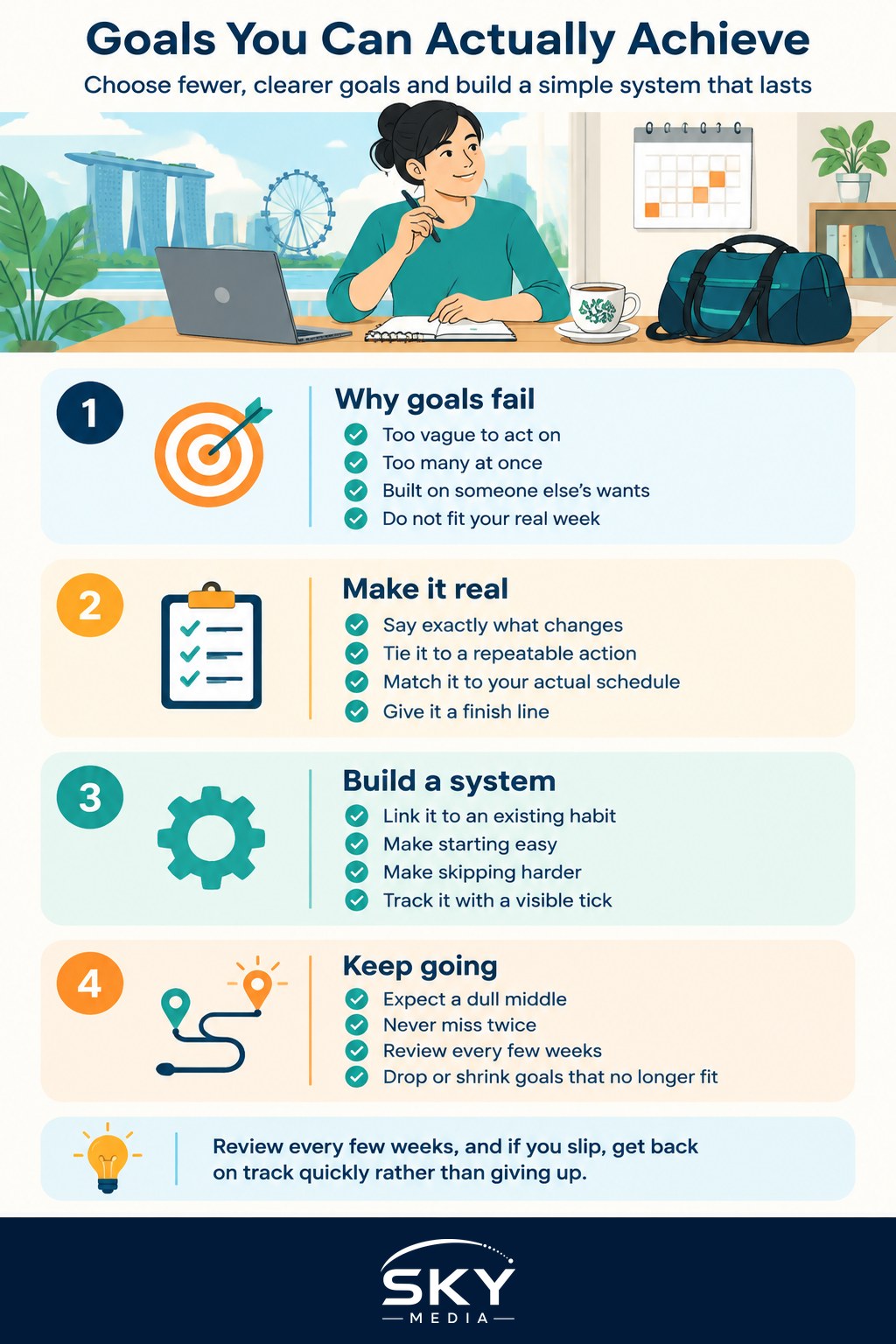
The problem is rarely laziness. In Singapore, a typical week is already full: long office hours, a packed MRT commute, family duties, maybe a course after work. Into that crowded life we drop a grand ambition like “get fit” or “read more” and expect it to survive on willpower alone. It does not, because a vague goal gives you nothing to do on a Tuesday night when you are tired.
Goals also fail when they are secretly someone else’s. A promotion your parents want, a hobby your friends rave about, a body shape from social media. If the reason behind a goal is not yours, you will not defend it when things get hard. Before you set anything, it helps to ask a plain question: if no one ever knew I did this, would I still want it? That single check filters out a surprising amount of noise.
Finally, goals collapse under their own weight. Chasing eight things at once means each gets a thin slice of your attention, and thin effort rarely moves anything. Fewer goals, done properly, beat a long wish list every time.
Make the goal small enough to be real
A good goal is specific and slightly boring. “Get healthier” is a mood; “walk 8,000 steps on weekdays” is a plan. The more concrete you make it, the less you have to negotiate with yourself each day, because the decision is already made.
Try shaping each goal around these points:
- Name the outcome plainly. What will actually be different, and how will you know? “Save $3,000 by December” is checkable. “Be better with money” is not.
- Attach it to a real action. Behind every outcome sits a repeatable habit. Weight loss sits on cooking more at home; a language goal sits on ten minutes of practice a day.
- Fit it to your true schedule. Look at your actual calendar, not your ideal one. If you get home at 8pm drained, a two-hour gym plan will not hold. Twenty honest minutes will.
- Set a finish line. Open-ended goals drift. A date, even a soft one, gives the goal shape and lets you review it.
Shrinking a goal is not lowering your standards. It is choosing a version small enough that you will still be doing it in three months, which is the only version that ever produces results.
Turn intentions into a system you follow
Motivation is a mood, and moods do not show up on schedule. What carries you through the flat, unglamorous middle of any goal is a system, the set of cues and routines that make the right action almost automatic.
The most reliable trick is habit stacking: attach a new habit to something you already do without thinking. “After I pour my morning kopi, I read one page.” “After I sit down on the MRT, I open the NLB app and read.” The existing habit becomes the reminder, so you are not relying on memory or mood.
Make the action easy to start and hard to skip. Lay out your gym clothes the night before. Keep the book on your pillow. Delete the app that eats your evenings, or at least log yourself out. You are not trying to be more disciplined by force; you are shaping your surroundings so the good choice is the easy one.
Track it visibly. A simple tick on a calendar or a note in your phone turns effort into a chain you will not want to break. The point is not perfection. It is noticing, honestly, whether the system is actually running.
Choosing between goal styles
Different goals suit different framings. A finish-line goal has a clear endpoint; a habit goal is about showing up repeatedly. Many people mix the two, using a habit to power an outcome. This table shows when each tends to work best.
| Goal style | Best for | Watch out for |
|---|---|---|
| Outcome goal (a target and date) | Clear, measurable results like a fixed savings sum or a certification | Feeling like a failure until the very end; ignoring the daily work |
| Habit goal (repeat an action) | Health, learning, and anything built on consistency | Going through the motions without checking it leads anywhere |
| Milestone goal (staged steps) | Big projects broken into chunks, such as a diploma over two years | Losing momentum between milestones if they are too far apart |
| Theme goal (a guiding focus) | A loose direction for the year, like “spend less, live simpler” | Being too vague to act on without a concrete habit underneath |
There is no single right style. The skill is matching the framing to the goal in front of you, rather than forcing everything into one mould.
Keep going when the excitement fades
Every goal has a dull stretch where the novelty is gone and the results are not visible yet. This is where most people quit, and it is also where the real progress is being built. Expect it, and it loses much of its power.
Plan for slips in advance. You will miss days; that is normal, not a collapse. The rule that saves goals is simple: never miss twice. One skipped run is a rest day. Two becomes a new habit of skipping. When you fall off, the aim is not guilt but a quick return.
Review your goals every few weeks rather than judging them daily. Ask what is working, what feels forced, and whether the goal still matters. It is fine to drop a goal that no longer fits, or to shrink one that is too heavy for this season of life. Changing course on purpose is not failure; abandoning something by accident is.
If you find yourself persistently low, exhausted, or unable to function, that is worth taking seriously and is beyond what any goal-setting tip can fix. Speaking to a doctor or a counsellor is a sensible step, and support such as mindline.sg or the Samaritans of Singapore (SOS) on 1767 is there when you need it.
Setting goals you can actually achieve comes down to choosing fewer, clearer things, building a system that survives a bad day, and forgiving yourself quickly when you stumble. Do that steadily, and progress stops being a January burst and becomes something you simply do.
Explore more
Once your goals are set, tighten them with a proven framework in using SMART goals in real life, and build the follow-through with how to build self-discipline. A yearly check-in also helps, so try how to do a personal yearly review.
Frequently Asked Questions
How many goals should I work on at once? Fewer than most people expect. One to three main goals is usually plenty, because each needs steady attention and time. Spreading yourself across eight at once tends to leave all of them half done. You can always queue the others for when one is complete.
Should I share my goals with other people? Sharing with one or two supportive people can help you stay accountable, especially if they check in kindly. Announcing goals to everyone can feel good at first but add pressure or judgement. Choose people who encourage you and will not make you feel bad on off days.
What is the difference between a goal and a habit? A goal is a result you want, such as saving a sum or finishing a course, while a habit is the repeated action that gets you there. Goals give direction, and habits do the daily work. The most reliable plans attach each goal to one small, repeatable habit.
How do I choose between competing goals? Ask which one matters most to you in this season of life, not which sounds most impressive. Consider your time, energy and money, and what would genuinely be affected if you postponed each. Parking one goal for later is a sensible decision, not a failure.
Is it okay to change or drop a goal halfway? Yes. If circumstances change or the goal no longer reflects what you want, adjusting or dropping it is a deliberate choice, not quitting. Review it every few weeks and decide with a clear head. Drop it on purpose rather than letting it fade and leave you feeling guilty.
Further reading: How to Write a Year-End Reflection You Will Revisit · How to Use OKRs for Personal Goals · How to Set Gaming Goals and Track Progress