

The future is never fully knowable, and yet the mind desperately wants to know. Will the job work out? Will the results be good? Will things be okay? Learning how to deal with uncertainty is not about finding answers to unanswerable questions. It is about building the inner steadiness to live well without those answers. This is general self-help, not medical or psychological advice. If uncertainty is fuelling anxiety that feels persistent, intense or is affecting your daily life, please speak to a doctor or counsellor.
Uncertainty itself is not the enemy. It is neutral, simply the open space of what has not happened yet. The discomfort comes from how our minds fill that space, usually with worst case stories. The skill is learning to sit in the not knowing without needing to fill it with fear.
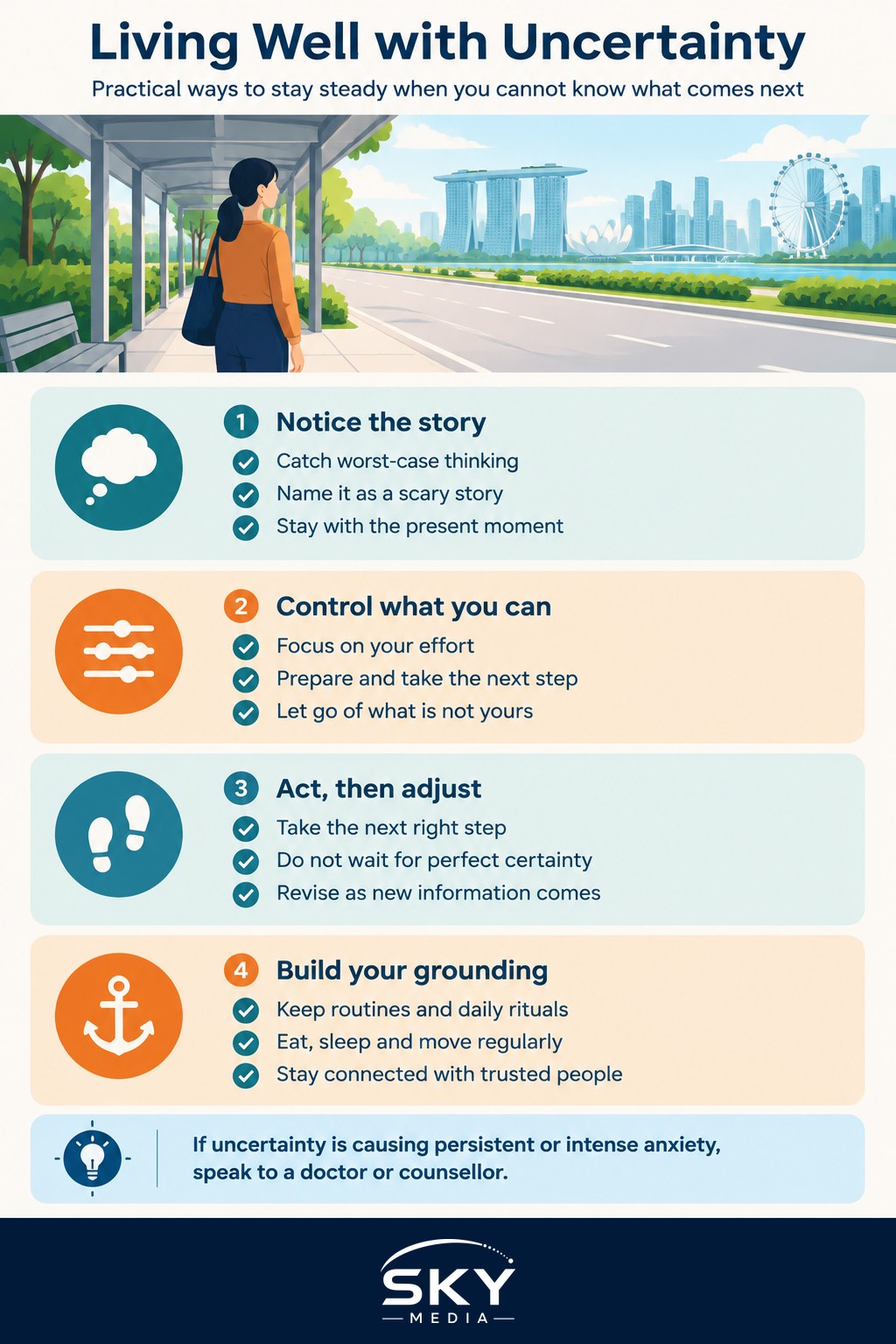
Notice what your mind does with the unknown
When faced with an open question, the brain tends to rush to fill the gap, and it rarely fills it with cheerful outcomes. It reaches for the worst case, because for our ancestors, expecting danger was safer than being caught off guard.
That instinct is understandable, but it means your fear is often about an imagined future, not the present moment. Catch it. When you notice yourself spiralling into “what if it all goes wrong”, name it: “I am telling myself a scary story about something that has not happened.” The present moment, right now, is almost always more manageable than the future your mind is dreading.
Sort what you can control from what you cannot
This single distinction takes an enormous amount of the sting out of uncertainty. Not everything is in your hands, and trying to control what is not simply drains you.
- Within your control: your effort, your preparation, your next step, how you treat people, how you look after yourself.
- Outside your control: other people’s choices, results not yet decided, the wider economy, what tomorrow brings.
Pour your energy into the first list. Practise loosening your grip on the second. This is not giving up. It is aiming your effort where it can actually make a difference, and refusing to exhaust yourself on things that were never yours to decide.
Take the next right step anyway
You do not need to see the whole road to take the next step on it. Waiting for certainty before you act usually means waiting forever, and the waiting itself is its own kind of suffering.
Ask, “Given what I know today, what is a sensible next move?” Then make it. You can adjust as new information arrives. Life is not a plan you set once and follow blindly, it is a series of steps you take and correct as you go. Action also has a quiet benefit: doing something, anything constructive, eases the helpless feeling that uncertainty breeds.
Certainty seeking versus tolerating the unknown
Much of our distress comes from chasing a certainty that does not exist. Learning to tolerate the unknown is the real skill.
| Approach | Chasing certainty | Tolerating uncertainty |
|---|---|---|
| Goal | Eliminate all doubt | Live well with some doubt |
| Behaviour | Over research, seek constant reassurance | Gather enough, then act |
| Feeling | Restless, never satisfied | Steadier, more at ease |
| Flexibility | Rigid, thrown by change | Adaptable, rolls with it |
| Result | Exhaustion, stuck | Movement, growth |
Notice that reassurance seeking, checking the news again, asking one more person, googling the same worry, brings only brief relief before the doubt returns. Tolerating uncertainty, by contrast, is a muscle that grows stronger each time you practise it.
Build your steadiness on the ground beneath you
When the future feels shaky, the present is your anchor. The more grounded you are in the here and now, the less the unknown can shake you.
- Return to your routines. Regular meals, sleep, movement and small daily rituals give your nervous system something solid to stand on when everything else feels up in the air.
- Focus on today’s tasks. What needs doing this afternoon is real and doable, unlike next year, which is only imagined.
- Stay connected. Talking with people you trust reminds you that you do not have to face the unknown alone.
You cannot make the ground stop shifting, but you can plant your feet more firmly on the part that is holding still.
Small habits for uncertain times
- Limit your inputs. Constant news and speculation feed the sense that everything is precarious. Check in, then step away.
- Keep a “handled before” list. Recall the uncertain times you have already come through. You have more evidence of your own resilience than your fear admits.
- Make room for not knowing. Practise saying, “I do not know yet, and that is okay.” It is one of the calmest sentences there is.
- Look after the basics. A rested, fed body tolerates uncertainty far better than a depleted one.
Let uncertainty hold some good too
We tend to assume the unknown hides bad news, but it holds the good news too. The opportunities you cannot foresee, the help that arrives unexpectedly, the way you surprise yourself when tested. Every good thing in your life was once an uncertainty. Holding the future a little more openly, as a space that could bring gifts as well as challenges, is not naive. It is simply more accurate than assuming the worst.
Making peace with the open road ahead
Dealing with uncertainty is not about becoming someone who never worries about the future. It is about worrying a little less, controlling what you can, acting sensibly on what you know, and building enough steadiness that not knowing no longer capsizes you. Some seasons will feel more uncertain than others, and in those seasons you lean harder on your routines, your people and your next small step.
Be gentle with yourself in the not knowing. It is genuinely hard to live without answers, and you are doing it, day after day, more capably than you probably realise. If uncertainty is feeding anxiety that feels persistent, intense or is affecting your daily life, please reach out to a doctor or counsellor, and if you need support now you can look up Singapore’s current national mental health helpline. The next step is enough. You do not have to see the whole road.
Explore more: How to Let Go of What You Cannot Control · Building Resilience When Things Go Wrong · Developing a Growth Mindset
Frequently Asked Questions
How do I cope with uncertainty about my job or career? Separate what you can influence, such as updating your skills, savings habits and network, from what you cannot, like company decisions. Take one practical step at a time and talk to people you trust. For official support on training or employment, check MOM and SWDA.
Is it normal to feel anxious about the future? Yes, most people feel some worry when outcomes are unclear. It becomes a concern when the anxiety is constant, intense or interferes with sleep, work or relationships. In that case, talk to a doctor or counsellor, who can help you find suitable support.
Should I make big decisions when everything feels uncertain? You can, but avoid rushing in a moment of fear. Gather enough information, consider the worst realistic outcome and whether it is recoverable, then choose what fits your values. Where possible, pick options that let you adjust later, and consult someone you trust.
How can I help my teenager cope with uncertainty about exam results? Listen first and acknowledge that waiting is stressful. Help them focus on what they can control, such as routines, rest and next-step options. Avoid adding pressure, and remind them that there are usually several paths forward. Their school counsellor can help if worry becomes heavy.
Does planning for every scenario help or make uncertainty worse? A light contingency plan can be calming, but trying to prepare for every possibility usually fuels worry. Plan for the likely scenarios, write down one backup and then return to the present. If you keep rehearsing outcomes, it may be rumination rather than preparation.
Further reading: How to Deal With the Sunday Scaries · How to Deal With Disappointment · How to Deal with Overwhelm When Everything Feels Like Too Much