
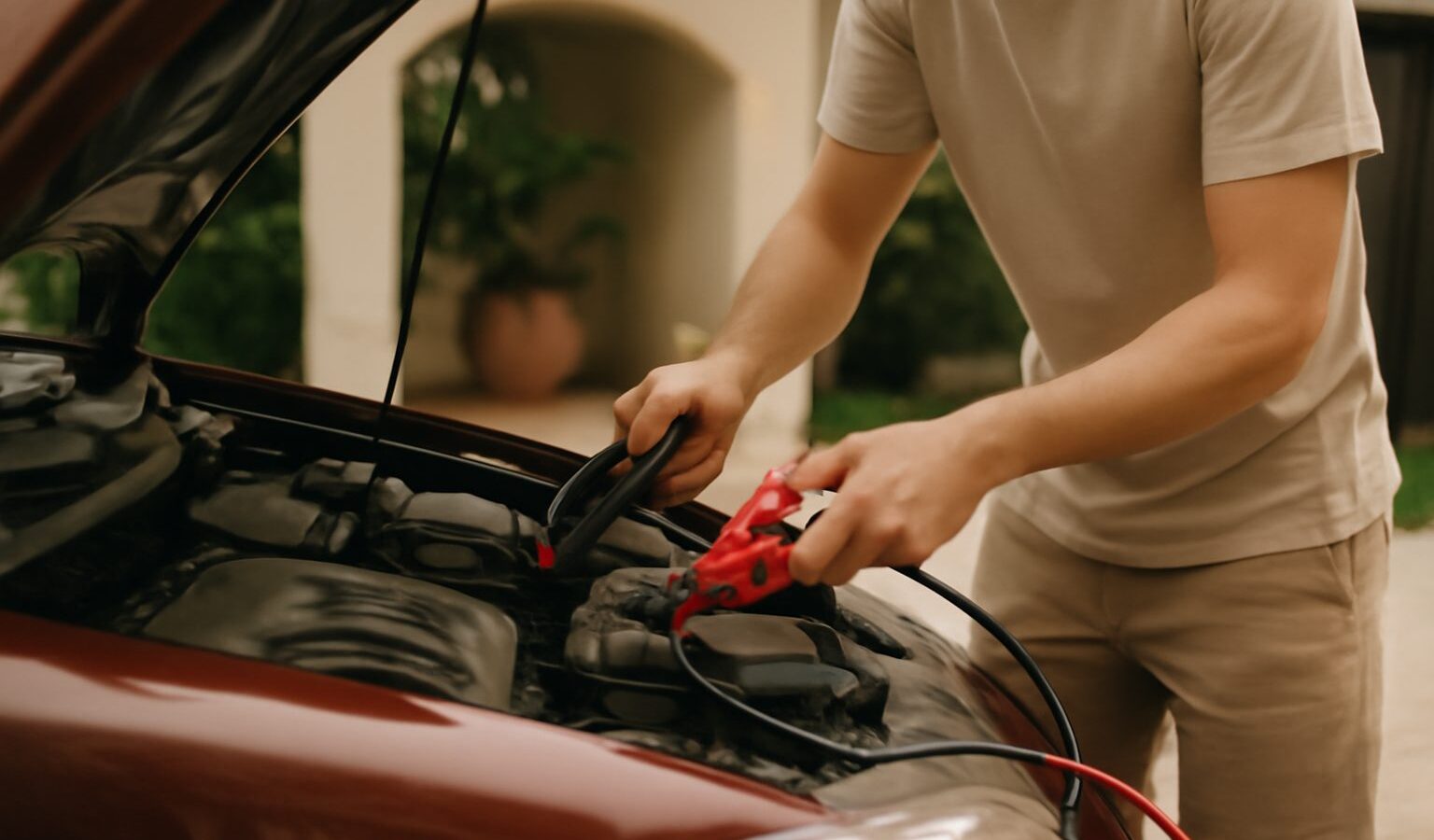
A flat battery has a way of striking at the worst moment, in a packed HDB carpark before work or after a long day out. The good news is that if you have a set of jumper cables and a running car nearby, you can often get moving again in a few minutes. Learning how to jump-start a car properly matters, though, because doing it in the wrong order can damage the electronics, or worse, cause a spark near flammable battery gas. This guide walks through the safe method for our local conditions, and just as importantly, when to stop and call for help instead.
Before anything else, remember this is general information, not professional mechanical advice. If you are unsure at any point, or the battery looks swollen, cracked or is leaking, do not attempt a jump-start. Call a workshop or your insurer’s roadside assistance line.

Why Batteries Fail Faster in Singapore
Car batteries dislike extreme cold, but heat is the quiet killer, and our climate serves up plenty of it. Sustained high temperatures speed up the chemical reactions inside a lead-acid battery and accelerate the evaporation of the fluid inside, which shortens its usable life. A battery that might last five or six years in a temperate country often bows out sooner here.
Humidity plays its part too, encouraging corrosion on the terminals, that crusty white or greenish powder you sometimes see. Corroded terminals make a poor connection and can leave you with a car that cranks weakly or not at all, even when the battery still has charge.
Short trips are another common culprit. If you mostly drive a few minutes to the nearby mall or MRT station, the alternator may never get enough running time to fully recharge the battery, and it slowly drains over weeks. Leaving interior lights, the boot light or a dashcam drawing power overnight will finish the job. Knowing this helps you spot the warning signs early: sluggish cranking, dim headlights, or the car struggling to start after sitting idle for a few days.
What You Need and What to Check First
You need two things: a set of jumper cables in good condition, and a donor car with a healthy, fully charged battery of a similar voltage (nearly all passenger cars use a 12-volt system). A portable jump-starter pack is a tidy alternative that removes the need for a second car, and it is worth keeping one in the boot.
Before you connect anything, run through these checks:
- Park safely. Position the donor car close enough for the cables to reach, but the two cars must not touch. Engage both handbrakes, put both cars in Park (or neutral for a manual), and switch off both engines.
- Inspect the flat battery. If it is visibly swollen, cracked, leaking or giving off a rotten-egg smell, stop. That battery may be damaged and could rupture. Call for help.
- Turn off the electrics. Switch off headlights, air-conditioning, the radio and any chargers in both cars to reduce the electrical load.
- Find the terminals. Identify the positive terminal, marked with a plus sign and often a red cover, and the negative terminal, marked with a minus sign. Clear away heavy corrosion gently if you can.
- Remove metal jewellery and keep the cable clamps from touching each other once connected.
The Correct Lead Order, Step by Step
The sequence matters. Connecting the leads in the wrong order is the mistake that causes sparks near the battery, and it can send a surge through sensitive electronics. Follow this order exactly.
- Positive to the flat battery. Clip one red (positive) clamp onto the positive terminal of the dead battery.
- Positive to the good battery. Clip the other red clamp onto the positive terminal of the donor battery.
- Negative to the good battery. Clip one black (negative) clamp onto the negative terminal of the donor battery.
- Negative to bare metal, not the flat battery. Clip the final black clamp onto a clean, unpainted metal surface on the engine block or a solid bracket of the car with the flat battery, away from the battery itself. This is the crucial step. Grounding here, rather than on the negative terminal, keeps any small spark well away from the hydrogen gas a battery can release.
Now start the donor car and let it idle for a few minutes to pass charge across. Then try starting the car with the flat battery. If it fires up, leave both running for a short while.
To disconnect, reverse the order exactly: remove the negative clamp from the engine block first, then the negative from the donor battery, then the positive from the donor, and finally the positive from the previously flat battery. Once running, keep the revived car’s engine going. A short drive or a spell at idle gives the alternator time to put charge back in.
Spark, Acid and Safety Precautions
A car battery holds sulphuric acid and can release flammable hydrogen gas, especially when charging, so treat it with respect.
- Never let the clamps touch each other or any metal while the other ends are connected. That completes a circuit and throws sparks.
- Ground the final lead away from the battery, as described, so any spark is nowhere near the gas.
- Keep flames and cigarettes away. No smoking near an open bonnet.
- Protect your eyes. If acid ever contacts skin or eyes, rinse with plenty of water and seek medical attention.
- Mind the hot engine. After a car has been running, the engine bay holds heat and has moving parts like the fan and belts. Keep hands, cables and loose clothing clear.
The table below sums up the difference between a correct and an incorrect approach.
| Situation | Correct approach | Why it matters |
|---|---|---|
| Final negative lead | Clip to bare engine metal, away from battery | Keeps any spark away from flammable battery gas |
| Cable clamps | Never touch each other or stray metal | Touching clamps short the circuit and spark |
| A swollen or leaking battery | Do not jump-start; call for help | A damaged battery can rupture or leak acid |
| After the car starts | Keep engine running, then drive a while | Lets the alternator recharge the battery |
When to Call for Help Instead
Jump-starting is a stopgap, not a repair. Even a textbook jump has limits, and some situations call for a professional from the start.
Call roadside assistance or a workshop if the battery is physically damaged, if the car still will not start after a couple of proper attempts, or if it starts but dies again soon after, which points to a battery at the end of its life or a charging fault. A grinding or rapid clicking noise, no dashboard lights at all, or a burning smell are all reasons to stop and get expert eyes on the car rather than keep trying.
Most comprehensive motor insurance policies in Singapore include a 24-hour roadside assistance number, so save yours in your phone before you ever need it. If the battery is simply worn out, a workshop can test it and fit a replacement, often on the spot. Continuing to jump-start a car that keeps going flat only masks the underlying problem and leaves you stranded again.
A jump-start is a handy skill that can rescue an otherwise ordinary day. Do it in the right order, keep sparks away from the battery, and know when calling for help is the smarter move. For anything beyond a straightforward flat battery, an LTA-authorised workshop or a qualified mechanic is always the safe choice.
Frequently Asked Questions
What is a portable jump-starter and is it better than jumper cables? A portable jump-starter is a battery pack that starts your car without a second vehicle, which is handy in an empty carpark. It is a tidy alternative worth keeping in the boot. Follow its instructions and your car manual.
How long should I drive after a jump-start? Keep the engine running and take a short drive or let it idle for a while so the alternator can put charge back into the battery. If the car dies again soon after, the battery or charging system likely needs professional attention.
How do I know if the battery is dead or if it is something else? Sluggish cranking, dim headlights and clicking suggest a flat battery, while a car that starts after a jump but dies again points to a worn-out battery or a charging fault. A workshop can test the battery properly.
Can I jump-start my car in the rain? Be cautious. Water and electrical connections do not mix well, and the weather makes mistakes more costly. If conditions are bad or you feel unsure, call your insurer’s roadside assistance rather than risk it.
Does car insurance in Singapore cover a flat battery? Many comprehensive motor policies include a 24-hour roadside assistance number, but cover varies by policy. Check your policy or ask your insurer, and save the number in your phone before you ever need it.