

If your car switches its engine off at traffic lights and restarts the moment you lift off the brake, it has an idle start-stop system, and it almost certainly does not use an ordinary car battery. It uses either an AGM or an EFB battery. Understanding the AGM vs EFB battery difference matters when the time comes to replace it, because fitting the wrong type is one of the most common and costly mistakes owners make.
This guide focuses on start-stop cars specifically. For conventional batteries, routine checks and general replacement tips, see our guide to car battery care and replacement.
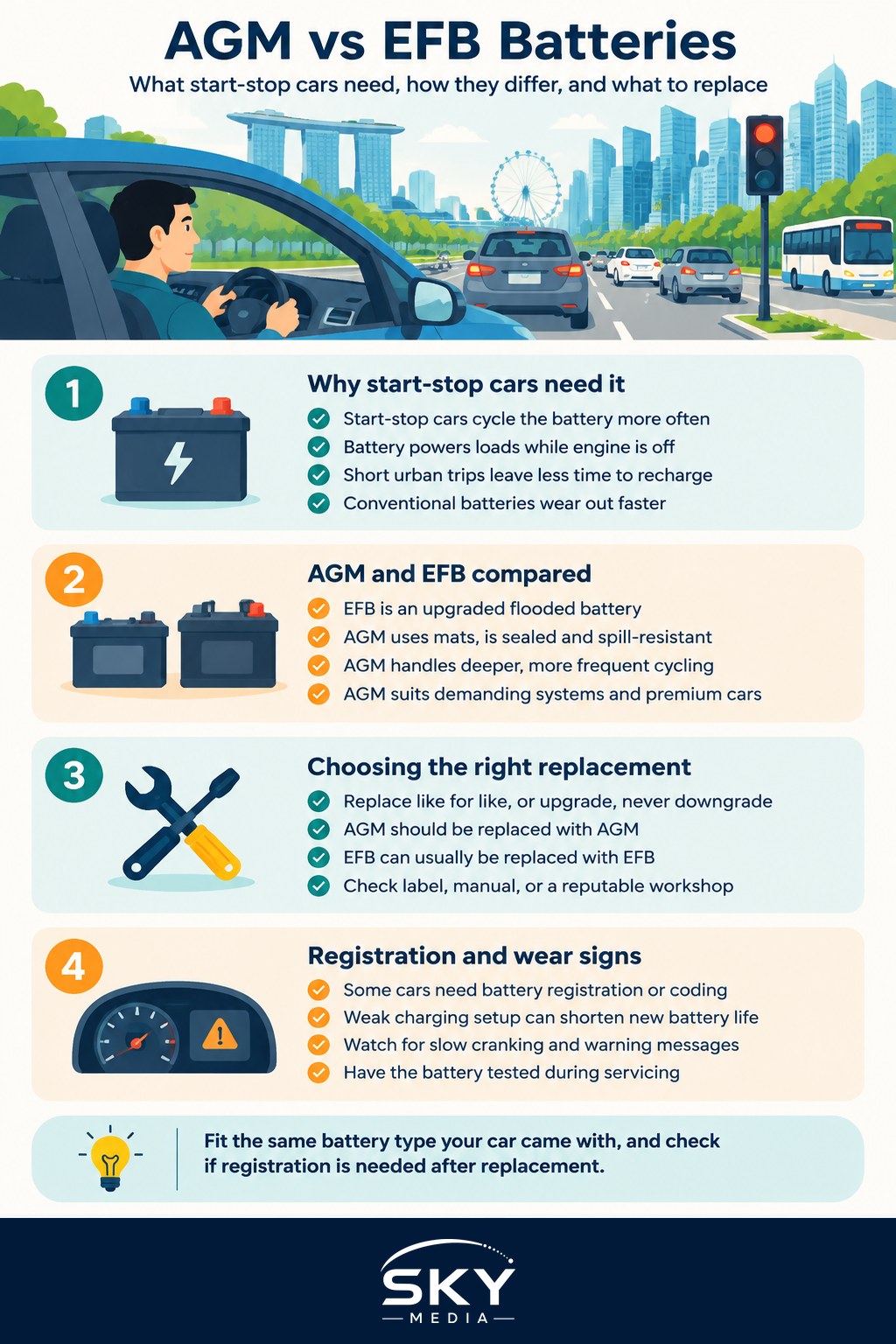
Why Start-Stop Cars Need a Different Battery
A conventional flooded lead-acid battery is designed for one big job: delivering a strong burst of current to start the engine, then being recharged by the alternator while you drive. It handles a few starts per trip well.
A start-stop car asks for much more. In Singapore’s stop-and-go traffic, the engine may shut down and restart dozens of times on a single drive through town. While the engine is off at a red light, the battery alone powers the air-conditioning fan, the infotainment screen, lights and the car’s electronics. Then it has to crank the engine again, often within a minute.
That pattern means:
- Many more charge and discharge cycles than a normal battery is built for.
- Deeper discharges, because the battery is supplying electrical loads with the alternator off.
- Less time to recharge, especially on short urban trips.
Put a conventional battery in a start-stop car and it typically wears out much faster, and the start-stop function may stop working early as the car’s battery sensor detects weak charge.
AGM vs EFB Battery: The Key Differences
EFB stands for Enhanced Flooded Battery. It is an upgraded version of the traditional wet-cell battery, with improved plates and internal design so it copes with more cycling. EFB batteries are commonly fitted to entry-level and mid-range start-stop cars.
AGM stands for Absorbent Glass Mat. Instead of free-flowing liquid electrolyte, the acid is held in fibreglass mats packed between the plates. This makes the battery sealed, spill-resistant and better at handling deep, frequent cycling. AGM batteries are usually found in cars with more demanding systems, such as those with regenerative braking, many electronic features or a more aggressive start-stop strategy, which often includes premium European models.
| Feature | Conventional flooded | EFB | AGM |
|---|---|---|---|
| Designed for start-stop | No | Yes, standard systems | Yes, demanding systems |
| Construction | Liquid electrolyte | Improved liquid electrolyte | Electrolyte absorbed in glass mats, sealed |
| Cycling endurance | Lowest | Moderate to good | Highest |
| Typical cars | Older cars without start-stop | Many mass-market start-stop cars | Premium cars, cars with regenerative braking |
| Relative price | Lowest | Middle | Highest |
| Heat tolerance | Fair | Fair | Good, but still affected by heat |
Which Battery Does Your Car Need?
The rule of thumb is simple: replace like for like or upgrade, never downgrade.
- If your car came with an AGM battery, replace it with an AGM. Fitting an EFB or conventional battery is a downgrade. It may start the car, but it is likely to fail early and can cause start-stop and electrical warnings.
- If your car came with an EFB battery, an EFB replacement is the normal choice. An AGM is generally an acceptable upgrade if it fits the tray and matches the specifications, though not every car benefits enough to justify the extra cost.
- If your car came with a conventional battery and has no start-stop, you do not need either, unless your workshop recommends otherwise.
To find out what you currently have:
- Look at the battery label. It will usually say AGM or EFB, or carry a code for one.
- Check the owner’s manual for the battery specification.
- Ask the authorised dealer or a reputable workshop with your car’s registration number or chassis details.
Match the other specifications too: physical size and terminal layout, capacity (Ah), cold cranking amps (CCA) and, if your car uses one, the battery’s fit with any vent tube.
Battery Registration and Coding
Many modern cars, especially European brands, have an intelligent battery sensor and battery management system. The car tracks the battery’s age and condition and adjusts how it charges it. When you fit a new battery, the system needs to be told, a step usually called battery registration or coding.
If this step is skipped, the car may keep charging the new battery as if it were the old, worn one. That can shorten the new battery’s life, cause start-stop to stay disabled, or trigger warning messages. Some cars also need to be told if you change the battery type, for example from EFB to AGM.
Before you book a replacement, ask:
- Does my car need battery registration after replacement?
- Does the workshop have the diagnostic tool to do it for my make?
- Is registration included in the quoted price?
Mobile battery replacement services are convenient when you are stranded, but confirm they can handle registration for your car if it is needed.
What Affects Replacement Cost
AGM batteries generally cost more than EFB batteries, and both cost more than conventional batteries of a similar size. Actual prices vary widely, so get two or three quotes. The main factors are:
- Battery type and capacity. Larger AGM batteries for premium cars sit at the top of the range.
- Brand and warranty length. A longer warranty usually costs more upfront.
- Battery location. Some cars place the battery in the boot or under a seat, which takes more labour.
- Registration and diagnostics. Some workshops include this, others charge separately.
- Where you buy it. Authorised dealers, independent workshops and mobile services price differently.
- Trade-in of the old battery. Ask whether the workshop takes back your old battery for proper recycling; lead-acid batteries should never go into general waste.
When comparing quotes, make sure each one is for the same battery type and specification, and that registration is either included or clearly listed.
Signs Your Start-Stop Battery Is Wearing Out
Start-stop batteries often give clues before they fail completely:
- The start-stop function stops activating even when conditions seem right. The car may be protecting a weak battery.
- Slow or laboured cranking, particularly after the car has been parked for a few days.
- Battery or electrical warning messages on the dashboard.
- Electrical oddities, such as the screen rebooting during restarts.
Note that start-stop can also stay off for normal reasons, such as when the air-conditioning is working hard on a hot afternoon, the engine is not yet warm, or the battery charge is low after short trips. Occasional non-activation is not always a fault. If the car will not start at all, our guide on why your car won’t start walks through other causes, and how to jump-start a car explains how to get moving safely. Check your owner’s manual before jump-starting, as some cars specify particular connection points.
Getting the Most From a Start-Stop Battery
Singapore’s heat is hard on every battery, AGM and EFB included. A few habits help:
- Drive longer trips occasionally so the battery gets a full charge, especially if you mainly do short errands.
- Avoid running electrical loads with the engine off, such as sitting in the car with the air-conditioning fan and screen on.
- Park in the shade or in covered car parks where possible.
- Have the battery tested during regular servicing, since workshop testers can show its health before it fails.
Fit the right type, make sure it is registered if your car needs it, and a start-stop battery should give you dependable service through the stop-and-go of city driving.
Frequently Asked Questions
Can I replace a start-stop battery myself? It is possible on some cars, but many need battery registration or coding with a diagnostic tool, and batteries are heavy and hazardous. Skipping registration can shorten the new battery’s life. For most owners, a workshop that can register the battery for your make is safer.
How long does a start-stop battery usually last? Lifespan varies with the battery type, driving habits, heat and how often the car makes short trips, so there is no fixed figure. Have it tested during regular servicing and check the warranty terms. Replace it early if start-stop keeps switching off.
Is it a good idea to switch off the start-stop button to save the battery? Switching it off reduces the number of restarts, but the system is designed to protect the battery by itself, and the setting usually resets each time you start the car. If start-stop keeps deactivating, have the battery tested rather than just disabling it.
What should I check on the warranty when buying a replacement? Check how long it covers, whether it is full replacement or pro-rated, and what proof is needed, such as the receipt and registration record. Ask whether registration is included. Keep paperwork safe, because claims often need evidence that the right type was fitted.
Further reading: What to Do With Old Car Tyres and Car Batteries in Singapore · Hybrid Car Battery Replacement in Singapore: Costs and Warning Signs