

“Am I saving enough?” is one of the most common money questions people ask, and one of the hardest to answer alone. Retirement readiness in Singapore is not a single number that fits everyone. It depends on the life you want, the age you hope to stop working, and the resources you are building along the way. This is general information to help you think it through, not financial advice, so do consider your own circumstances and, if it helps, speak with a licensed, MAS-regulated financial adviser.
The good news is that you do not need to be an expert to get a useful sense of where you stand. A few simple checks can turn a vague worry into a clearer picture, and a clearer picture makes it far easier to act.
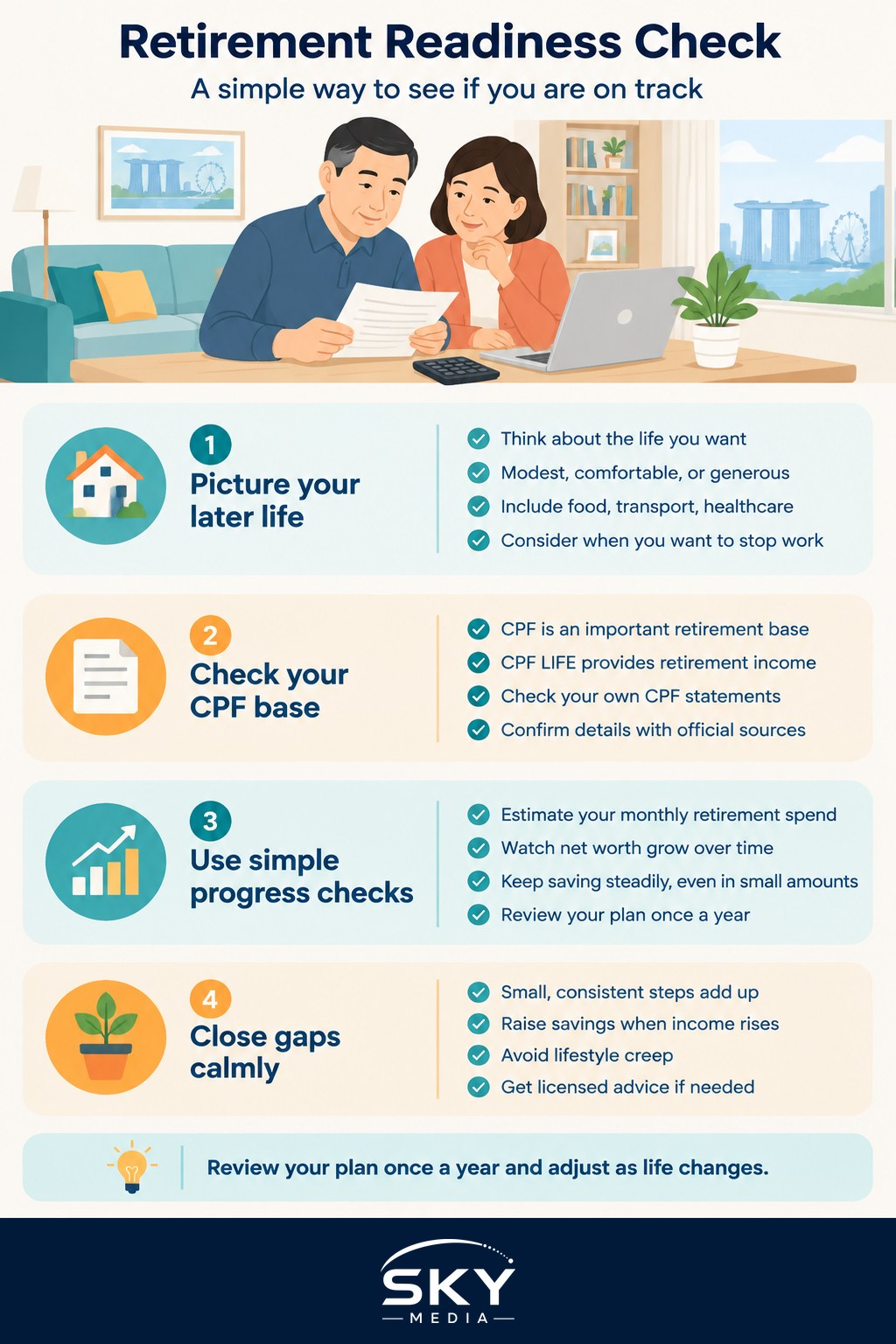
Start with the life you actually want
Retirement readiness begins with a question that has nothing to do with spreadsheets: what does a good later life look like for you? Someone who dreams of quiet days at home and hawker meals will need a very different amount from someone who hopes to travel often. There is no right or wrong answer, only your answer.
Try to picture your typical month in retirement. Think about housing, food, transport, healthcare, and the small pleasures that make life feel like living. You do not need precise figures yet. A rough sense of whether your future lifestyle is modest, comfortable, or generous is enough to guide the next steps.
It also helps to think about when you would like to stop working, or to work less. The earlier you hope to slow down, the more you will generally need to have prepared, because your savings may need to last longer. Being honest about your hopes here shapes everything that follows.
Understand your CPF foundation
For most people in Singapore, CPF forms an important base for retirement. It is designed to provide a stream of retirement income later in life through CPF LIFE, alongside your own savings and investments. Because CPF rules, retirement sums, payout ages, and interest rates are set by the CPF Board and change over time, it is best to check your own situation directly with official sources rather than relying on figures from any article.
A practical starting point is to log in and review your own CPF statements to see what you have built up, and to read the CPF Board’s own explanations of how the system works. Our overviews of CPF accounts explained and CPF LIFE explained offer a plain-language introduction, but always confirm the current details with CPF itself, since the numbers are updated periodically.
CPF is a strong foundation, yet for many people it is one part of the picture rather than the whole. Thinking about what you want to add on top is where personal planning comes in.
Simple checks to gauge where you stand
You can get a helpful read on your progress without complex maths. These rough checks are not precise targets, but they help you sense the direction of travel:
- Know your number, roughly. Estimate your expected monthly spending in retirement, then consider how your CPF payouts and personal savings might cover it.
- Track your net worth over time. Watching your assets grow, or your debts shrink, year by year is a quiet but powerful signal. Our guide on how to calculate your net worth shows you how.
- Check your savings habit. A steady, automated contribution to your future, however modest, matters more than an occasional large one.
- Review once a year. Life changes, and so should your plan. A yearly check keeps small gaps from becoming large ones.
If any of these checks reveals a gap, please do not panic. A gap spotted today is a gap you still have time to work on. Awareness is the whole point, and it is genuinely good news to know where you are.
Closing the gap without stress
If you feel behind, remember that many people do, and steady action beats worry. Small, consistent steps compound over time in your favour. Increasing your savings rate a little when your income rises, avoiding lifestyle creep, and letting time do its work are quietly effective strategies.
For those who want to go deeper, a broader plan can bring CPF, savings, and investments together. Our companion piece on how to plan for retirement in Singapore walks through the wider picture at a comfortable pace. Just keep in mind that any investing carries risk, that values can rise and fall, and that there are no guaranteed returns, so it is worth understanding what you are putting money into.
A calm way to move forward
Being on track for retirement is less about hitting a perfect number and more about building steady habits and reviewing them over time. Start by picturing the life you want, check your CPF foundation with the official sources, and track your progress once a year. If you would value tailored guidance, a licensed financial adviser can help you map a plan to your own circumstances.
Whatever your starting point, the fact that you are thinking about this now is itself a good sign. The most important step is simply to begin, and to keep going gently from there.
Official sources: CPF Board
Further reading: Using Your Home to Fund Retirement