

Most players think they are practising when they are really just playing. They queue up, have some fun, and hope improvement happens on its own. Deliberate practice gaming is the opposite: you choose one weakness, work at it with full focus at the edge of your ability, and review the results honestly. It is harder than mindless grinding, but it is how good players get good far faster than everyone stuck on autopilot.
This guide is game-agnostic and practical. Whatever you play, the method for turning practice time into real skill is the same.
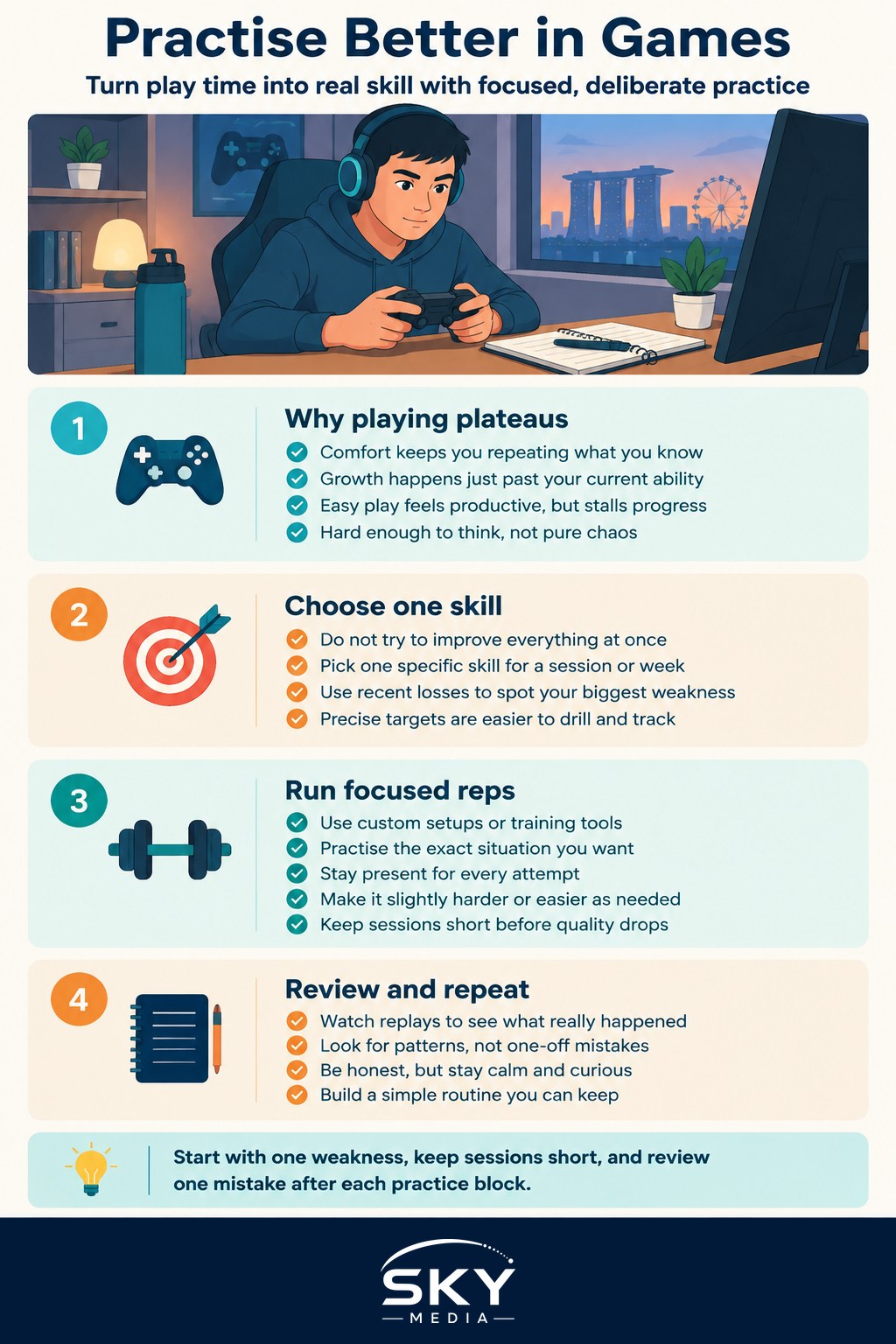
Understand why simply playing plateaus
There is a reason so many players get stuck at the same level for months. Playing lots of matches keeps you comfortable, repeating what you already do well and quietly avoiding what you do badly. Comfort feels productive, but it is not where growth happens.
Real improvement lives just past your current ability, in the tasks that are hard enough to make you think and fail sometimes, but not so hard they are pure chaos. That zone is uncomfortable on purpose. Deliberate practice is the discipline of choosing to spend time there instead of drifting back to what feels easy.
Pick one specific skill at a time
The biggest mistake is trying to get better at everything at once. Attention is limited, and spreading it thin means nothing improves much. Instead, choose a single, specific skill for a session or a week.
“Get better” is too vague to act on. “Improve my crosshair placement,” “learn to track objective timers,” or “clean up my movement in one situation” are specific enough to actually practise. The more precise your target, the easier it is to design a drill for it and to tell whether you are making progress.
A simple way to find your target: think about your recent losses and ask what kept costing you. The thing that shows up again and again is your best candidate. Fixing your most frequent weakness pays off far more than polishing a strength.
Design focused reps
Once you know your target, build a way to repeat it with focus. The best practice packs many quality attempts into a short time, with full attention on each one.
- Isolate the skill. Use training tools, custom setups or a specific situation you can recreate, so you get many reps of the exact thing you are working on rather than waiting for it to come up by chance.
- Stay present for each rep. Ten focused attempts beat a hundred distracted ones. If your mind wanders or you are just going through the motions, the reps stop counting.
- Push slightly past comfortable. If every attempt succeeds easily, make it harder. If you fail almost every time, make it easier. You want a difficulty where you succeed often enough to learn but fail enough to be challenged.
Keep these sessions short. Focused practice is tiring, and quality collapses once you are mentally spent. Fifteen to thirty genuinely focused minutes is worth more than hours of half-attention.
Compare deliberate practice with just playing
It helps to see clearly how the two differ, because the gap explains why one improves you and the other mostly does not.
| Aspect | Just playing | Deliberate practice |
|---|---|---|
| Focus | Whatever happens | One chosen skill |
| Comfort | Stays comfortable | Sits at the edge |
| Feedback | Rarely reviewed | Reviewed honestly |
| Feeling | Relaxing | Demanding |
| Result | Slow plateau | Steady growth |
Neither is bad. Playing for fun is a perfectly good reason to game, and you should keep doing it. The point is to know which one you are doing, so that when you actually want to improve, you practise deliberately instead of assuming casual play will get you there.
Review your mistakes honestly
Practice without feedback is just repetition, and repetition can bake in bad habits as easily as good ones. The review step is what turns effort into improvement.
After a session or a match, look back at where things went wrong. Watching your own replays is the most powerful tool here, because memory is unreliable and the recording is not. Focus on the skill you chose to work on and ask concrete questions: did I actually do the thing I was practising, and if not, why?
Look for patterns, not one-offs
A single mistake might be bad luck. The same mistake five times is a habit worth fixing. Hunt for the recurring errors, because those are where a small change makes the biggest difference.
Be honest but kind
Honest review means owning your mistakes rather than blaming teammates or bad luck. It does not mean beating yourself up. The tone that works is a calm, curious “what can I fix here,” not a harsh “why am I so bad.” You will look at your own play far more often if the process does not feel like punishment.
Build a simple routine
Deliberate practice works best as a light habit rather than an occasional heroic effort. A workable routine can be as simple as a short focused drill before you start playing for fun, then a quick review afterwards to note one thing to work on next time.
You do not need hours. Even a few focused minutes a day, aimed at one clear weakness and reviewed honestly, compounds into real improvement over weeks. Consistency matters more than intensity, and a routine you can actually keep beats an ambitious plan you abandon.
Trust the process
Improvement from deliberate practice is quiet. Day to day you may notice little, and then you realise a weakness that used to cost you games barely comes up any more. That is the payoff for choosing the uncomfortable, focused path over comfortable grinding. Pick one skill, drill it with full attention, review it honestly, and repeat. Deliberate practice gaming is not glamorous, but it is the most reliable way to get better, and it is available to anyone willing to practise with intent.
Explore more: How to Review Your Own Gameplay · How to Improve at Competitive Games · How to Train Your Aim
Frequently Asked Questions
How do I know if I am practising deliberately or just playing? Ask whether you picked one specific skill, stayed fully focused on it, and reviewed the results afterwards. If you queued up and hoped for the best, you were playing. Playing is fine for fun, but it is not the same as practising.
How long should a focused practice session last? Keep it short. Focused practice is tiring and quality drops once you are mentally spent, so a genuinely focused stretch beats hours of half-attention. Stop when your concentration fades, and fit in a quick review afterwards.
How do I choose which weakness to work on first? Look back at recent losses and note what keeps costing you. The mistake that appears again and again is your best target. Fixing your most frequent weakness usually pays off more than polishing something you already do well.
Do I need replays to improve, or can I rely on memory? Replays are far more reliable. Memory is selective and tends to blame luck or teammates, while a recording shows what you actually did. If your game does not save replays, record your screen and review a few key moments.
Can I still play casually and improve at the same time? Yes. A short focused drill before you play for fun, plus a quick review afterwards to note one thing to work on, is enough. Casual play stays relaxing, and the deliberate part keeps your improvement steady over weeks.
Further reading: The Deliberate Practice Method Explained · How to Set Gaming Goals and Track Progress