

We spend a lot of energy gripping tightly to things: a certain outcome at work, an image of how a friendship should go, a plan for the weekend that the weather ruins. When life does not match the picture in our heads, the gap can hurt. Practising non-attachment is a quiet, ancient response to this. It does not mean you stop caring or go cold. It means learning to hold what you value with an open hand, so that when things change, and they always do, you can meet the change with a little more calm and a little less panic.
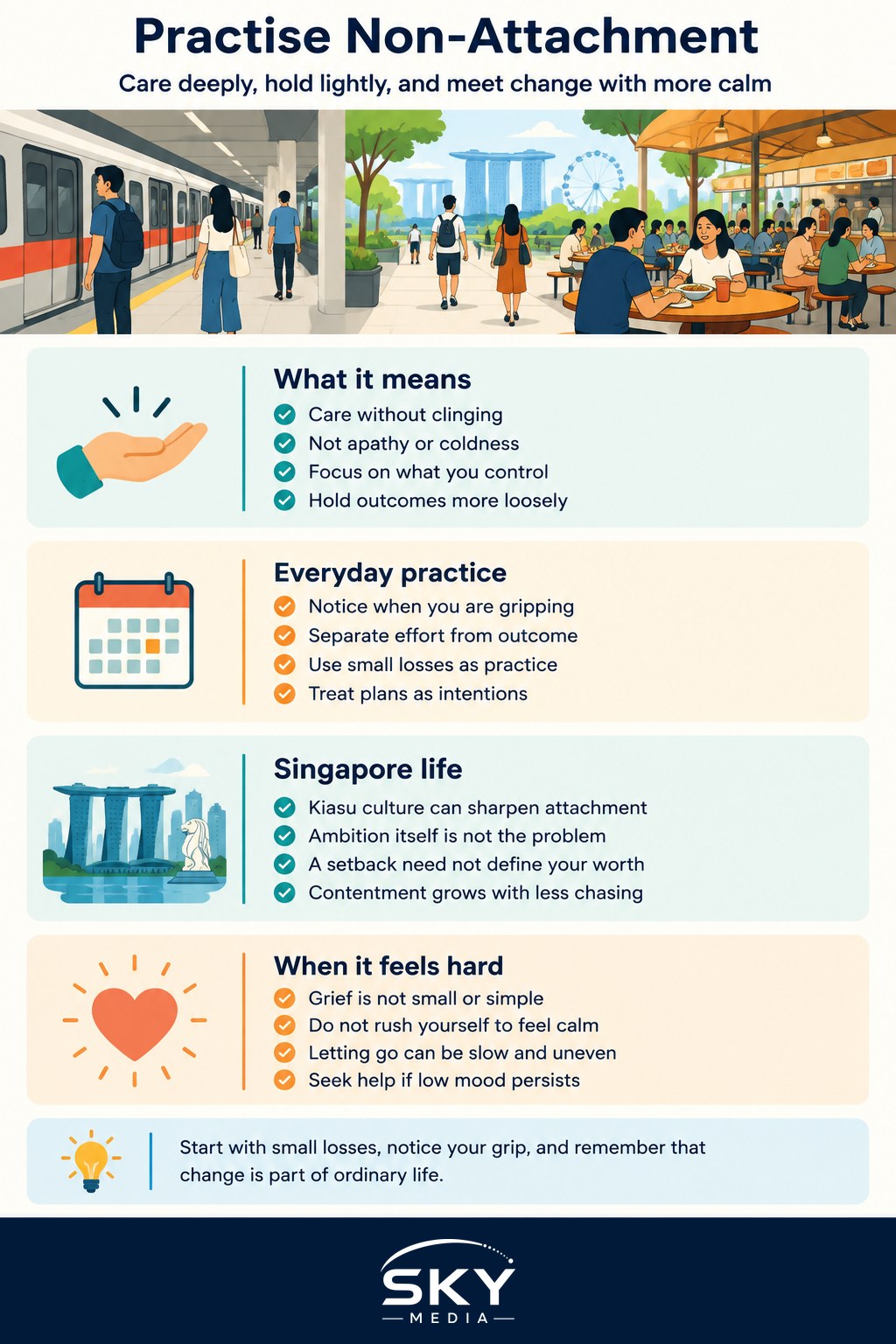
What non-attachment actually means
Non-attachment appears in more than one tradition, and interpretations vary, so it helps to be careful with it. In Buddhist thought it is closely tied to the idea that clinging to things that are impermanent is a source of suffering. In Stoic philosophy from the Greco-Roman world, there is a related instinct: focus on what is within your control, your own actions and judgements, and hold everything outside that more loosely. These are rich, serious traditions, not quick life hacks, and any short article can only point at them.
What non-attachment is not is just as important. It is not apathy, and it is not detachment from the people and work you love. You can love your family deeply and still accept that you cannot control everything that happens to them. You can pour yourself into a project and still hold the result loosely. The aim is not to feel less, but to suffer less from the parts you were never able to command in the first place. Think of it as caring fully while clinging less.
Small ways to practise non-attachment
You do not need a monastery or a mountain retreat. Non-attachment is built in ordinary moments, and Singapore gives you plenty.
- Notice when you are gripping. The feeling is often a tight chest, replaying a conversation, or the words “it must go this way.” Naming it is the first loosening.
- Separate the effort from the outcome. You can send the strong application, prepare well for the presentation, or plan the perfect gathering. Whether you get the job, the applause, or perfect weather is only partly yours.
- Practise with small losses first. The MRT doors close as you reach them. The hawker stall runs out of your dish. Let these be tiny rehearsals for letting go, rather than reasons to sour your whole morning.
- Hold plans as intentions, not guarantees. “I hope to” and “I will try to” leave room for reality to be different without it feeling like failure.
None of this happens in one sitting. Non-attachment is a direction you keep walking in, not a badge you earn once.
Non-attachment in real Singapore life
Our fast pace and kiasu culture can quietly train us to attach hard, to grades, to job titles, to the size of the flat, to being ahead of others. There is nothing wrong with ambition, but when your sense of peace depends entirely on outcomes you cannot fully control, life becomes exhausting.
Non-attachment offers a gentler footing. If you did not get the promotion this round, you can still respect your own effort and keep going, rather than tying your whole worth to one decision made by other people. If a friendship drifts despite your care, you can grieve it honestly and still release your grip on how it “should” have turned out. This is closely related to how to let go of what you cannot control, and it pairs well with how to practise radical acceptance, which is about meeting reality as it is before deciding what to do next.
It also connects to contentment. When you are not constantly chasing the next thing to grip, you free up attention for what is already here. If that appeals, you might explore how to cultivate contentment alongside this practice.
When letting go feels too hard
Be honest with yourself: some things are genuinely hard to release. Grief, a lost relationship, a health scare, or a long-held dream that did not work out are not small matters, and non-attachment is not a tool for skipping past real pain. You are allowed to feel the full weight of these things. Letting go, when it comes, is usually slow and uneven, and forcing yourself to feel calm before you are ready is its own kind of grip.
If you find yourself stuck in persistent low mood, anxiety that will not settle, or a sense of hopelessness that lingers for weeks, please treat that as a signal to reach out, to someone you trust, or to a GP or counsellor. Non-attachment is a philosophy for living well, not a substitute for care and support when you are struggling.
Practising non-attachment, done kindly, is less about giving things up and more about loosening a grip that was tiring you out. You still love, still work, still hope. You simply carry it all a little more lightly, so that when life shifts, as it will, you have room to breathe, adjust, and keep going. Start with the small losses, be patient with the big ones, and let this be one gentle thread in a fuller, warmer life.
Frequently Asked Questions
Does non-attachment mean I should not set goals? No. You can set ambitious goals and work hard on them while accepting that results are only partly in your hands. The shift is in how tightly your peace depends on the outcome. Aim fully, then hold the result with an open hand.
How can I practise non-attachment in a close relationship without becoming distant? Keep showing love and attention while accepting that you cannot control the other person’s choices or feelings. Letting go of how things should be often makes you more present, not less. Honest conversations matter more than emotional withdrawal.
Is non-attachment the same as being detached or indifferent? No. Indifference means not caring, whereas non-attachment means caring deeply without clinging to a fixed outcome. If you find yourself numb or withdrawn, that is not the practice and may be worth discussing with a counsellor.
How do I let go of an outcome I worked really hard for? Acknowledge the disappointment first, then separate the effort, which was real, from the result you did not control. Write down what you learned and what you would try next. Grief over a lost goal is normal and takes time.
Do I need to be Buddhist or Stoic to practise non-attachment? Not at all. Both traditions offer ideas, but anyone can try noticing when they are gripping and loosening it. You can take what helps from them without adopting a belief system. Interpretations vary, so go at your own pace.
Further reading: How to Practise Delayed Gratification · How to Practise Memento Mori · How to Practise Negative Visualisation