

Learning how to process your emotions is one of the most useful life skills nobody formally teaches us. Many of us grew up with two default settings: bottle it all up until we go numb, or let it burst out and hurt someone. There is a healthier middle path, where feelings are allowed to arrive, be understood, and move through you rather than getting stuck. It can be practised, and it gets easier.
A gentle note before we start. This is general self-help writing, not medical or psychological advice. If certain emotions feel overwhelming, refuse to shift, or start affecting your daily life, please treat that as a reason to speak with a doctor or counsellor, and you can look up Singapore’s current national mental-health helpline number if you need support now.
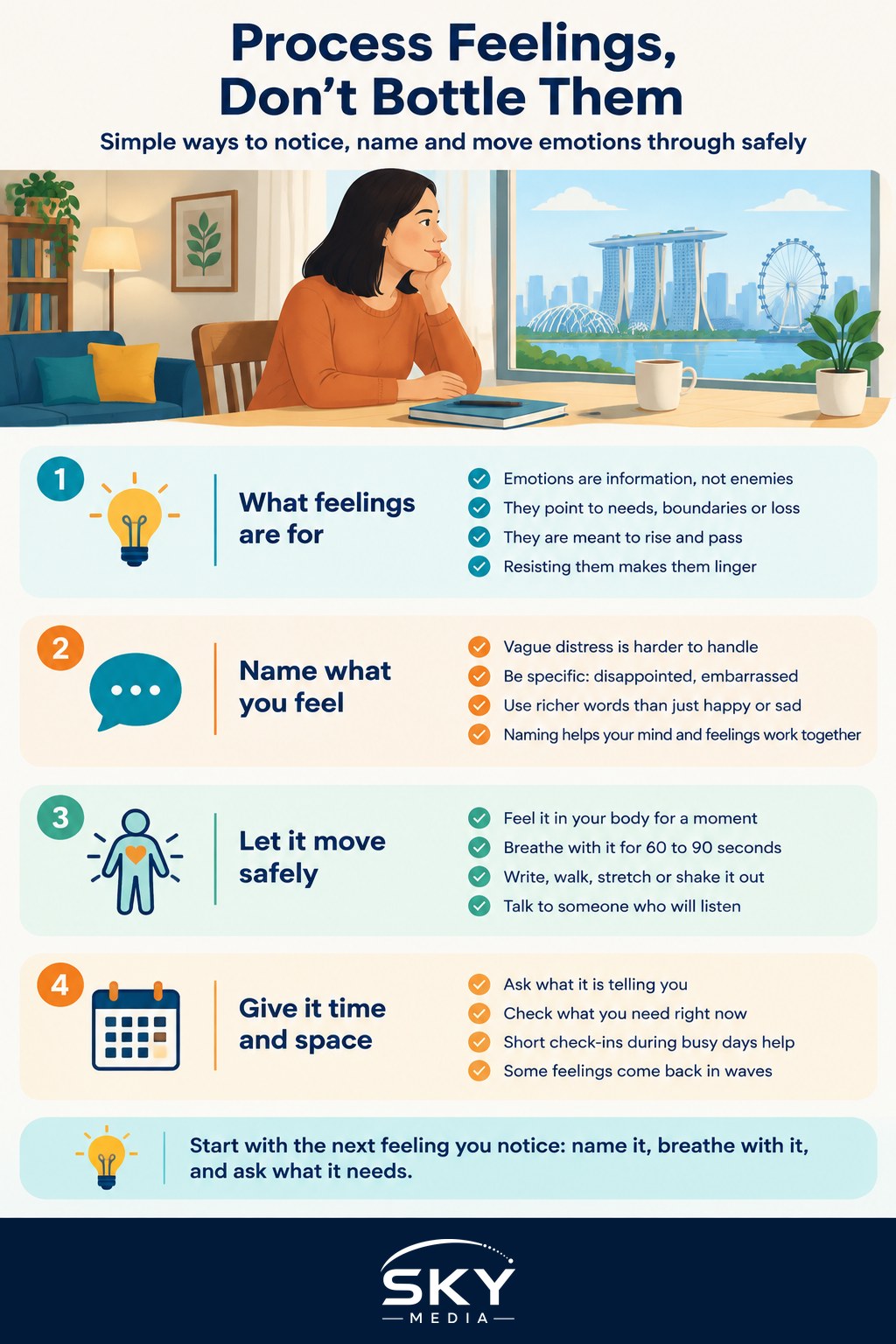
Understand what a feeling actually is
An emotion is information, not an enemy. It is your inner system flagging something: a need, a boundary, a loss, a hope. Anger often points to a crossed line. Sadness points to something that mattered. Anxiety points to a perceived threat. When you treat feelings as messengers rather than misbehaviour, you stop fighting them and start listening.
Crucially, emotions are designed to move. The word itself suggests motion. Left to flow, most feelings rise, peak and pass. It is the resisting, judging and bottling that makes them lodge and linger.
Name it to tame it
The single most powerful first step is to put language to what you feel. Vague, unnamed distress is far harder to handle than a named one. Instead of “I feel awful”, get specific: “I feel disappointed and a bit embarrassed.”
Try widening your vocabulary beyond happy, sad, angry. Are you frustrated, lonely, resentful, hopeful, relieved, ashamed, tender? The more precisely you name it, the more the raw intensity settles, because your thinking mind and feeling mind start working together instead of at odds.
Let it live in your body for a moment
Emotions are physical before they are verbal. Anxiety may sit as a tight chest, anger as heat in the face, grief as a heavy throat. A simple practice is to locate the feeling in your body and just breathe alongside it for sixty to ninety seconds without trying to fix it.
This is often called sitting with emotions. You are not wallowing; you are allowing. Place a hand where you feel it, breathe slowly, and silently tell yourself, “This is here right now, and it is allowed to be.” Very often the sensation softens once it stops being fought.
Give it a healthy outlet
Once a feeling is named and felt, it usually wants some expression. The goal is an outlet that discharges the energy without harming you or anyone else.
- Write it out. A few unfiltered minutes on paper, meant for no one, can drain a surprising amount of pressure.
- Move it out. A brisk walk, a stretch or simply shaking out your hands helps the body complete the stress cycle.
- Talk it out. Telling a trusted person, “I just need to be heard, not fixed,” lets the feeling be witnessed.
Choose the outlet that fits the moment. A stormy anger may want movement; a quiet grief may want words or stillness.
Bottling, exploding, or processing
It helps to see the three common paths side by side.
| Approach | What it looks like | What it tends to cost |
|---|---|---|
| Bottling | Pushing feelings down, “I’m fine” | Numbness, tension, sudden overflow later |
| Exploding | Venting rawly onto others | Damaged relationships, guilt afterwards |
| Processing | Naming, feeling, expressing safely | Short-term discomfort, long-term relief |
Processing is not the easiest in the moment, but it is the only one of the three that actually resolves the feeling rather than storing or spreading it.
Ask what the feeling needs
After the wave has settled a little, put a curious question to it: “What are you trying to tell me, and what do I need right now?” The answer is often simpler than expected. Loneliness may need a message to a friend. Overwhelm may need one task crossed off or a proper rest. Hurt may need a boundary set kindly.
A short reflection sequence
- Name it: what exactly am I feeling?
- Locate it: where does it sit in my body?
- Trace it: what happened just before this rose?
- Need it: what would genuinely help right now?
Running through these four takes only a few minutes and turns a confusing flood into something you can respond to.
Make a little space in a busy day
Many of us tell ourselves we have no time to feel anything, so we override emotions and push through. The feelings do not disappear; they wait, and they tend to leak out sideways as short tempers, tension headaches or restless nights.
You do not need an hour of solitude to process well. A few honest minutes count. Try a short check-in at a natural pause in your day, perhaps on the commute home or before bed. Ask yourself, “What did I actually feel today, and what have I been ignoring?” Even a small, regular window like this keeps emotions moving instead of accumulating. Over time, these tiny check-ins prevent the big overflow that comes from weeks of pushing things down.
Do not rush the timeline
Some emotions, especially those tied to loss or big change, do not resolve in one sitting. They come in waves over days or weeks. This is normal and not a sign you are doing it wrong. Your job is not to force yourself back to cheerful but to keep giving each wave a little room as it comes.
Be patient and kind with yourself in these stretches. Bottling to look strong only delays the reckoning. Letting the feelings move through, gently and repeatedly, is what genuinely helps them ease.
A closing encouragement
Processing your emotions is a lifelong practice, not a test you pass once. You will still get caught out, still bottle or snap sometimes, and that is part of being human. Each time you pause to name a feeling, breathe with it, and ask what it needs, you are building a steadier relationship with your inner world. Start with the very next feeling that arrives today. Name it, let it be here, and see how much lighter that one small act can make you.
Explore more: How to Become More Self-Aware · How to Manage Everyday Stress · How to Practise Self-Compassion
Frequently Asked Questions
What if I feel numb and cannot tell what I am feeling? Numbness is common after long stress or when feelings have been pushed down for years. Start with simple body check-ins, such as noticing tension or heaviness, and use a feelings list to find words. If numbness lasts or affects daily life, speak to a doctor or counsellor.
How can I share my feelings if my family never talks about emotions? Start small with one trusted person and use simple, concrete statements, such as saying you have been feeling stressed lately. You do not need a big talk. Writing a note or sharing while doing an activity together can feel easier. Friends or a counsellor are also options.
How can I help my child process big emotions? Stay calm, name the feeling for them and let them know it is okay to feel it. Wait until they settle before discussing what happened. Offer simple outlets such as drawing, movement or a quiet corner, and model naming your own feelings.
How do I deal with strong emotions at work when I cannot leave the room? Slow your breathing, press your feet to the floor and silently name what you feel. A brief walk to the pantry or a short break can help you settle. Save the fuller processing for later, such as writing about it or talking it through after work.
When is it better to see a counsellor than handle emotions on my own? Consider professional help if feelings are overwhelming, last for a long time, or interfere with sleep, work or relationships, or if you have thoughts of harming yourself. Self-help is useful for everyday emotions but is not a substitute for care. A doctor can guide you.
Further reading: How to Track Your Mood and Emotions · How to Forgive Someone Who Hurt You (Without Excusing the Harm)