

Most resolutions collapse quietly by the second week, not because we lack willpower but because we set them wrong from the start. If you want resolutions that stick, you need fewer of them, smaller versions of them, and a plan for the ordinary days when motivation is nowhere to be found. This guide shows you how.
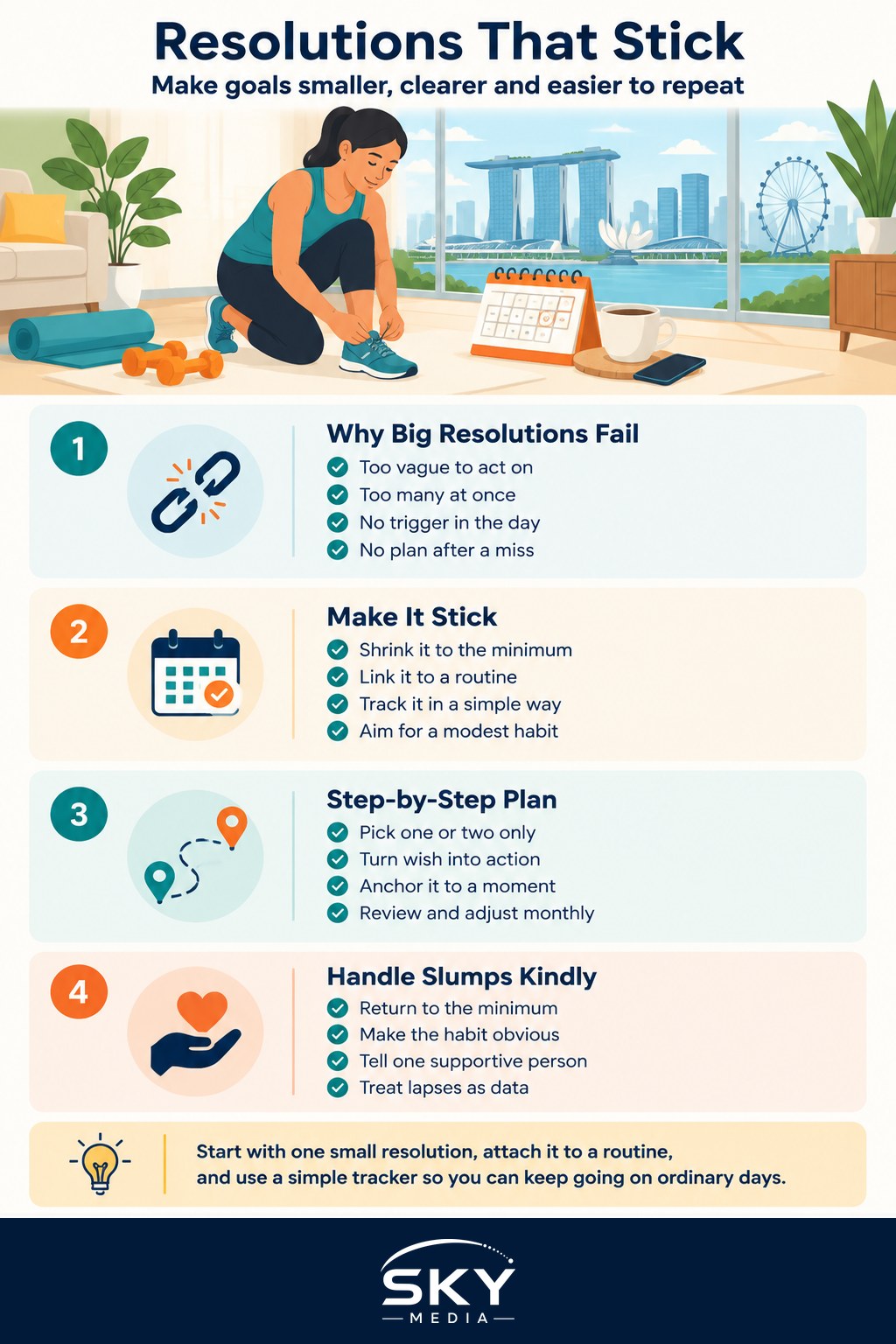
Why most resolutions fail
The usual resolution is big, vague and lonely. “Get fit”, “read more”, “save money”. It has no size, no trigger, and no home in your week. When the initial excitement fades, there is nothing left to carry it. You forget for a day, feel guilty, then quietly drop the whole thing.
Resolutions also fail because we set too many at once. Trying to overhaul your health, finances, career and relationships in the same January guarantees that none of them get the attention they need. Real change asks for focus.
What makes a resolution stick
A resolution sticks when it is small enough to do on a bad day, tied to something you already do, and tracked simply enough that you cannot lie to yourself. The aim is not a heroic month followed by collapse. The aim is a modest habit that survives long enough to become normal.
Three ideas do most of the work:
- Shrink it. Pick a version so small it feels almost too easy. Ten minutes, one page, one dollar.
- Anchor it. Attach it to an existing routine, such as “after I brew my morning kopi” or “when I sit down on the MRT”.
- Track it plainly. A tick on a calendar or a note on your phone. Visible, honest, quick.
Step by step
Step 1: Choose one or two resolutions, no more. Focus beats ambition. If everything is a priority, nothing is.
Step 2: Turn the wish into a specific action. “Get fit” becomes “walk for twenty minutes after dinner”. “Save money” becomes “move fifty dollars to savings every payday”.
Step 3: Shrink it to a version you cannot fail. If twenty minutes feels heavy on a tired night, make the minimum five minutes. A small win done daily beats a big plan done never.
Step 4: Anchor it to an existing habit. Decide the exact moment it happens. “After I shower” or “before I open my laptop” gives the resolution a home.
Step 5: Decide how you will track it. A wall calendar with a marker works well. Each day you do it, you make a mark. The growing chain becomes its own quiet encouragement.
Step 6: Plan for the miss. You will miss a day. Decide in advance: never miss twice in a row. One missed day is life. Two in a row is the start of a new habit of skipping.
Step 7: Review monthly and adjust. If a resolution is not sticking, do not abandon it. Make it smaller or move its anchor. Treat it as an experiment, not a test of your worth.
A worked example
Consider Raj, who resolves every year to “exercise more” and every year gives up by Chinese New Year. This time he does it differently.
He picks just one resolution instead of five. He turns “exercise more” into “do ten press ups and a fifteen minute walk”. He shrinks the minimum: on a terrible day, just the ten press ups count as a win. He anchors it to a routine he never skips, brushing his teeth at night, so the press ups happen right after. He tracks it with a marker on the kitchen calendar.
In week three he catches a cold and misses two days. Because he planned for the miss, he does not spiral. He restarts the next morning with just the press ups. By March the walk feels automatic, and he slowly adds distance. The resolution held because it was small, anchored and forgiving, not because Raj suddenly found more discipline.
Big resolution versus small resolution
The difference between a resolution that fades and one that lasts is usually size and specificity, not willpower.
| Feature | Resolution that fades | Resolution that sticks |
|---|---|---|
| Size | “Run every day” | “Put on my shoes and step outside” |
| Trigger | Whenever I feel like it | After I brush my teeth |
| Tracking | In my head | A mark on the calendar |
| Missed day plan | Give up | Never miss twice |
| Number at once | Five big changes | One or two small ones |
The right hand column is not less ambitious. It is more honest about how habits actually form, one repeated ordinary day at a time.
Handling motivation and slumps
Motivation is a guest, not a housemate. It visits on good days and vanishes on tired ones. Systems are what remain. This is why the anchor matters more than the mood: you do the thing because it is attached to a routine, not because you feel inspired.
When a slump hits, do the following:
- Return to the minimum. On hard weeks, do only the smallest version. Keeping the chain alive matters more than the size of each link.
- Make it obvious. Lay out your running shoes, leave the book on your pillow, set the transfer to automatic. Reduce the friction between you and the action.
- Tell one person. A friend or family member who casually asks how it is going adds gentle accountability without pressure.
When to change the resolution
Sometimes a resolution is not sticking because it was the wrong one. If after two honest months you feel no pull towards it at all, ask whether it truly reflects what you want, or whether you chose it because it sounded respectable. A resolution built on someone else’s expectations rarely survives. Swap it for one that connects to something you genuinely care about.
Keep it kind
The last ingredient is self kindness. People who bounce back after a missed day keep their habits far longer than people who punish themselves. Guilt does not build discipline; it just makes you avoid the whole thing. Treat a lapse as data, not failure. Note what got in the way, adjust the plan, and carry on.
Start this week with one small, anchored, trackable resolution. Do the tiny version even on the days you do not feel like it. That is the whole secret of resolutions that stick: not a burst of willpower in January, but a gentle, repeatable action you can keep doing all year.
Explore more: How to Set Goals You Will Actually Achieve · Using SMART Goals in Real Life · How to Break Big Goals into Steps in Singapore
Frequently Asked Questions
Do I have to start my resolutions on 1 January? No. Any day can be a fresh start, such as a birthday, the Lunar New Year or the first of a month. What matters is that the goal is small, anchored and trackable. A calm week without big commitments is often a better start than a rushed January.
How long does it take for a new habit to stick? It varies between people and habits. Simple actions may settle in within a few weeks, while complex ones can take months. Rather than counting days, focus on making the action easy and repeatable, and treat consistency as the real measure of progress.
Does telling a friend help me keep my resolution? For many people it does. A friend who casually checks in adds gentle accountability, and sharing the goal with someone who also wants to change can help both of you. Choose someone supportive, not critical, and agree on how often to update each other.
How do I restart after giving up on a resolution for weeks? Do not wait for a new year. Shrink the goal to its smallest version and restart tomorrow, attached to an existing routine. Treat the break as information about what got in the way, then adjust the plan rather than punishing yourself.
How should I set a money resolution that actually lasts? Make it a small, automatic action, such as moving a fixed amount into savings on payday. Track it simply and review monthly. For bigger decisions about investing or debt, consider speaking to a licensed financial adviser.
Further reading: The WOOP Method: Mental Contrasting for Goals That Stick