

You have probably seen the SMART framework on a whiteboard at work or in a self-help post. It is one of the most quoted goal-setting tools around, and for good reason: it forces a vague wish into something you can actually act on. The trouble is that most people learn the acronym, nod along, then go back to setting fuzzy goals anyway. This guide takes SMART goals off the poster and into a real Singapore week, showing how each part works, where it helps, and where people trip up.
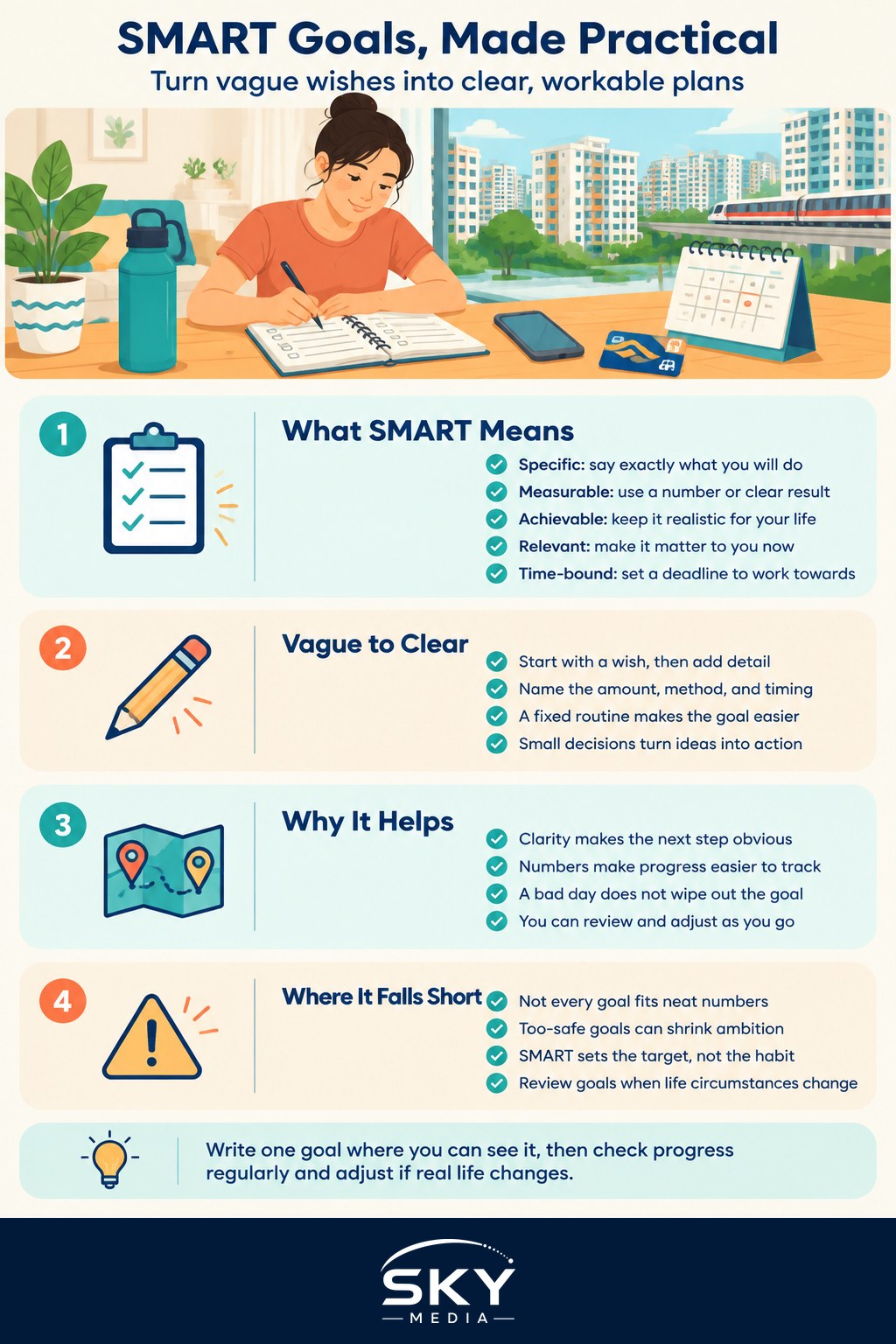
What SMART actually stands for
SMART is a checklist for turning a loose intention into a clear target. Each letter asks one honest question of your goal. The exact wording varies between sources, but the widely used version is this:
- Specific. What exactly are you going to do? “Exercise more” is a wish. “Do a 30-minute home workout three times a week” is specific.
- Measurable. How will you know you have done it? Attach a number or a clear yes/no so there is no arguing with yourself later.
- Achievable. Is this realistic given your time, energy, and starting point? A stretch is fine; a fantasy sets you up to quit.
- Relevant. Does this goal actually matter to your life right now, or is it someone else’s expectation? A goal you do not care about will not survive a hard week.
- Time-bound. By when? A deadline, even a gentle one, gives the goal shape and a moment to review.
Run any goal through those five questions and the weak spots show up fast. Often you will find a goal is specific but not achievable, or measurable but not actually relevant to you.
Turning a vague wish into a SMART goal
The value of SMART is in the rewrite. Take a common resolution and put it through the filter, and you can watch it change from a slogan into a plan.
Start with “I want to save money.” It is relevant to most people, but it fails almost every other test. There is no amount, no method, no deadline. Now rework it: “I will save $300 a month by setting up a standing instruction on payday, and review it in six months.” Suddenly it is specific (a fixed sum), measurable (the transfer either happens or it does not), achievable (you chose an amount that fits your pay), relevant (you decided it matters), and time-bound (a six-month check-in).
Do the same with learning. “Get better at Mandarin” becomes “Study Mandarin for 15 minutes every weekday on my MRT ride, using one app, for the next two months.” The magic is not in the framework itself. It is that the rewrite forces you to decide the boring details you were avoiding, and those details are what make a goal doable on an ordinary Tuesday.
SMART goals versus vague goals
It is easy to underestimate how much the framing changes your daily behaviour. The same ambition, written two ways, produces very different weeks. This table lays the two side by side.
| Aspect | Vague goal | SMART goal |
|---|---|---|
| Clarity | “Get fit this year” | “Walk 8,000 steps on weekdays” |
| Knowing you did it | Guesswork and gut feel | A number you can check daily |
| Daily action | Unclear, so nothing happens | Obvious next step, easy to start |
| Handling a bad day | The whole goal feels blown | You just resume tomorrow |
| Review | Nothing concrete to assess | Clear progress to adjust from |
Seen this way, a SMART goal is really just a vague goal with the decisions already made. That is why it survives contact with a tiring, unpredictable week when a slogan does not.
Where SMART goals fall short
SMART is a useful tool, not a law of nature, and it has real limits worth knowing. Treat it as one instrument in a larger kit rather than the whole answer.
- It suits measurable goals best. Some worthwhile aims, like becoming a kinder person or a calmer parent, resist tidy numbers. Forcing a metric onto them can miss the point. For these, a guiding theme may serve you better than a strict target.
- “Achievable” can quietly shrink your ambition. If you only ever set safe goals, you may never stretch. The fix is to keep the goal realistic but let the deadline or the scale be genuinely challenging.
- It says nothing about how you will follow through. SMART defines the target; it does not build the habit. That daily engine comes from routines, cues, and a system, not from the acronym.
- Life changes, so goals should too. A SMART goal set in January may not fit your circumstances by June. Reviewing and rewriting is part of the process, not a sign you failed.
The framework is a starting structure, not a straitjacket. Use it to get clear, then lean on habits and honest reviews to keep going.
Making SMART goals stick
Writing a SMART goal is quick; living it is the real work. A few practical moves close the gap between the neat sentence and the messy week.
First, write the goal where you will see it. A note on your phone lock screen or a line stuck to your desk keeps it present instead of forgotten. A goal out of sight quietly becomes a goal out of mind.
Second, break the time-bound target into smaller checkpoints. A six-month goal is easier to hold if you set a monthly glance at your progress. Each checkpoint is a chance to adjust the plan rather than abandon it. Pair this with a simple habit that drives the goal, so there is always a clear thing to do today.
Third, keep the goal honest. If a target turns out to be unrealistic once real life hits, shrink it rather than dropping it entirely. A smaller goal you actually meet builds more momentum than a grand one you keep missing. And if you are consistently overwhelmed or worn down, that matters more than any target; a chat with a doctor or a counsellor, or support such as mindline.sg, is a sensible step.
Used well, SMART goals are less about the clever acronym and more about the honesty it forces: deciding exactly what you want, how you will measure it, and by when. Get those clear, back them with a daily habit, and review them without guilt, and the framework quietly does its job in the background of a busy life.
Explore more
SMART goals work best once you know what you truly want, so start with how to set goals you will actually achieve. Then power the follow-through with how to build self-discipline, and if setbacks knock you off track, try how to overcome the fear of failure.
Frequently Asked Questions
Can you give an example of a SMART goal for work? One example is: complete a recognised short course by the end of the second quarter by studying two evenings a week, and apply one new skill to a project. It names the action, sets a measure, fits a realistic schedule, matters to your career and has a deadline.
What does the A in SMART stand for? It is most often given as achievable, though some versions use attainable or agreed. The idea is that the goal should be realistic for your time, energy and starting point. It can still stretch you, but it should not be a fantasy that sets you up to give up.
What is the difference between SMART goals and OKRs? SMART is a checklist for writing one clear goal. OKRs, short for objectives and key results, are a way of pairing an ambitious aim with several measurable results, often used by teams and companies. Individuals can use SMART for personal goals and borrow the OKR idea for bigger ambitions.
Can I use SMART goals for my children or teenagers? Yes, in a simpler form. Help them state a clear target, such as reading a set number of pages a day for a month, with a way to tick off progress. Let them choose goals they care about, since a goal imposed by parents rarely sticks.
How many SMART goals should I set at once? Keep it to a small handful, ideally one to three. Each SMART goal comes with its own habits and checkpoints, which take time and attention to maintain. If you find yourself writing ten, pick the ones that matter most this season and save the rest.
Further reading: How to Use OKRs for Personal Goals