

Few businesses carry as much responsibility, or as much regulation, as caring for young children. Demand is real and enduring, because working parents need trusted, quality care, but this is one of the most closely governed sectors in the country, and rightly so. If you are considering starting a childcare Singapore families will trust with their children, this guide explains the opportunity, the licensing body you must work with, staffing and premises realities, costs, and the pitfalls to avoid. Above all, it points you to the official authority for the rules that matter most.
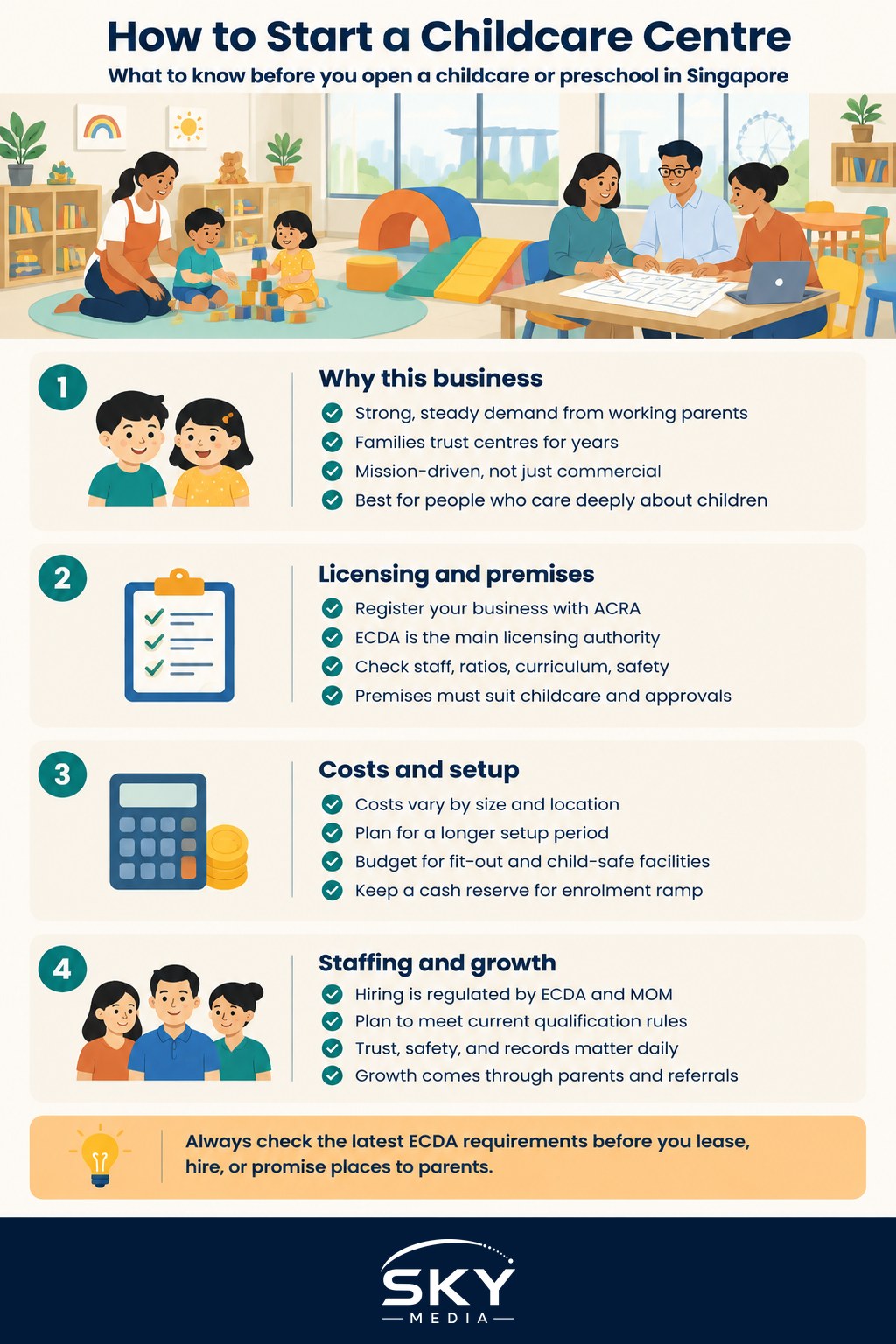
The opportunity and who it suits
Singapore places strong emphasis on early childhood development, and many parents rely on childcare and preschool for both education and care. That creates steady, long-term demand, and families who trust a centre tend to stay for years and refer others. It is a mission-driven business as much as a commercial one.
It suits people who genuinely care about children and education, and who can also handle serious operational discipline: compliance, safety, staffing, and finances. This is not a light-touch venture. The regulatory bar is high because the stakes are high, and the paperwork, standards, and inspections are all part of the job, not obstacles to it.
Be clear-eyed about the commitment. You are responsible for children’s safety and wellbeing every single day, and parents will hold you to the highest standard. If that responsibility energises you rather than daunts you, it can be a deeply worthwhile business.
Licensing, ACRA registration and premises
Like any business, you register the entity with ACRA through BizFile and choose a suitable structure, taking advice from an accountant or corporate secretary, and you handle GST and IRAS appropriately. But the defining authority for this sector is the Early Childhood Development Agency (ECDA).
ECDA is the licensing and regulatory body for childcare centres and preschools in Singapore. Licensing, staff qualification requirements, staff-to-child ratios, curriculum expectations, health and safety standards, and premises requirements all fall under ECDA. These requirements are specific, detailed, and subject to change, so this guide will not restate or invent them. Instead, the single most important step in your entire plan is to go directly to ECDA, study the current licensing requirements in full, and build your whole project around them from day one. Do not sign a lease, hire staff, or promise places to parents before you understand what ECDA requires and confirm your plan can meet it. When in doubt, defer to ECDA, because on this topic they are the authority and precise requirements change over time.
Premises are tightly tied to licensing. A childcare centre needs space that meets ECDA’s requirements as well as general premises approvals, so the unit must be suitable and approved for the intended use. Location, safety, layout, and outdoor or activity space all matter, both for compliance and for parents’ confidence. Verify everything with ECDA and the relevant authorities before committing.
Costs and getting started
This is a demanding business to set up, and costs vary widely with size, location, and the standard of your facilities. Avoid anyone quoting precise figures without knowing your plan. What you can do is understand the drivers and plan for a longer, more careful runway than a typical small business, because licensing and fit-out take time before you can enrol children.
The table below compares broad startup and effort drivers across three common formats. Specific requirements come from ECDA, not from this table.
| Driver | Small preschool | Full-day childcare | Larger centre |
|---|---|---|---|
| Space and premises | Smaller, still compliant | Larger, care facilities | Substantial, multiple rooms |
| Staffing needs | Qualified educators | More staff, ratios apply | Sizeable qualified team |
| Compliance load | High, ECDA-led | High, ECDA-led | High, ECDA-led |
| Fit-out | Safe, child-appropriate | Extensive, care-ready | Extensive, plus facilities |
| Lead time | Longer than typical | Longer than typical | Longest |
Budget in general terms for premises deposit and a child-safe, compliant fit-out, qualified staff, insurance, learning materials, administration systems, and a substantial cash reserve for the extended setup and enrolment period. Look at Enterprise Singapore and official schemes for general business support, and note that the early childhood sector has its own official support landscape, so check current details directly.
Staffing, running and growing it
Staffing is not just important here, it is regulated. ECDA sets expectations around staff qualifications and staff-to-child ratios, so your hiring plan must be built to meet the current ECDA requirements rather than to a budget you wish were lower. General employment matters also fall under MOM rules. Recruiting and retaining qualified, caring early childhood educators is genuinely challenging, and it is central to both compliance and quality.
Running a centre well rests on trust and consistency:
- Meet and maintain all ECDA requirements continuously, not just at licensing.
- Put safety and child wellbeing first in every decision, every day.
- Communicate openly and often with parents, since trust is everything.
- Keep careful records, and manage health, hygiene, and safety diligently.
- Support and develop your educators, because retention protects quality.
Growth is slow and reputation-led. Centres grow through parent trust, waitlists, and referrals, not through discounting. Quality and safety are the marketing.
Common pitfalls to avoid
The gravest mistake is underestimating the regulatory reality: committing to premises, staff, or parents before fully understanding and confirming ECDA’s current requirements. Others include understaffing or hiring without the required qualifications, weak safety and record-keeping, and thin cash reserves that cannot cover the long setup and enrolment ramp.
Watch your numbers, including enrolment against capacity, staffing costs, and rent, but never let cost pressure compromise safety, ratios, or qualification requirements. This is general information, not legal, financial, or professional advice. For anything touching licensing, staff qualifications, ratios, or premises, defer to ECDA and the relevant authorities, and consult qualified professionals, before you commit.
Explore more
If you are exploring businesses that serve families and children, compare how to start an enrichment centre in Singapore, which sits alongside early childhood care, and how to start a pet care or grooming business in Singapore for a different kind of trust-based care venture. For a community-focused business with recurring revenue, how to start a fitness studio or gym in Singapore offers a useful contrast in setup and licensing.
Frequently Asked Questions
Can I look after other people’s children at home for a fee? Possibly, but do not assume. Caring for children for payment can be regulated, and the rules depend on the arrangement and number of children. Ask ECDA what applies to your situation before you advertise or take any child, since safety standards are strict.
Do I need an early childhood qualification myself to run a centre? ECDA sets the qualification expectations for the people who run and teach in licensed centres, and they can change. Check its current requirements early, because you may need to hire qualified educators or a principal even if you do not hold the qualifications yourself.
How long does it take before a new childcare centre can open? There is no single timeline, but plan for a longer runway than a typical small business. Licensing, fit-out and hiring qualified staff all take time before children can be enrolled. Do not sign a lease or promise places to parents until ECDA confirms your plan.
What is the difference between childcare, preschool and kindergarten? Childcare usually offers longer hours with care and learning for working parents, while kindergarten typically focuses on early learning in shorter sessions. Terms overlap in everyday use. Check with ECDA which category your model falls under and what rules apply.
How does a new childcare centre earn parents’ trust? Be transparent about safety, staff qualifications, daily routines and how you communicate. Offer visits and open houses, answer questions openly and keep parents updated. In this sector trust grows slowly through consistent, safe practice, not discounts.
Official sources: Early Childhood Development Agency (ECDA)