

Most competitive games include a training mode, and most players barely touch it. They load in, mess around for two minutes, get bored, and jump straight into real matches. That is a wasted opportunity, because a training mode is the one place where you control everything and can fail safely. If you learn to use training modes in Singapore games with a bit of structure, you will improve faster than someone who only ever plays live matches, without the sting of losing while you figure things out.
This guide covers what training modes are actually for, how to run a session that helps, and the common traps that make them feel useless.
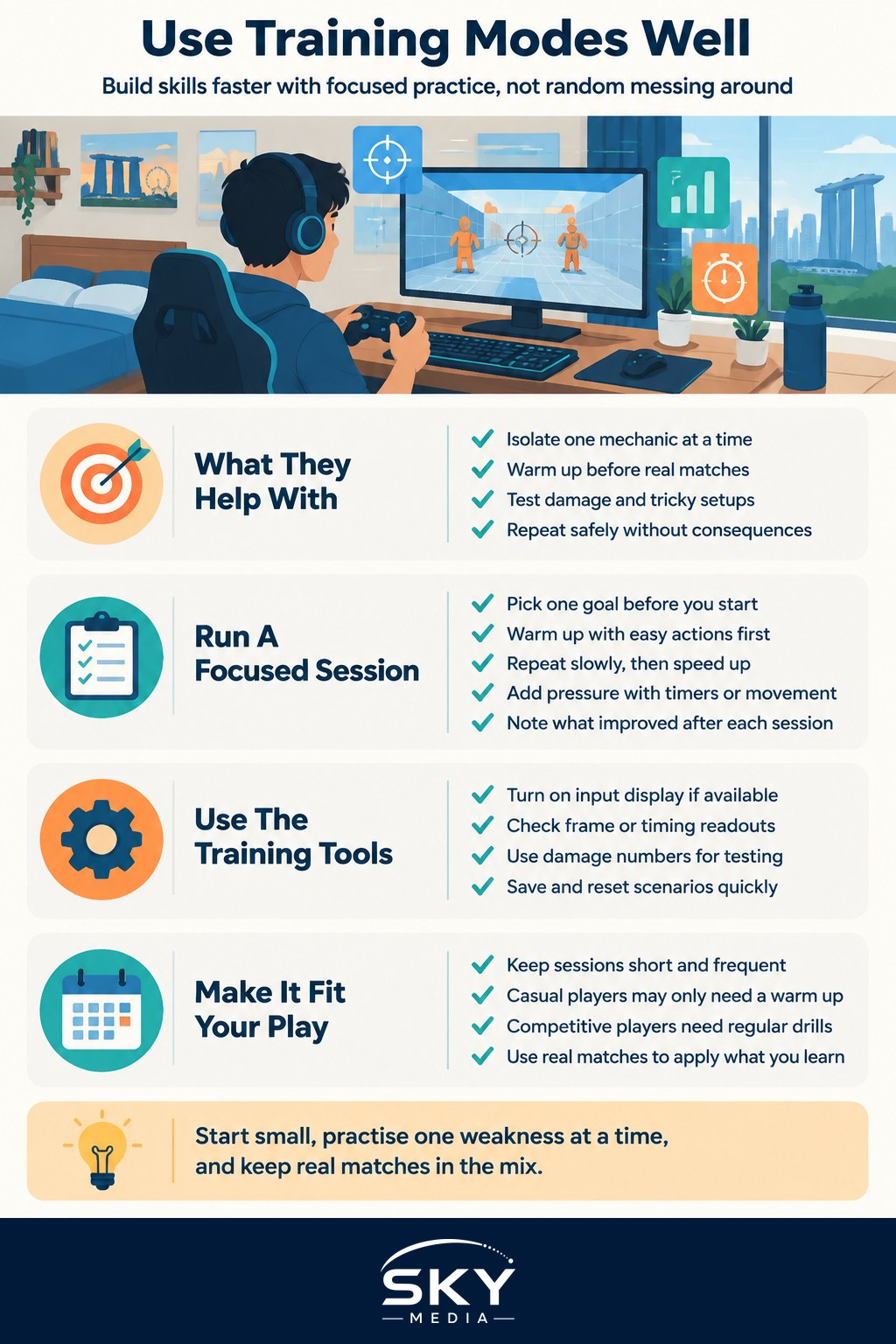
What Training Modes Are Good For
A training mode is a sandbox. Depending on the game it might let you spawn enemies, reset situations instantly, slow down time, turn on inputs display, or set up a specific scenario again and again. The value is not that it is fun, because often it is not. The value is repetition without consequences.
Training modes are especially good for a few kinds of practice:
- Mechanics you can isolate. Aiming, movement, recoil control, combos, timings, and resource management can all be drilled cleanly away from the chaos of a real match.
- Warming up. A short routine before you play gets your hands and reactions ready so your first live match is not your warm up.
- Testing. Want to know exactly how much damage something does, or whether a trick works? The training room lets you check instead of guessing mid game.
What training modes are less good for is decision making under real pressure. A bot standing still is not the same as a thinking opponent, so you still need real matches to test the mental side. Think of training as building the tools, and matches as learning when to use them.
How to Run a Focused Session
The biggest mistake is loading in with no plan and just flailing. A good session has a target. Before you start, decide the one thing you want to work on, for example landing a specific combo, controlling a weapon’s recoil, or hitting a movement timing consistently.
Then structure it roughly like this:
- Warm up gently. Spend a few minutes on easy, familiar actions so you are loose.
- Drill the one thing. Repeat it slowly and correctly first, then gradually speed up. Doing it right slowly beats doing it wrong fast, because you are teaching your hands the correct pattern.
- Add pressure. Once it is reliable, make it harder. Use a moving target, add a distraction, or set a timer. This closes the gap between the training room and a real game.
- Cool down and note progress. Jot down what improved and what still feels shaky so you know where to start next time.
Keep sessions short and frequent rather than long and rare. Twenty focused minutes a few times a week will beat one exhausting two hour grind, because tired repetition just cements sloppy habits. If your wrists or hands start to ache during all this repetition, stop and rest, and see a doctor or physiotherapist for any pain that keeps coming back.
Turn On the Tools the Mode Gives You
Training modes often hide genuinely useful settings in the menu. Dig through the options before you start. Common ones worth switching on include an input display that shows exactly which buttons you are pressing, a frame or timing readout, damage numbers, and the ability to save and instantly reset a scenario. Seeing your own inputs on screen is one of the fastest ways to spot why a combo or action keeps failing.
This kind of self review pairs perfectly with looking back at your real games too. Recording a match and watching it back tells you which weaknesses are worth taking into the training room in the first place, and our guide to how to review your own gameplay walks through how to do that without being too hard on yourself.
Fit It Into How You Actually Play
Training modes are a means to an end, not the whole hobby, so be realistic about how much time you want to give them. If you play casually for fun, a five minute warm up before you start is probably all you need, and that alone will make your first matches feel smoother. If you are chasing improvement in a competitive title, a proper drilling session a few times a week is where the real gains come from.
A couple of final pointers:
- Do not confuse training with playing. You still need real matches to apply what you drill. The two work together.
- Match the drill to a real weakness. Practising something you are already good at feels nice but changes nothing. Aim at what actually loses you games.
- Be patient. New mechanics can feel worse before they feel better while your hands adjust. That dip is normal.
Used well, a training mode turns vague frustration into concrete progress. It is the difference between hoping you improve and actually building the specific skills that win matches. If you want to go further on structuring your practice overall, how to practise deliberately in games is a natural next read, and it plugs straight into everything above.
Frequently Asked Questions
How often should I use training mode? A short warm-up before playing is enough for casual players. If you are chasing improvement, a focused session a few times a week works well. Short, regular sessions beat one long, tiring one, and you can adjust as your schedule allows.
Can I improve by only using training mode and skipping real matches? No. Training builds the individual skills, but real matches teach decision-making, timing against thinking opponents and handling pressure. Use both together, drilling a weakness in training and then testing it in a live game.
What should I practise first in a training mode? Start with whatever costs you the most games, such as a movement habit, a basic combo or recoil control. Pick one thing and repeat it correctly at a slow pace before speeding up. Reviewing a recorded match can help reveal that weakness.
How do I stay motivated when drilling feels boring? Keep sessions short, set a clear target, and track a small measurable improvement, like a success count out of ten attempts. Mixing in a fun scenario at the end helps. If it feels like a chore every time, shorten it.
Does the game I play need a training mode for me to practise? Not necessarily. If there is no practice mode, use custom games, private lobbies, tutorials or low-stakes casual modes to rehearse specific skills. Recording and reviewing your own matches is another way to practise without a training room.