

Walking is one of the simplest ways for older adults to stay active, but Singapore’s weather does not always cooperate. A sudden afternoon downpour, a hazy week or a blazing midday sun can turn a planned stroll into a skipped one. The good news is that indoor walking Singapore options are everywhere once you know where to look. This guide is written for seniors and their families, and covers the kinds of sheltered places that work well, how to plan a route, and how to stay safe and comfortable while you walk.
This is general information, not medical advice. If you have a heart condition, joint problems, balance issues or have recently been unwell, speak to your doctor or polyclinic before starting a new walking routine.
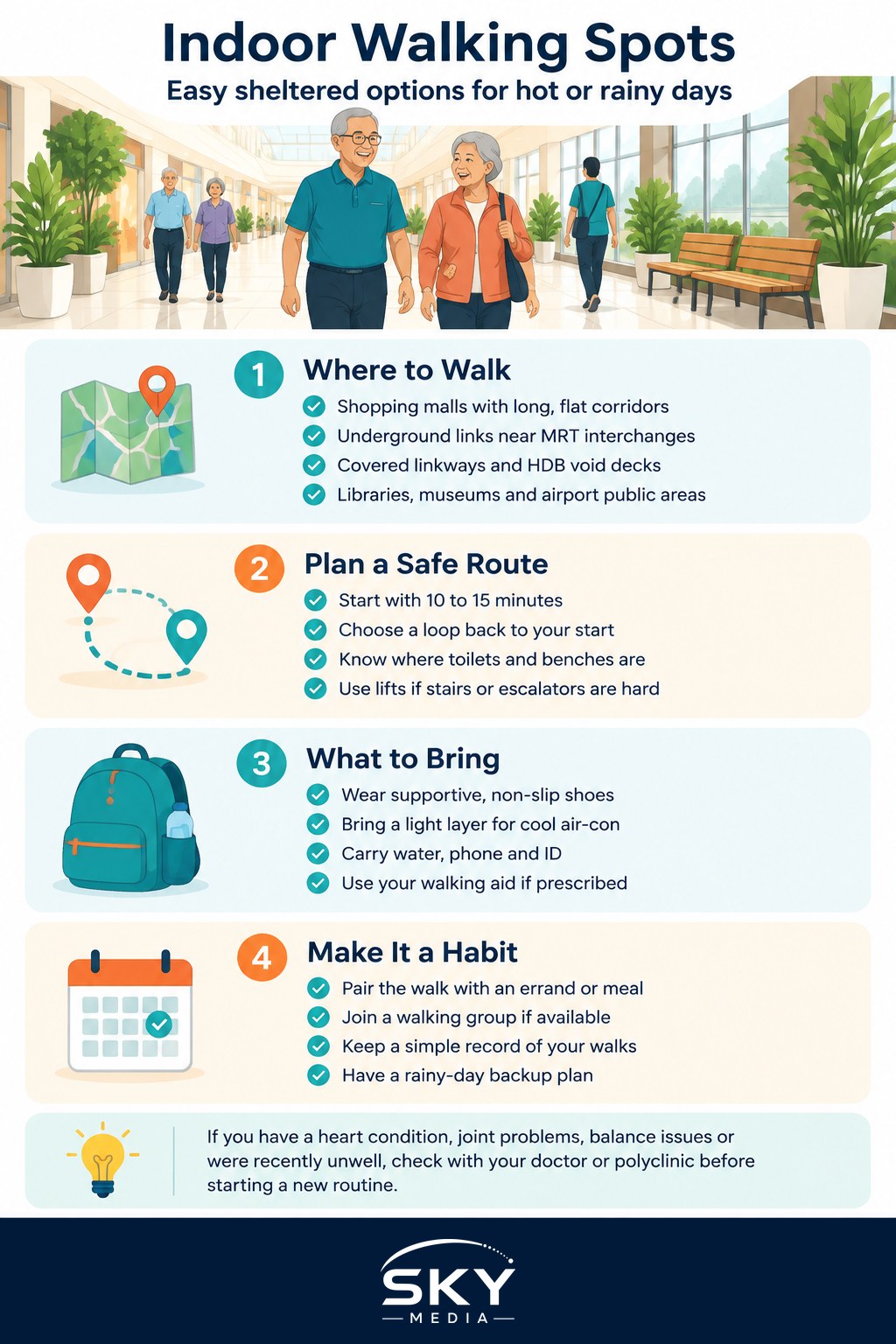
Why Walking Indoors Makes Sense
Many seniors already walk in their neighbourhood or park. Walking indoors is not about replacing that, but about having a reliable backup so the habit continues on days when the weather is unkind.
- Steady temperature. Air-conditioned spaces remove the risk of overheating, which matters more as we age because the body becomes less efficient at cooling down.
- Flat, even floors. Indoor surfaces are usually smooth and level, with fewer tree roots, puddles and uneven kerbs.
- Toilets, seats and water nearby. Rest stops are rarely far away.
- People around. Being in a busy, well-lit place can feel reassuring, and help is close at hand if needed.
- No rain delays. You can keep a regular time each day regardless of the forecast.
For more on why a daily walk pays off, see our article on the health benefits of walking more every day.
Types of Indoor and Sheltered Places to Walk
You do not need to travel far. Most heartland and city areas offer at least one of these:
Shopping malls. The classic choice. Large malls have long, flat corridors over several floors, lifts and escalators, toilets and benches. Walking early, soon after the mall opens, is usually quieter and cooler. Check the mall’s own website or directory for its current opening times.
Underground pedestrian links. Parts of the city centre, such as the areas around major MRT interchanges, have underground walkways connecting stations, malls and office buildings. These let you cover a good distance without going outside.
Covered linkways and HDB void decks. Many estates have sheltered walkways linking blocks, bus stops, MRT stations and markets. They are not air-conditioned, but they keep off rain and direct sun. Early morning or evening is cooler.
Community clubs and sports centres. Some community clubs and ActiveSG sports centres have indoor spaces or sheltered tracks. Programmes and access change over time, so check with your community club or the ActiveSG website for what is currently available near you.
Museums and libraries. Public libraries and museums offer quiet, air-conditioned spaces where slow, gentle walking between exhibits or shelves is easy on the body. Look up each venue’s opening hours and any entry requirements before you go. Our list of free indoor places in Singapore is a handy starting point.
Airport public areas. The public zones of the airport have long, flat, air-conditioned stretches. Many families combine a walk there with a meal. Check what is open to the public before you visit.
Choosing the Right Place for You
| Place type | Good points | Things to watch | Best time |
|---|---|---|---|
| Shopping mall | Air-conditioned, toilets and seats everywhere | Crowds on weekends, slippery floors near entrances on rainy days | Weekday mornings |
| Underground pedestrian link | Long continuous distance, sheltered | Busy at peak commuting hours, some stairs | Mid-morning or mid-afternoon |
| Covered linkway or void deck | Close to home, free, familiar | Not air-conditioned, wet edges in heavy rain | Early morning or evening |
| Library or museum | Quiet, cool, interesting | Shorter distances, need slower pace | Weekday daytime |
| Airport public area | Very long flat walkways | Travel time to get there, crowds during holidays | Weekday mornings |
There is no single best option. Many seniors keep two or three places in mind: one close to home for short walks, and a bigger mall or link for longer outings.
Planning a Safe Indoor Walking Route
A little planning makes indoor walking more pleasant and safer.
- Start short. Begin with 10 to 15 minutes at an easy pace and build up gradually, as your doctor advises.
- Map out a loop. Pick a circuit, such as one full floor of a mall, that brings you back to your starting point. Count how many loops feel comfortable.
- Note toilets and benches. Know where you can rest before you start.
- Use lifts if stairs or escalators are hard. Escalators can be tricky for people with balance issues or when carrying bags.
- Avoid peak crowds. Busy lunchtime and weekend crowds increase the risk of bumping into people.
- Watch the floors. On rainy days, entrances and lobbies can be wet and slippery. Slow down and look for warning signs.
- Walk with a buddy if you can. Friends, family or a neighbour make the walk more enjoyable and safer.
What to Wear and Bring
- Good shoes. Supportive, closed shoes with non-slip soles matter more indoors than many people expect, because polished floors can be slippery. Our guide to the best walking shoes for Singapore explains what to look for.
- Light layers. Air-conditioning can feel cold after a while. A thin jacket or cardigan helps.
- Water. Bring a small bottle, even indoors.
- Phone and ID. Keep an emergency contact saved, and carry any medical information you may need.
- A small bag. Keep hands free so you can use handrails.
- Walking aid if prescribed. If you use a walking stick or frame, bring it. It is not a sign of weakness, it is what lets you keep walking safely.
Turning It Into a Habit
The hardest part of any routine is keeping it going. A few ideas that help many older adults:
- Pair the walk with an errand. Walk the mall before doing your marketing, or before a meal with family.
- Join a group. Some community clubs, active ageing centres and residents’ networks organise walking groups. Ask at your nearest community centre about what is currently available.
- Keep a simple record. Tick a calendar or use a phone step counter to see your progress.
- Make a rainy-day plan. Decide in advance where you will walk if it rains, so you do not have to think about it on the day.
- Stop if something feels wrong. Chest pain, dizziness, shortness of breath or sudden weakness are reasons to stop, sit down and seek help immediately.
Wet-season months make a backup plan especially useful. For more ideas, read our guide to staying active in the monsoon season.
Indoor walking is a gentle, practical way to keep moving whatever the weather. With a familiar route, good shoes and a little planning, a hot or rainy day no longer has to mean a day without exercise.
Further reading: What to Eat at a Hawker Centre When It’s Raining · How to Build a Walking Routine in Singapore Malls · Rainy-Day Photography Tips