

There is something special about pressing a shutter and watching a real photo develop in your hand a minute later. Instant cameras have stayed popular at weddings, birthday parties, travel trips and gatherings because the print itself becomes a small keepsake. If you are shopping for an instant camera in Singapore, the camera body is only half the decision. The film format you choose decides how big your photos are, how they look and, most importantly, how much every single shot costs you over time.
This guide compares the main instant film formats, explains how to think about running costs, and helps you choose the right kind of camera for how you actually plan to use it.
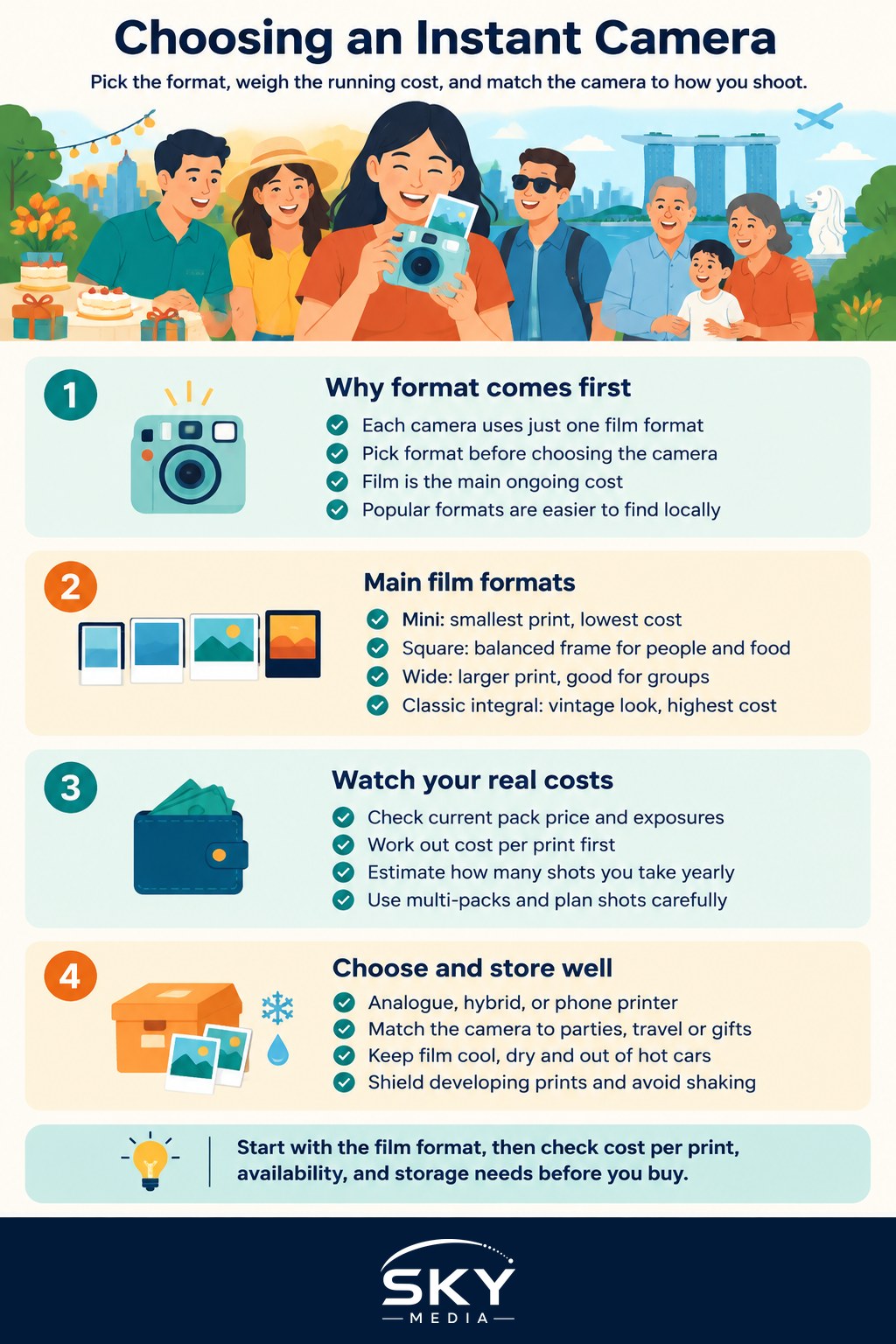
Why the Film Format Matters More Than the Camera
With digital cameras, you buy the camera once and photos are essentially free. Instant photography works the other way around. Cameras can be relatively affordable, but every press of the shutter uses a sheet of film you have to buy.
That means two things:
- Each camera only takes one film format. A camera designed for mini film cannot use wide or square film. Pick the format first, then the camera.
- Film is your real ongoing cost. Over a year of regular use, you will usually spend more on film than you did on the camera.
Film supply is also worth considering. Popular formats are widely sold at camera shops, electronics retailers and online marketplaces in Singapore, while some less common formats can be harder to find locally.
Instant Film Formats Compared
The main formats on the market today come from a small number of manufacturers. Exact dimensions, pack sizes and prices change over time, so check current details with the retailer before buying. In general terms:
| Format | Print size and shape | Typical look | Relative cost per print | Good for |
|---|---|---|---|---|
| Mini (credit card size) | Small, narrow portrait | Bright, punchy colours | Lowest of the main formats | Parties, journals, casual everyday shots |
| Square | Medium, square | Balanced, social-media style framing | Middle | Portraits, food, travel scenes |
| Wide | Large, landscape | Detailed, more room for groups | Higher than mini | Group photos, scenery, events |
| Classic integral (larger square with thick bottom border) | Large, square | Softer, dreamy, more vintage colour | Usually the highest | Artistic shots, people who love a retro feel |
A few general points help when comparing:
- Mini film is usually the most widely available and the cheapest per shot, which is why many first-time buyers start here. The trade-off is a small image, which can make group shots or landscapes feel cramped.
- Square film gives a more balanced frame that suits faces and objects well.
- Wide film is excellent for groups, which makes it popular for wedding guestbooks and large family gatherings.
- Classic integral film has a distinctive look that many enthusiasts love, but it can be more sensitive to temperature and light, and each print generally costs more.
Working Out Your Real Running Costs
Instead of comparing camera prices, compare the cost of a year of shooting. A simple method:
- Check the current price of a film pack for the format you are considering, and how many exposures it contains.
- Divide the pack price by the number of exposures to get your cost per print.
- Estimate how many photos you will take in a year. Be honest. Someone who shoots one pack a month uses far more film than someone who brings the camera out twice a year.
- Multiply cost per print by your yearly estimate. Add this to the camera price to see the true first-year cost.
Ways to keep costs reasonable:
- Buy multi-packs when you know you will use them, as they are often cheaper per print than single packs.
- Plan your shots. Instant photography rewards slowing down, so treat each frame as worth taking.
- Avoid shooting into harsh backlight or very dark rooms unless your camera handles those well, because failed exposures still cost money.
- Keep special editions, such as coloured borders or monochrome packs, for occasions where they add something.
Analogue, Hybrid and Printer Options
Beyond traditional cameras, there are a few other ways to get instant prints:
Fully analogue instant cameras expose the film directly. What you see is what you get, with no second chances. Many people love this for its simplicity and surprise.
Hybrid instant cameras have a digital sensor and screen. You take a photo, review it, and only print the ones you like. This can save a lot of film and also keeps a digital copy. Some purists feel they lose a little of the magic, but for cost-conscious users hybrids make a lot of sense.
Smartphone instant printers use instant film to print photos from your phone. These are handy if you already take most photos on your phone and want physical prints for scrapbooks, gifts or decorating your room. They use the same film formats, so the same running cost logic applies.
Using and Storing Instant Film in Singapore’s Climate
Heat and humidity are the main challenges for instant film locally. Most manufacturers recommend storing film in a cool, dry place and using it before the expiry date printed on the box. Practical tips:
- Do not leave film or a loaded camera in a hot car or in direct sun. Heat can affect colours and development.
- Keep unopened packs in an air-conditioned room where possible. Some enthusiasts refrigerate film, but follow the manufacturer’s storage advice, and let film return to room temperature before using it to avoid condensation.
- Shield prints from light as they develop, especially for formats that are light-sensitive in the first moments after ejection. Check your film’s instructions.
- Avoid shaking the print. Despite the popular habit, shaking does not help modern instant film and can sometimes cause marks.
- Store finished prints away from direct sunlight, in an album or box, so colours last longer.
Choosing the Right Camera for How You Shoot
Think about your main use before you buy:
- Parties and gatherings: a mini format camera with a simple automatic exposure mode is easy to pass around to guests.
- Group photos and events: a wide format camera captures more people without squeezing.
- Travel: look for something compact and light, and consider whether a hybrid would let you be choosier with prints.
- Creative photography: cameras with manual controls, double exposure modes or close-up lenses give more room to experiment.
- Gifting to children: choose sturdy, simple cameras and teach them to plan each shot, since film runs out quickly.
Other features worth checking include a built-in flash with an off option, a selfie mirror, a tripod socket, the battery type and how easy it is to load the film.
Ideas for Using Your Prints
Instant prints are made to be shared and displayed. Popular uses include guestbooks at weddings and baby showers, travel journals, fridge collages, handwritten notes on the bottom border, and gifts tucked into cards. If you enjoy decorating with photographs, our guide on how to choose art and prints for your home has ideas for grouping small prints on a wall. And if you are thinking of turning your photography into a small side project, print-on-demand in Singapore explains how some hobbyists start selling their designs.
Quick Buying Checklist
- Decide on the film format first, based on print size and look
- Calculate cost per print and estimate a year of film spending
- Check that film for that format is easy to buy locally
- Choose analogue, hybrid or phone printer based on how much control you want
- Plan cool, dry storage for film in Singapore’s climate
An instant camera is one of the most fun ways to slow down and enjoy taking photos again. Choose the format that fits your style and budget, and every print becomes something worth keeping.
Further reading: Shooting With a Disposable Film Camera: Tips and Where to Develop · How to Choose an Action Camera