
If you have worked as a freelancer or run a small service business in China, you are used to the fapiao (发票) system, where official invoices are issued through a tax-controlled platform. Singapore works differently. There is no government-issued invoice paper for most businesses, and an invoice is simply a clear commercial document you create yourself. Knowing how to invoice Singapore clients properly helps you get paid on time and keeps your records ready for tax season.
This article is general information, not legal or tax advice. Rules can change, so confirm current requirements with the official bodies named below.
First, Check That You Are Allowed to Do the Work
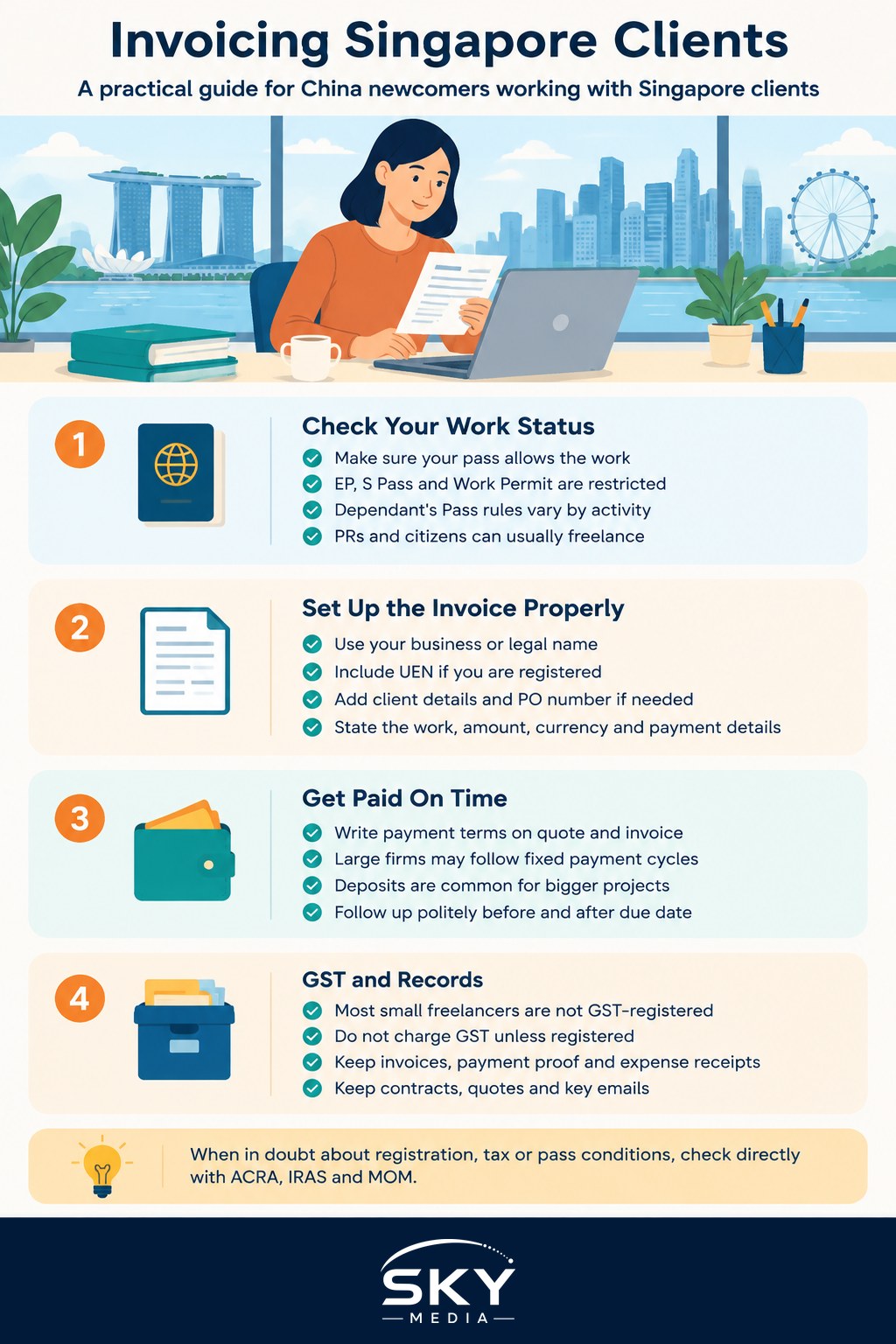
Before sending any invoice, make sure your immigration status allows you to earn this income. This is the most important step for newcomers.
- Employment Pass, S Pass and Work Permit holders are generally tied to their sponsoring employer. Doing paid work for other clients on the side may not be allowed without permission.
- Dependant’s Pass holders must follow the Ministry of Manpower (MOM) rules for that pass, which have changed over time. Some activities may need a separate work pass or letter of consent.
- Permanent Residents and citizens can generally register a business and freelance.
Whether a pass holder may run a business or freelance depends on MOM’s rules for that specific pass. Check MOM’s website, or ask MOM directly, before you start. Invoicing for work you are not permitted to do can put your pass at risk.
Sole Proprietor, Company or Individual: How You Invoice Depends on Your Setup
How you appear on the invoice depends on whether you have registered a business with ACRA (the Accounting and Corporate Regulatory Authority) through its online portal, Bizfile.
| Your setup | Name on the invoice | Identifier to show | Who pays tax on the income |
|---|---|---|---|
| Registered sole proprietorship | Your registered business name | The business UEN | You, as personal income through IRAS |
| Private limited company (Pte Ltd) | The company’s registered name | The company UEN | The company, through corporate tax |
| Unregistered individual freelancer (where permitted) | Your full legal name | Usually none; some clients ask for NRIC/FIN for their records | You, as personal income through IRAS |
The UEN (Unique Entity Number) is the identification number every registered business or company receives. It is the Singapore equivalent of a business registration number and clients often use it to check that you exist on ACRA’s records. Whether you need to register at all depends on your activity, so check ACRA’s guidance on when business registration is required. Our guide on keeping your China and Singapore documents in order covers how to store registration papers and pass documents together.
What a Singapore Invoice Should Include
There is no single compulsory template for businesses that are not GST-registered, but clients, especially larger companies with finance teams, expect certain details. A clear invoice usually includes:
- The word “Invoice” at the top, and a unique invoice number. Use a simple sequence such as INV-0001, INV-0002.
- Invoice date and the due date for payment.
- Your details: business or legal name, UEN if registered, address and email.
- Client details: company name, billing address and the contact person. Ask if they have a purchase order (PO) number and include it, as many companies cannot pay without one.
- Description of work: what you did, the period it covers and the agreed rate or fixed fee.
- Amount and currency: state “SGD” clearly, especially if you sometimes bill in RMB or USD.
- Payment instructions: bank name, account name and number, and PayNow details if you accept them.
- GST details, only if you are GST-registered (see below).
Write the description in plain English. If a client’s finance team cannot match your invoice to a project, payment will usually sit in a queue.
Payment Terms and Getting Paid on Time
In China, you may be used to payment schedules that depend heavily on relationships or year-end settlements. In Singapore, payment terms are normally written down and followed.
- State your terms clearly on both the quotation and the invoice, for example “Payment due within 30 days of invoice date”. Agree this with the client before work starts.
- Large companies often have fixed payment cycles and may only pay on certain days of the month. Ask their accounts team early.
- Deposits are common for new clients or bigger projects. Put the deposit percentage and what it covers in writing.
- Follow up politely a few days before the due date, then again once overdue. A short, friendly email referencing the invoice number works best.
For payment methods, bank transfer and PayNow (instant transfers linked to a UEN, mobile number or NRIC/FIN) are the most common. Our guide to PayNow and mobile payments for China newcomers explains how they compare with Alipay and WeChat Pay. If you plan to receive money in China from Singapore clients, check your bank’s cross-border rules and any foreign exchange requirements on the China side.
If a client simply does not pay, Singapore has formal routes for small disputes, but start with clear documentation: the signed quote, emails confirming the scope and the invoice itself.
GST: When It Applies and When It Does Not
GST (Goods and Services Tax) is Singapore’s consumption tax, similar in idea to VAT (增值税) in China. Many new freelancers worry about it unnecessarily, while a few forget to check at all.
- Most small freelancers are not GST-registered. Registration is compulsory only once your taxable turnover passes a threshold set by IRAS (the Inland Revenue Authority of Singapore). Check the current threshold and rules on the IRAS website.
- If you are not GST-registered, do not charge GST and do not show a GST amount on your invoice. Charging GST without being registered is not allowed.
- If you are GST-registered, your invoices must meet IRAS’s requirements for a tax invoice, including your GST registration number and the GST amount shown separately. IRAS publishes what a valid tax invoice must contain.
- Voluntary registration is possible in some cases, but it brings compliance obligations. Speak with an accountant before choosing it.
Some clients may ask “Are you GST-registered?” during onboarding. Answering accurately is fine, and a simple “No” is common for new freelancers.
Records and Tax at Year End
Singapore does not use a fapiao system, so your own records are the evidence. Keep:
- Copies of every invoice issued, in number order, including any cancelled ones marked clearly.
- Proof of payment received, such as bank statements.
- Receipts for business expenses you may claim.
- Contracts, quotations and key emails.
IRAS requires businesses to keep records for a set number of years; check the current period on its website. Self-employed income is declared in your annual income tax return. If this is your first year in Singapore, also read about your first-year tax residency, as residency status affects how your income is taxed.
A Quick Invoicing Checklist
Before you send each invoice, check:
- Your work pass or residency status permits this work.
- The invoice number is unique and in sequence.
- Your UEN (if registered) and the client’s details are correct.
- The PO number is included, if the client uses one.
- The currency is stated and the total matches the agreed fee.
- GST appears only if you are GST-registered.
- Payment details are correct and the due date is clear.
Getting these basics right from your first invoice builds trust with Singapore clients, who generally value clarity and punctuality. When in doubt about registration, tax or pass conditions, check directly with ACRA, IRAS and MOM.
Further reading: How to Handle Late Paying Clients in Singapore