

Almost every small business owner, freelancer and agency in Singapore eventually faces the same problem: the work is done, the invoice has been sent, and the money has not arrived. Late payment in Singapore is common, especially for smaller suppliers working with larger clients, and it can quietly strain cash flow, delay salaries and stop you investing in growth.
The good news is that most late payments can be prevented or resolved without a fight. This late payment Singapore guide walks through three layers: preventive terms that set expectations, a reminder workflow that keeps invoices moving, and escalation options for when a client simply will not pay. It is general information, not legal or financial advice. For a specific dispute, speak to a lawyer or check the official guidance from the Singapore Courts and other relevant bodies.
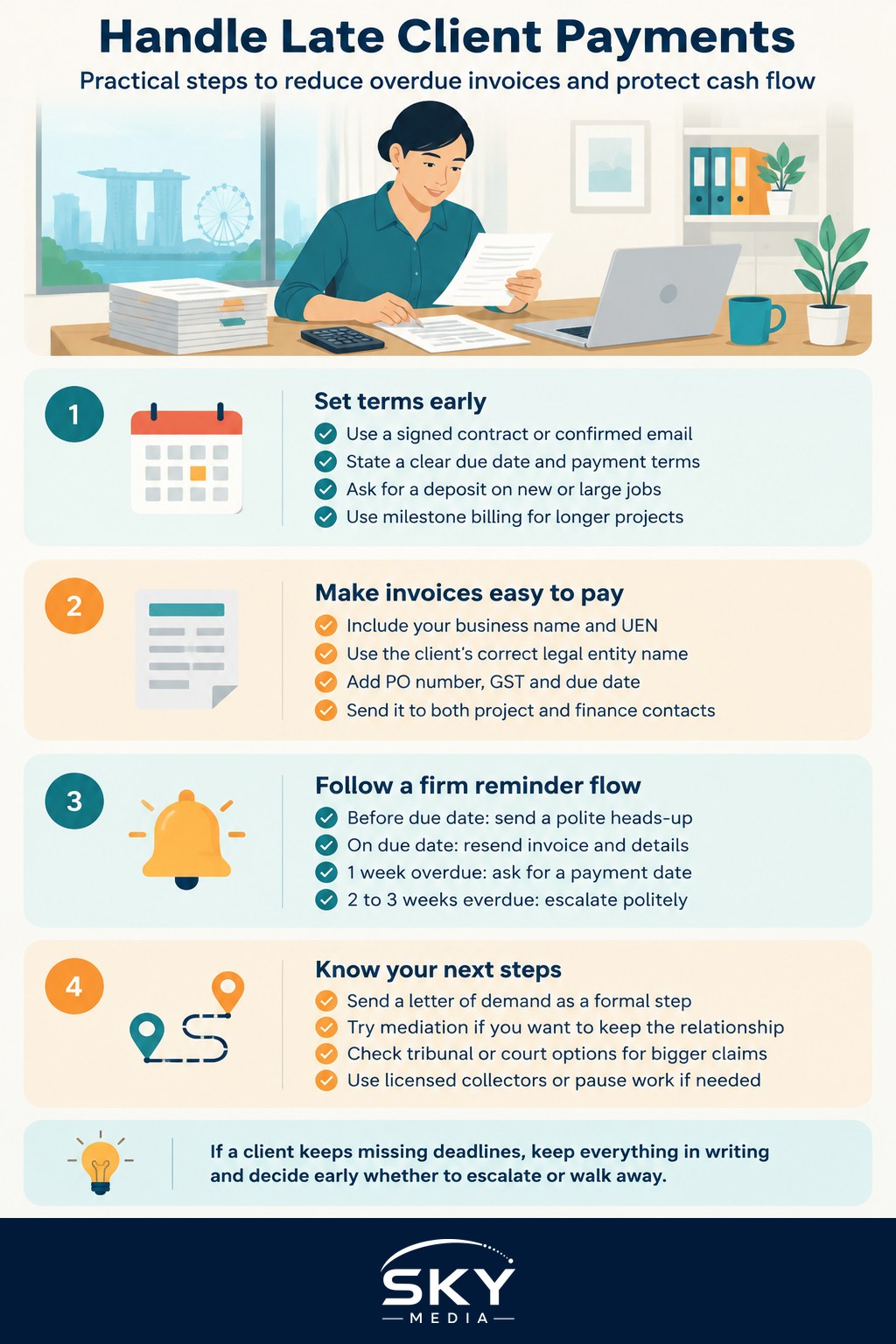
Prevent Late Payment Before You Start Work
The cheapest debt to collect is the one that never becomes overdue. Strong terms agreed upfront give you leverage later.
- Put it in writing. Use a signed contract, a signed quotation or at least a confirmed email setting out scope, price and payment terms. Verbal agreements are hard to enforce.
- Set a clear due date. “Payment within 30 days of invoice date” is better than “Net 30” alone, because it removes ambiguity about when the clock starts.
- Ask for a deposit. For new clients or large projects, a deposit before work starts reduces your exposure and filters out clients who are not committed.
- Use milestone billing. Break long projects into stages, each invoiced on completion, so you never carry the full value of the work unpaid.
- State late payment terms. Your contract can include a reasonable late payment interest clause or an administrative charge, and a right to pause work if invoices are overdue. Get advice on wording if amounts are significant.
- Check the client. For larger contracts, a quick business profile search through ACRA’s Bizfile (the Accounting and Corporate Regulatory Authority’s online registry) confirms the entity is registered and active. Ask peers in your industry about their experience too.
Send Invoices That Are Easy to Pay
Many invoices are paid late simply because they are hard to process. Large organisations often have finance teams that reject invoices missing key details.
Every invoice should include your business name and UEN (Unique Entity Number), the client’s correct legal entity name, a purchase order number if the client uses them, a clear description of the work, the amount, GST details if you are GST-registered, the due date and your payment details such as bank transfer or PayNow.
Send the invoice to the right person. Ask at the start of the engagement who handles accounts payable, and copy both your project contact and the finance contact.
Build a Firm but Friendly Reminder Workflow
A consistent routine stops overdue invoices from slipping through the cracks. Set it up once in your accounting software or calendar, and run it for every client.
- A few days before the due date: a short, polite note confirming the invoice was received and the due date is approaching.
- On the due date: a friendly reminder with the invoice attached again and the payment details.
- One week overdue: a firmer email asking for a payment date, and a phone call to your contact to check if anything is holding it up.
- Two to three weeks overdue: escalate to a more senior contact or the finance head. Mention your contract’s late payment terms and, if relevant, that work may pause.
- One month or more overdue: a final written reminder stating that you will consider formal steps if payment is not received by a specific date.
Keep the tone professional throughout. Many late payers are not acting in bad faith. They may have cash flow problems of their own, an internal approval delay or a lost invoice. If the client is struggling, a written instalment plan can recover more money than a confrontation.
Keep a record of every reminder, call and reply. If you ever escalate, this paper trail matters.
Escalation Options When Reminders Fail
If a client still refuses or ignores you, there are several formal paths. Which one suits you depends on the amount, the relationship and the evidence you have.
| Option | What it involves | Best suited for |
|---|---|---|
| Letter of demand | A formal written demand, sent by you or a lawyer, setting a final deadline | Most unpaid debts, as a first formal step |
| Mediation | A neutral mediator helps both sides reach a settlement, through bodies such as the Singapore Mediation Centre | Disputes where you want to keep the relationship |
| Small Claims Tribunals | A lower-cost court process for smaller contract claims, where parties usually represent themselves | Claims within the tribunal’s limit, which you should check on the Singapore Courts website |
| Civil claim in court | A formal lawsuit, usually with a lawyer | Larger debts or complex disputes |
| Debt collection agency | A third party pursues the debt for a fee or commission | Cases where you prefer to outsource collection |
A few points to keep in mind:
- Letters of demand are often enough. A formal letter shows you are serious, and many clients pay at this stage.
- The Small Claims Tribunals have claim limits and time limits for filing, and certain types of claims are excluded. Check current rules and fees on the Singapore Courts website before you file.
- Construction industry payments have their own framework under the Building and Construction Industry Security of Payment Act, which provides a faster adjudication process for payment claims. If you work in construction, check whether it applies to you.
- Debt collection agencies in Singapore are regulated, so choose a licensed agency and make sure their methods are lawful.
- Legal costs can outweigh the debt for small amounts. Weigh the time, fees and stress against what you are likely to recover.
Protect Your Cash Flow While You Wait
Even with good processes, some invoices will be paid late. Plan for it rather than hoping it will not happen.
- Keep a cash buffer covering at least a few months of fixed costs.
- Track your average days to payment by client, and adjust terms for slow payers.
- Avoid relying on one big client for most of your revenue.
- Consider invoice financing if your bank offers it, but compare costs carefully.
- Review your own owner’s draw. If you are a company director, how you pay yourself affects how much buffer stays in the business, as our guide to paying yourself through salary or dividends explains.
When to Walk Away From a Client
Sometimes the best outcome is to collect what you can and stop working with a client. Warning signs include repeated late payments despite reminders, constant disputes about scope after delivery, or requests for more work while old invoices remain unpaid.
Replacing a difficult client is easier when you have a steady pipeline. If you are a solo operator, our guide to finding clients as a freelancer in Singapore covers ways to build one.
Late payment in Singapore is frustrating, but it is manageable. Clear terms, professional invoices, a consistent reminder routine and a known escalation path put you back in control of your cash flow.
Further reading: Chargebacks in Singapore and How Businesses Handle Them