
If you have just moved here, you may have heard that Singapore is strict about everything, and wondered whether holding hands or kissing your partner at the MRT station could get you into trouble. The short answer is that ordinary affection is not illegal. The longer answer is that there are two separate questions: what the law covers, and what most people around you consider comfortable. This guide explains PDA Singapore law in plain terms, then walks through the social side so you can relax and enjoy life here with your partner.
This is general information, not legal advice. Laws can change, so check official sources such as Singapore Statutes Online or speak to a lawyer if you have a specific concern.
What the Law Actually Covers
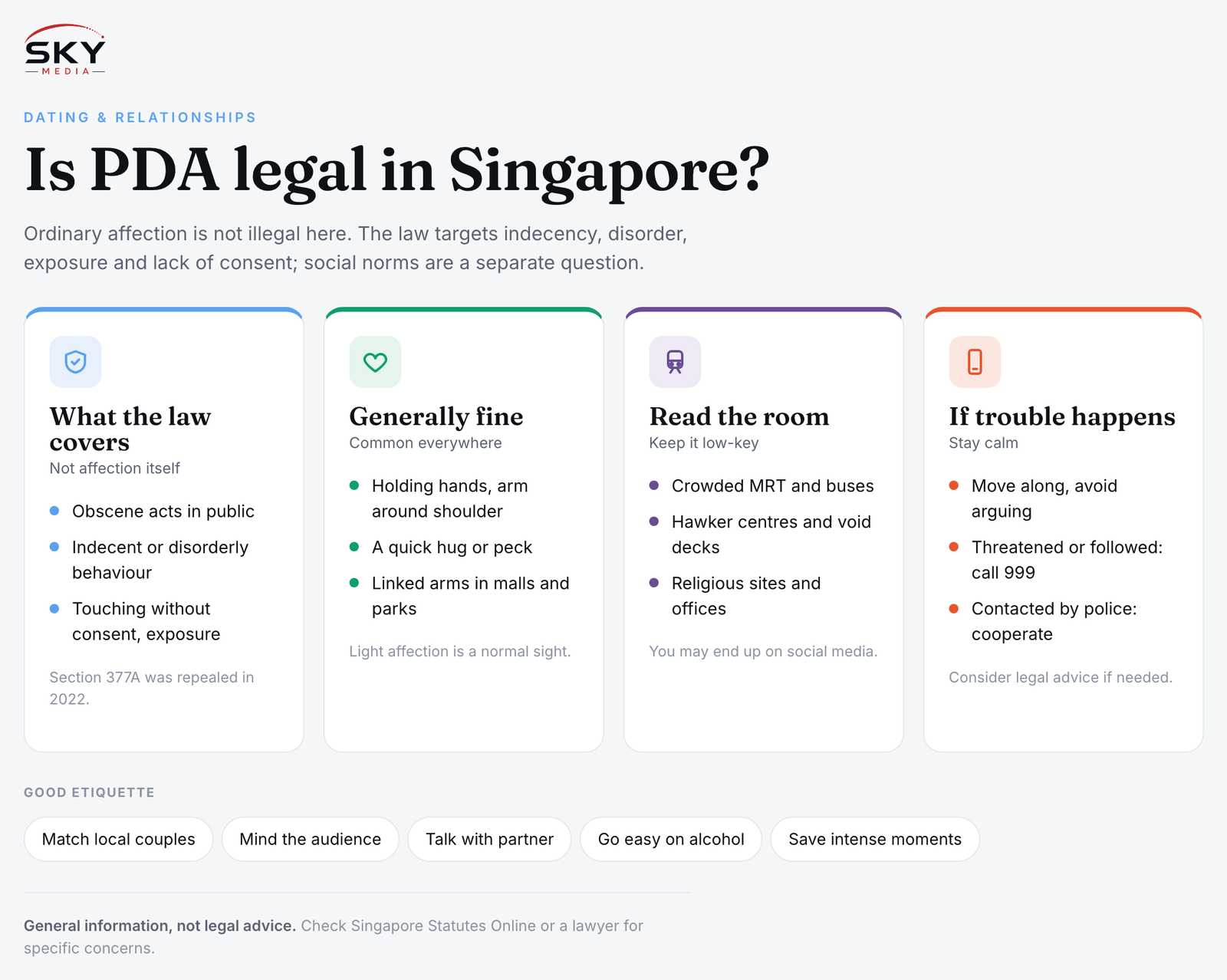
Singapore does not have a law that bans couples from holding hands, hugging or kissing in public. What the law does address is conduct that crosses into indecency, disorder or harm to others. In broad terms:
- Obscene acts in public. The Penal Code makes it an offence to do an obscene act in or near a public place to the annoyance of others. This is aimed at sexual acts and exposure, not a goodbye kiss.
- Indecent or disorderly behaviour. The Miscellaneous Offences (Public Order and Nuisance) Act covers behaviour in public that is indecent, riotous or disorderly. Again, the focus is on conduct that goes well beyond normal affection.
- Consent and harassment. Touching someone without their consent, or behaving in a way that alarms or distresses them, can be an offence under the Penal Code or the Protection from Harassment Act. Affection must always be welcome, including from a partner.
- Nudity and exposure. Being indecently exposed in a public place, or in a private place where you can be seen by the public, can also be an offence. This includes some situations people do not expect, such as being visible from a neighbour’s window.
The details of each offence, including penalties, are set out in the legislation. The point for most couples is simple: affection that would not make a reasonable passer-by uncomfortable is very unlikely to be a legal issue.
Same-sex couples are covered by the same general public order and indecency laws as everyone else. Section 377A of the Penal Code was repealed in 2022. Social attitudes still vary, which is covered below.
For a wider picture of how laws are made and enforced here, see our guide to Singapore’s legal system explained.
Legal vs Socially Acceptable: A Quick Comparison
Something can be completely legal and still draw stares. This table sets out how common behaviours generally land, though reactions vary from person to person and place to place.
| Behaviour | Legal position (general) | How most people react |
|---|---|---|
| Holding hands, arm around the shoulder | Not an offence | Completely normal everywhere |
| A quick hug or peck on the lips | Not an offence | Fine in most places, including MRT and malls |
| Extended kissing or making out | Not usually an offence on its own | Often seen as awkward, especially on public transport |
| Sitting on a partner’s lap in a crowded space | Not usually an offence on its own | Commonly seen as inconsiderate |
| Groping, sexual acts or exposure in public | Can be an offence | Unacceptable, may be reported to police |
Social Norms Most Singaporeans Share
Singapore is a multicultural, multi-religious society, and many people are fairly reserved about affection in public. That does not mean anyone expects couples to act like strangers. Hand-holding, linked arms and a quick kiss are common sights in malls, parks and at the airport.
What tends to draw disapproval is prolonged or intense affection, especially:
- On public transport. Trains and buses are crowded, and people cannot easily move away. Many commuters find long kissing sessions uncomfortable.
- In family spaces. Hawker centres, playgrounds, void decks and neighbourhood malls are full of children and older residents.
- At religious sites. Temples, mosques and churches are places of worship. Keep affection to a minimum and follow any dress and behaviour guidance at the entrance.
- At work and formal settings. Office culture is generally professional, and colleagues may feel awkward.
People here rarely confront strangers directly. Instead, you might notice looks, or occasionally find a photo of yourself circulating on social media. That is worth knowing, because a moment you thought was private can end up online. Our guide on whether it is legal to photograph strangers in public explains the rules around being photographed.
Advice for Newcomers and Different Backgrounds
Newcomers come from very different starting points. Some are used to more open affection, as in parts of Europe, Australia or the Americas. Others come from places that are more conservative than Singapore. A few tips help either way:
- Read the room. Look at how other couples around you behave in that particular place, and match the general level.
- Think about the audience. Near schools, hospitals, places of worship and family events, keep it low-key.
- Talk with your partner. You may each have different comfort levels, which is completely normal. If this is a source of friction, our guide on how to handle unequal desire for public displays of affection has ideas for finding a middle ground.
- Be mindful of alcohol. Late-night areas can get rowdy, and behaviour that feels fun after a few drinks can tip into disorderly conduct.
- Same-sex couples. Many people in Singapore are accepting, but attitudes vary. Most couples find that hand-holding and light affection are fine in central areas, and they use their own judgement elsewhere, as many couples of all kinds do.
For mainland Chinese newcomers, norms here will feel broadly familiar to many big cities in China: holding hands and light affection are fine, while heavy kissing in crowded places is seen as poor manners rather than a crime.
What to Do If You Feel Harassed or Are Reported
Occasionally, someone may object loudly or film you. If that happens:
- Stay calm and avoid arguing in public. Simply move along if you feel uncomfortable.
- If you are threatened, followed or harassed, call the police. In an emergency, call 999.
- If you are contacted by the police about an incident, cooperate politely and consider getting legal advice. Our guide to getting legal help and legal aid in Singapore explains where to start, including community legal clinics.
- If photos of you are shared online without your consent in a way that causes distress, you may have options under harassment laws. A lawyer can advise on your situation.
The Takeaway on PDA in Singapore
Affection itself is not against the law in Singapore. The legal lines are about indecency, disorder, exposure and lack of consent, and ordinary couples are very unlikely to come near them. The social lines are softer but still worth respecting: keep it light in crowded and family spaces, take extra care at religious sites, and save the intense moments for private. Do that, and you will fit in comfortably wherever you go.
Further reading: Age of Consent and Dating Laws in Singapore Explained