

Grand romantic gestures make lovely memories, but they are not what holds a relationship together. What quietly keeps two people feeling loved is the small stuff: the good-morning text, the hand on the shoulder, the cup of kopi made without being asked. Showing affection in everyday life is less about big occasions and more about a steady stream of little moments that say, “I am thinking of you.” This is friendly, general guidance for couples, not therapy or professional advice, and it is meant to be adapted to whatever fits your relationship.
In Singapore, where many couples both work long hours and see each other most in the tired gaps of the day, these small habits matter even more. The good news is they cost nothing and take seconds.
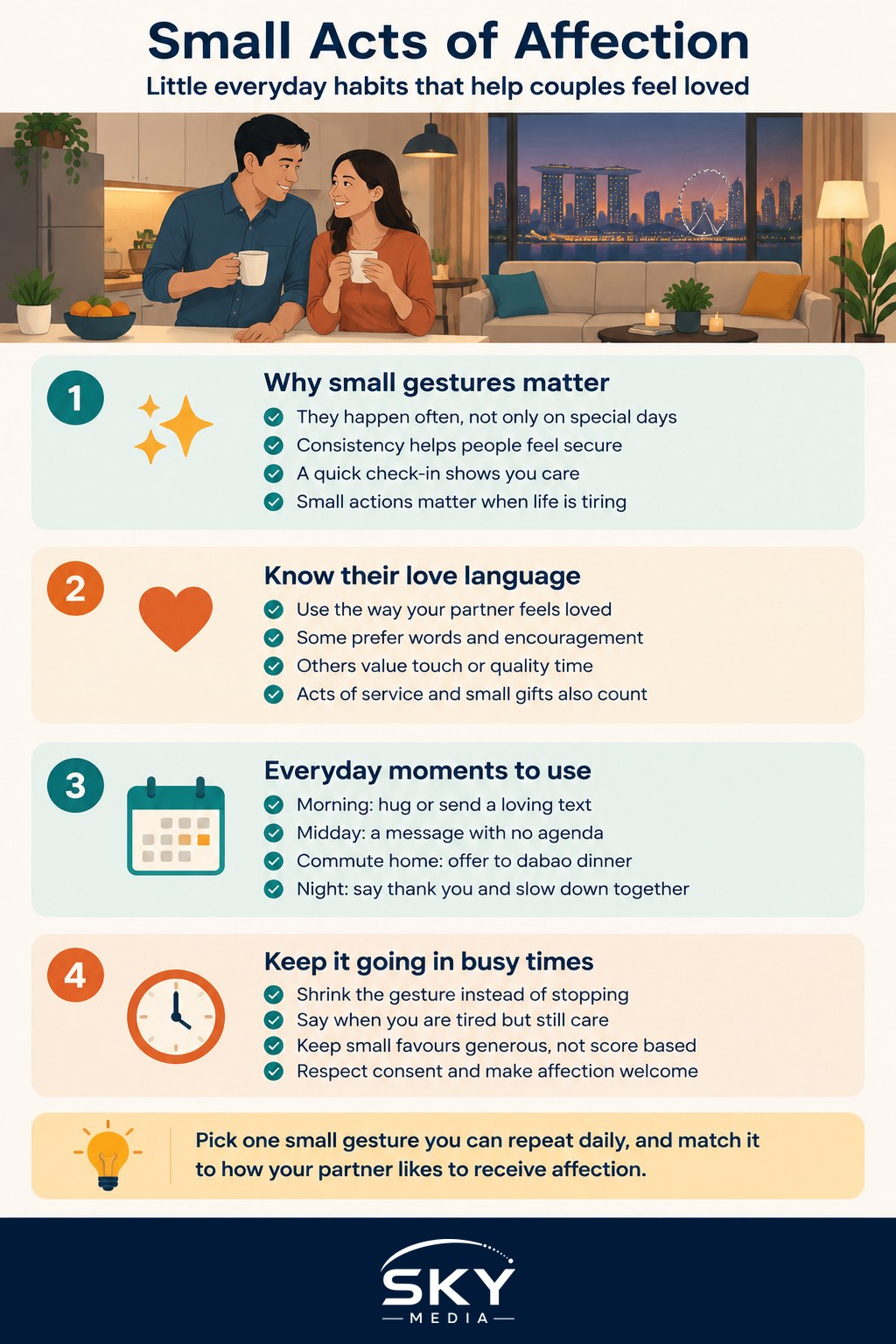
Why Small Gestures Matter More Than Big Ones
It is easy to assume love is proven through anniversaries, expensive dinners or holidays. Those are wonderful, but they are rare. Affection lives in the ordinary hours in between, and that is where a relationship is really built or slowly starved.
Small, frequent gestures work because they are consistent. A partner who feels noticed a dozen times a week, in tiny ways, feels far more secure than one who waits months for a single big event. Frequency beats size. A quick “text me when you reach home safe” or a warm hug at the MRT gate lands as care, again and again.
There is another reason. When life gets stressful, and in Singapore it often does, affection is usually the first thing to quietly drop off the to-do list. Couples stop reaching for each other, not out of anger but out of tiredness. Keeping small gestures alive protects your bond precisely when you are too busy to plan anything grand. If romance has faded after a long stretch together, our guide on keeping romance alive after years together offers gentle ways to rebuild it.
Speak Your Partner’s Love Language
People give and receive affection differently, and mismatches are common. You might leave loving notes while your partner just wants ten unhurried minutes of your attention. Both are affection; they are simply different dialects. Learning your partner’s preferred way of feeling loved, rather than only offering your own, is one of the kindest skills in a relationship.
Broadly, affection tends to show up in a few forms:
- Words: genuine compliments, encouragement, a heartfelt “thank you”, or a text in the middle of a hard day.
- Touch: holding hands on the bus, a hug, a shoulder squeeze, sitting close on the sofa.
- Acts of service: topping up their EZ-Link card, packing their lunch, handling a chore they dread.
- Quality time: a phone-free supper, a walk around the neighbourhood, really listening to how their day went.
- Small gifts: their favourite kaya toast on the way home, a snack they mentioned once, a flower stall pick.
You do not need to master all of these. Learn which one or two make your partner feel most cherished, and lean into those. Different people also have different intimacy needs, so it is worth asking rather than assuming. Being emotionally present matters too, and our piece on emotional availability explores how to truly show up.
Everyday Ways to Show Affection
Affection thrives on habit. The trick is to attach small gestures to things you already do, so they become automatic rather than another task. Here are ideas woven through an ordinary Singapore day.
- Morning: a proper hug before you both rush out, or a short “have a good day, I love you” text once you reach the office.
- Midday: a quick message with no agenda, just “thinking of you” or a funny photo. It reminds them they are on your mind.
- Commute home: ask if they want you to dabao their favourite dinner, so they come home to a small comfort.
- Evening: put the phone face down for the first fifteen minutes together and actually ask about their day, then listen without fixing.
- Night: a genuine thank you for one thing they did, and a moment of closeness before sleep.
None of this takes planning or money. It takes attention. Keeping physical intimacy alive grows naturally from this kind of steady, everyday warmth, and small acts of appreciation make your partner feel truly seen.
The table below shows how ordinary moments can become chances to connect instead of passing you by.
| Everyday moment | Missed chance | Small way to show affection |
|---|---|---|
| Waking up | Reaching for the phone first | A quick cuddle or “morning, I love you” before you scroll |
| Eating together | Both on separate screens | Ask one real question about their day and listen |
| Partner had a rough day | “At least it’s over now” | “That sounds tough. I’m here, tell me about it.” |
| Passing in the kitchen | Walking straight by | A hand on the back, a squeeze, a quick kiss |
| Running errands | Going solo out of habit | “Come with me, we can grab kopi after” |
Keeping Affection Alive Through Busy Seasons
Every couple hits stretches where affection is hard to sustain, whether it is a crushing work project, exam season, National Service, or the exhausting early months with a newborn. Closeness naturally dips, and that is normal, not a failure. If you have recently become parents, keeping your bond strong takes extra intention, which we cover in keeping your relationship strong after a baby.
During these seasons, shrink the gesture rather than dropping it entirely. A ten-second hug still counts when a date night is impossible. Say out loud, “I am stretched thin right now, but I still love you,” so your partner reads your tiredness as tiredness and not as coldness. Trade small favours generously without keeping score. And remember that affection should always feel welcome; a good gesture reads the room, respects consent, and never turns into pressure.
If, despite genuine effort, one of you feels persistently unloved, lonely or shut out, it is worth talking honestly and, if needed, seeking support rather than letting resentment settle. A neutral space can help, and our guide on when to consider couples counselling can help you weigh it up. Family Service Centres around Singapore offer help too.
Please also look after yourself. If your mood has been low or everything feels like too much, mindline (1771) offers mental-health support and SOS (1767) is there in distress. And if affection is ever replaced by control, fear or pressure, that is not love; it is not your fault, and you can reach the National Anti-Violence and Sexual Harassment Helpline on 1800-777-0000, or call the Police on 999 in an emergency.
Most of the time, though, showing affection is simply a habit of noticing and reaching out. Start with one small gesture today. Do it again tomorrow. Over the weeks and years, those tiny moments become the quiet, unshakeable proof that you are loved.
Related across Sky Media: Reusable Swaps for Everyday Life