
Street photography is everywhere in Singapore: hawker centres at lunch, commuters on the MRT, uncles playing chess at void decks, crowds at festival light-ups. Sooner or later, every street shooter asks the same question. Is it legal to photograph strangers in public in Singapore? If you have searched “photograph strangers legal singapore”, the short answer is that taking photos of people in ordinary public places is generally not illegal, but there are clear legal red lines, rules for specific places, and strong courtesy norms that matter just as much.
This article is general information, not legal advice. Laws change, and the facts of each situation matter. If you are unsure about a particular case, speak to a lawyer. Our guide to getting legal help and legal aid in Singapore explains where to start.
The General Position: Public Places and Expectations
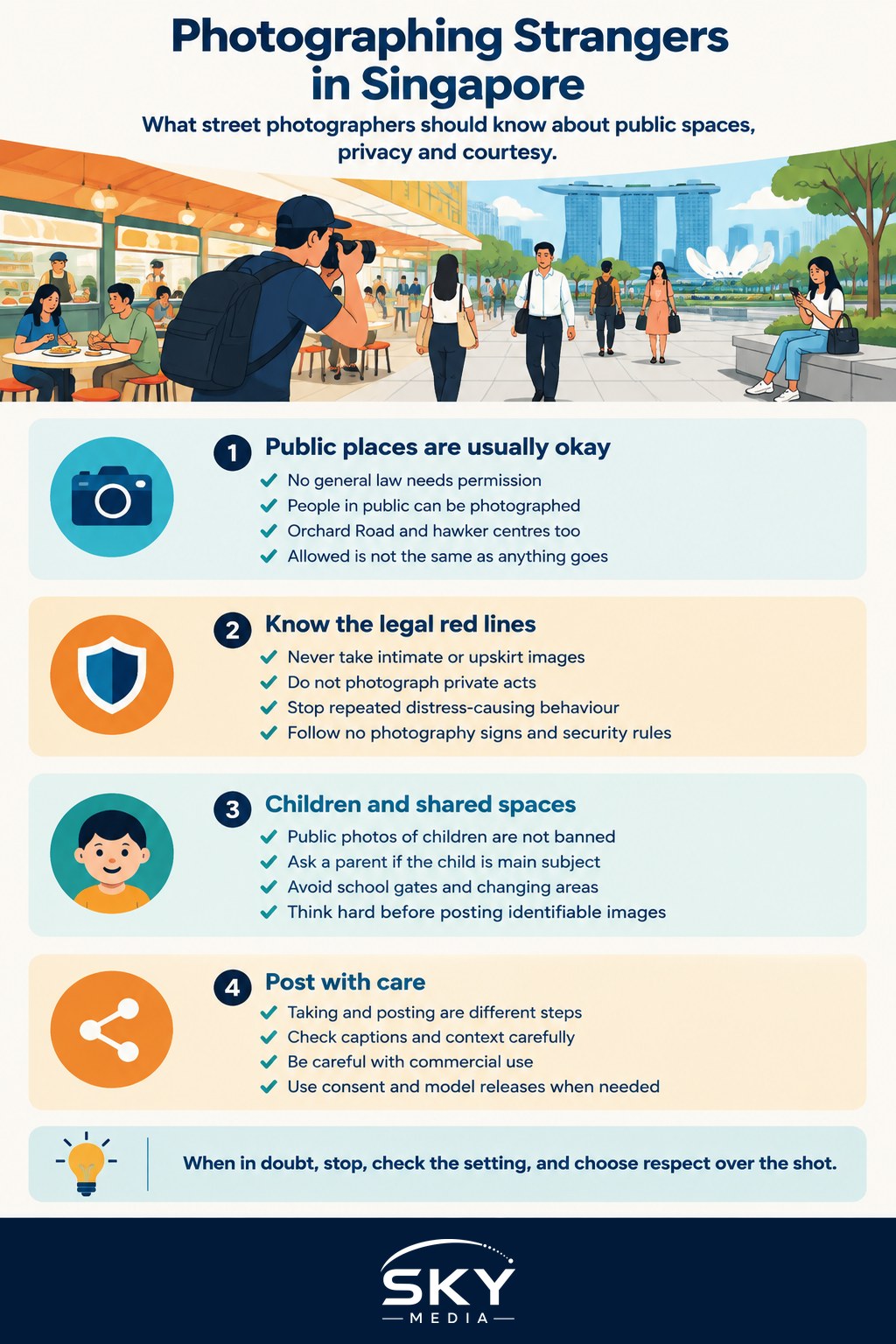
Singapore does not have a general law that requires you to get permission before photographing someone in a public place. Many people are surprised by this, especially if they have heard about strict privacy rules elsewhere. In practice, people walking down Orchard Road or eating at a hawker centre can be captured in photos, whether by street photographers, tourists or CCTV.
That said, “generally allowed” is not the same as “anything goes”. The law steps in when photography becomes intrusive, harassing, sexual or connected to security, and private property owners can set their own rules. Social expectations in Singapore also lean towards politeness and discretion.
What the PDPA Does and Does Not Cover
Many people assume the Personal Data Protection Act (PDPA) stops them from taking photos of strangers. The PDPA governs how organisations, such as businesses and other bodies, collect, use and disclose personal data. A clear photo of a person’s face can be personal data.
However, the PDPA generally does not apply to individuals acting in a personal or domestic capacity. If you are a hobbyist taking street photos for your own enjoyment or personal social media, the PDPA is usually not the law that governs you.
The picture changes when photography is done by or for an organisation:
- A company shooting marketing material at an event usually needs to think about notices and consent under the PDPA.
- A freelance photographer hired by a business may be acting on the business’s behalf.
- Using a recognisable person’s image to sell a product raises separate questions about consent and model releases.
The Personal Data Protection Commission (PDPC) publishes guidance on photography and video, so check its official website for the current position if you shoot for a business.
The Legal Red Lines Every Street Photographer Should Know
Even in public, some photography is clearly against the law. The table below summarises the main areas. It is a simplified overview, not a full statement of the law.
| Situation | Why it matters | Practical takeaway |
|---|---|---|
| Intimate or upskirt images, or photos of people in private acts such as using a toilet or changing | The Penal Code has specific voyeurism offences, with serious penalties | Never photograph anyone in these situations, under any circumstances |
| Repeatedly following, photographing or posting about someone to cause distress | The Protection from Harassment Act (POHA) covers harassment, including some online conduct | Stop if someone objects; never single out a person repeatedly |
| Protected areas and places, such as some military and security sites | The Protected Areas and Protected Places Act and related rules can prohibit photography | Obey “no photography” signs and leave if asked by security staff |
| Private property, such as malls, condos and some attractions | Owners can set conditions for entry, including photography rules | Check signage and ask management before serious shoots |
| Using someone’s image to imply endorsement or to defame them | Defamation and other laws can apply depending on how the image is used | Be careful with captions and context, not just the photo |
Pay special attention to “no photography” signs. In Singapore, they are not merely suggestions at government or security-related sites, and arguing with security officers is never a good idea.
Photographing Children
Photographing children in public is not automatically illegal, but it is an area where you should be especially careful. Parents in Singapore are, understandably, protective, and a stranger taking pictures of a child at a playground can cause real worry.
Good practice includes:
- Asking a parent or guardian before photographing a child as the main subject.
- Avoiding photos in sensitive places such as school gates, changing rooms or swimming pools.
- Thinking twice before posting identifiable images of children online, even if they were taken legally.
Courtesy Norms for Street Photography in Singapore
The law sets the minimum standard. Courtesy is what keeps street photography welcome. Many experienced street shooters in Singapore follow informal habits like these:
- Respect a “no”. If someone waves you off, covers their face or asks you to delete a photo, it is usually best to delete it, even if you were legally allowed to take it.
- Be open, not sneaky. Carrying your camera visibly and making eye contact tends to make people more relaxed than hiding a long lens.
- Mind vulnerable moments. Avoid photographing people who are injured, distressed, grieving, or sleeping rough, and think hard about whether a shot is respectful.
- Respect religious spaces. At temples, mosques, churches and during religious processions, follow posted rules and ask before photographing worshippers.
- Watch workers at work. Hawkers, cleaners and other workers are often happy to be photographed if you ask, chat a little and perhaps buy something. Shooting them without a word can feel like you are treating them as scenery.
- Do not block the way. On narrow pavements, MRT platforms and hawker centre aisles, keep movement flowing and never use a tripod where it is a hazard.
- Offer to share. Many photographers offer to send a copy to their subject, which builds goodwill.
Posting and Publishing Your Street Photos
Taking a photo and publishing it are two different steps. Before posting a photo of an identifiable stranger online, ask yourself:
- Would this person be embarrassed or put at risk if they saw this online?
- Does the caption make claims about them that you cannot support?
- Are you using the photo for anything commercial, such as advertising or stock sales?
For personal and artistic posts, context and kindness are your main guides. For commercial use, model releases and consent become important, and you should check the relevant rules or get advice before selling or licensing photos of recognisable people.
A Simple Rule of Thumb
If you are photographing ordinary public life in an open, respectful way, you are generally on safe ground. Stay well clear of anything intimate, harassing or security-related, follow property and venue rules, and treat a stranger’s discomfort as a reason to stop. For a broader understanding of how laws are made and enforced here, see Singapore’s legal system explained. And if you prefer subjects that never object, try our guide on how to photograph the moon.
Further reading: How to Photograph Thaipusam Respectfully in Singapore