

Switching careers mid-way is common now, but the question of how to prove you can do the new job is still hard. A short online course may not carry enough weight, and a full master’s degree can feel like too big a commitment. For many people, a graduate diploma Singapore institutions offer sits in a useful middle ground: substantial enough to signal serious retraining, short enough to finish while working.
This guide looks specifically at the graduate diploma as a reskilling credential for people who already have a degree or significant work experience. It covers what the qualification is, how it compares with other options, how to choose a programme and what to check about funding. Course details, fees and funding rules change, so confirm everything with the institution and the Skills and Workforce Development Agency (SWDA, formed in 2026 from Workforce Singapore and SkillsFuture Singapore) before you enrol.
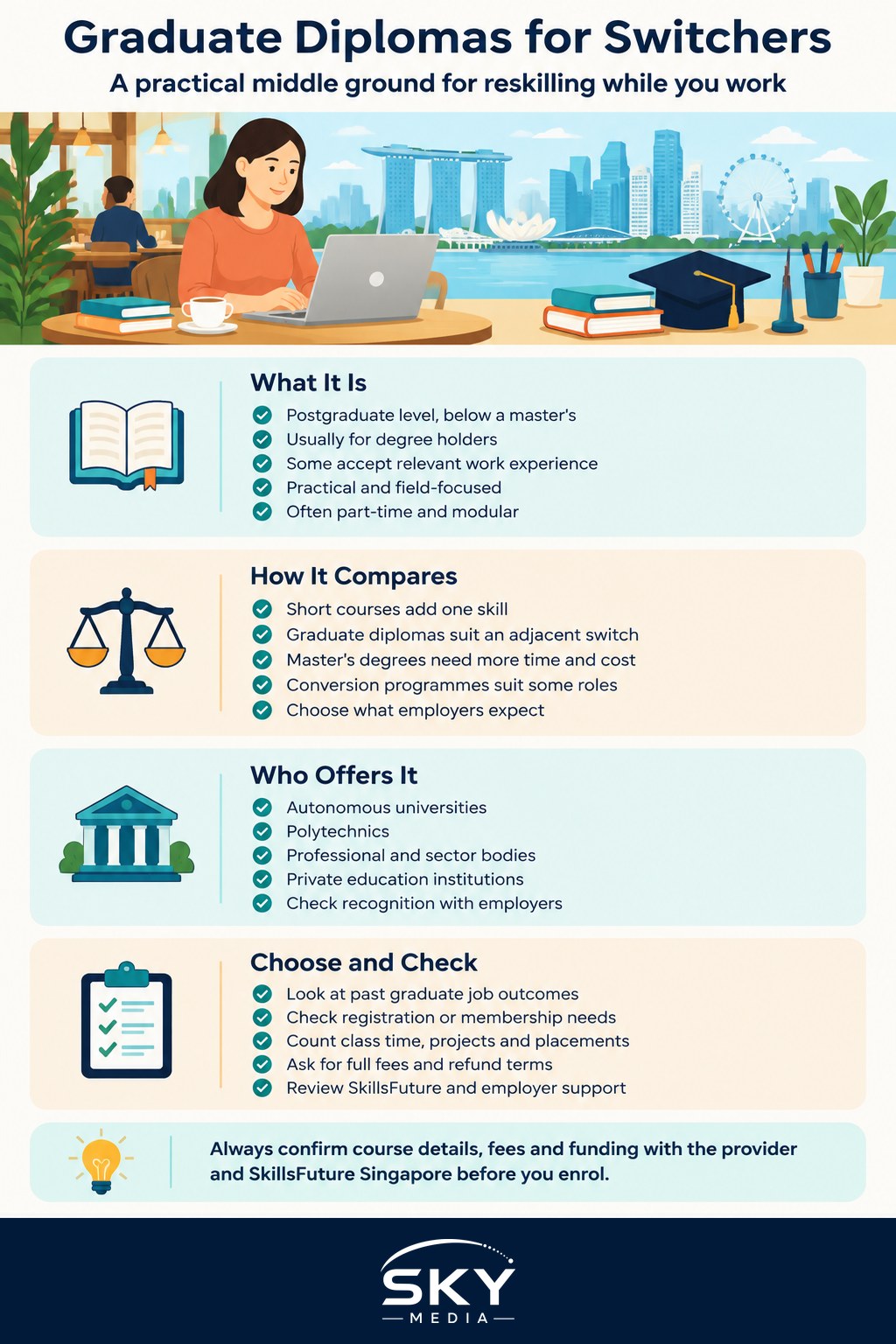
What a Graduate Diploma Is
A graduate diploma is a postgraduate level qualification that usually sits above a bachelor’s degree but below a master’s. It is generally designed for people who already hold a degree, although some programmes also consider applicants with relevant work experience. Programmes tend to be:
- Focused. They concentrate on one professional field, such as data analytics, human resources, counselling, education, logistics or project management.
- Practical. Many are built around workplace application, case studies and projects rather than pure theory.
- Part-time friendly. Evening, weekend or blended formats are common, with modular structures you can take in sequence.
- Stackable in some cases. Certain programmes let you count completed modules towards a related master’s degree later. Check this carefully if it matters to you, since it varies widely.
You may also see “postgraduate diploma” used for similar qualifications, and “specialist diploma” for programmes offered by polytechnics, which are often aimed at diploma or degree holders wanting deeper skills in a technical area.
How It Compares With Other Reskilling Routes
The best credential depends on how far you are switching and what employers in your target field expect. This comparison gives a general picture.
| Option | Typical commitment | Best for | Main limitation |
|---|---|---|---|
| Short course or microcredential | Days to weeks | Adding one skill to your current role | May not convince employers of a full switch |
| Graduate diploma | Several months to around a year or more, often part-time | Moving into an adjacent field with structured grounding | Less depth and recognition than a master’s |
| Master’s degree | One to two years or longer | Fields where a master’s is the expected entry standard | Higher cost and time commitment |
| Structured conversion programmes | Varies | Switchers with an employer lined up | Limited to participating roles and sectors |
For many career switchers, the graduate diploma hits a sweet spot when the new field values formal training, such as counselling, education, supply chain or HR, but does not insist on a master’s for entry roles.
Who Offers Graduate Diplomas
In Singapore, graduate diplomas are commonly offered by:
- Autonomous universities and their continuing education arms. Several local universities run lifelong learning units with part-time graduate certificates and diplomas for working adults.
- Polytechnics. These typically offer specialist diplomas and post-diploma certificates, often with strong industry links.
- Professional and sector bodies. Some fields have programmes linked to professional recognition or membership.
- Private education institutions. Many partner with overseas universities. If you consider one, check its registration status with the Committee for Private Education, part of SWDA, and confirm who actually awards the qualification.
Whatever the provider, check whether employers and professional bodies in your target field recognise the specific qualification. A quick look at job ads in your new field, or a conversation with a hiring manager, can be more telling than a brochure.
How to Choose the Right Programme
Use these questions to narrow your shortlist.
- Does it lead where you want to go? Look at the job titles past graduates moved into. Ask the provider for real examples, not just general claims.
- Is it recognised by the relevant body? For regulated or professionalised fields, check whether the qualification meets their requirements for registration, accreditation or membership.
- What does the timetable really demand? Count contact hours, assignments and any practicum or placement. A placement is valuable for switchers but may need daytime availability.
- Who teaches it? Practitioner lecturers can open doors to networks in your new field.
- What are the entry requirements? Some programmes need a degree in any discipline; others need related experience or prerequisite modules.
- What does it cost in total? Ask for the full fee breakdown, including any application, material or exam fees, and the refund policy if you need to withdraw.
Funding and Support to Check
Singapore has several forms of support for adult learners, though eligibility depends on the course, your citizenship and your age, and schemes are updated over time.
- SkillsFuture Credit. Singapore Citizens can use their credit for eligible courses. Check on the MySkillsFuture portal whether your chosen programme is listed and how much can be offset.
- Course fee subsidies. Some programmes funded by SWDA or the Ministry of Education carry subsidies for eligible Singapore Citizens and Permanent Residents. The provider can tell you whether its programme qualifies.
- Mid-career support. There have been additional schemes for mid-career workers. Check the latest options on the SkillsFuture website, as these change with national budgets.
- Employer sponsorship. Your current employer may sponsor training that also benefits them, often with a service commitment. Read any bond terms before signing.
If you are not a Singapore Citizen, check whether you are eligible for subsidies and whether your pass conditions affect part-time study. Contact the institution and the relevant authority if unsure.
Making the Switch Work
A graduate diploma is a tool, not a guarantee. Switchers who succeed usually combine the qualification with deliberate career moves:
- Start networking in the new field while you study, through class projects, industry talks and alumni.
- Use assignments to build a portfolio of real work you can show employers.
- Look for internships, volunteer roles or part-time projects that give you relevant experience.
- Rewrite your CV to connect your previous experience with your new direction, rather than starting from zero.
For broader planning, see our guide to switching careers in Singapore, and consider whether career coaching could help you test your direction before committing. If you are still deciding between qualification levels, choosing between a diploma and a degree explains how the different credentials fit together.
Further reading: Postgraduate Diplomas in Singapore Explained Clearly · Specialist Diplomas at Polytechnics for Working Adults