
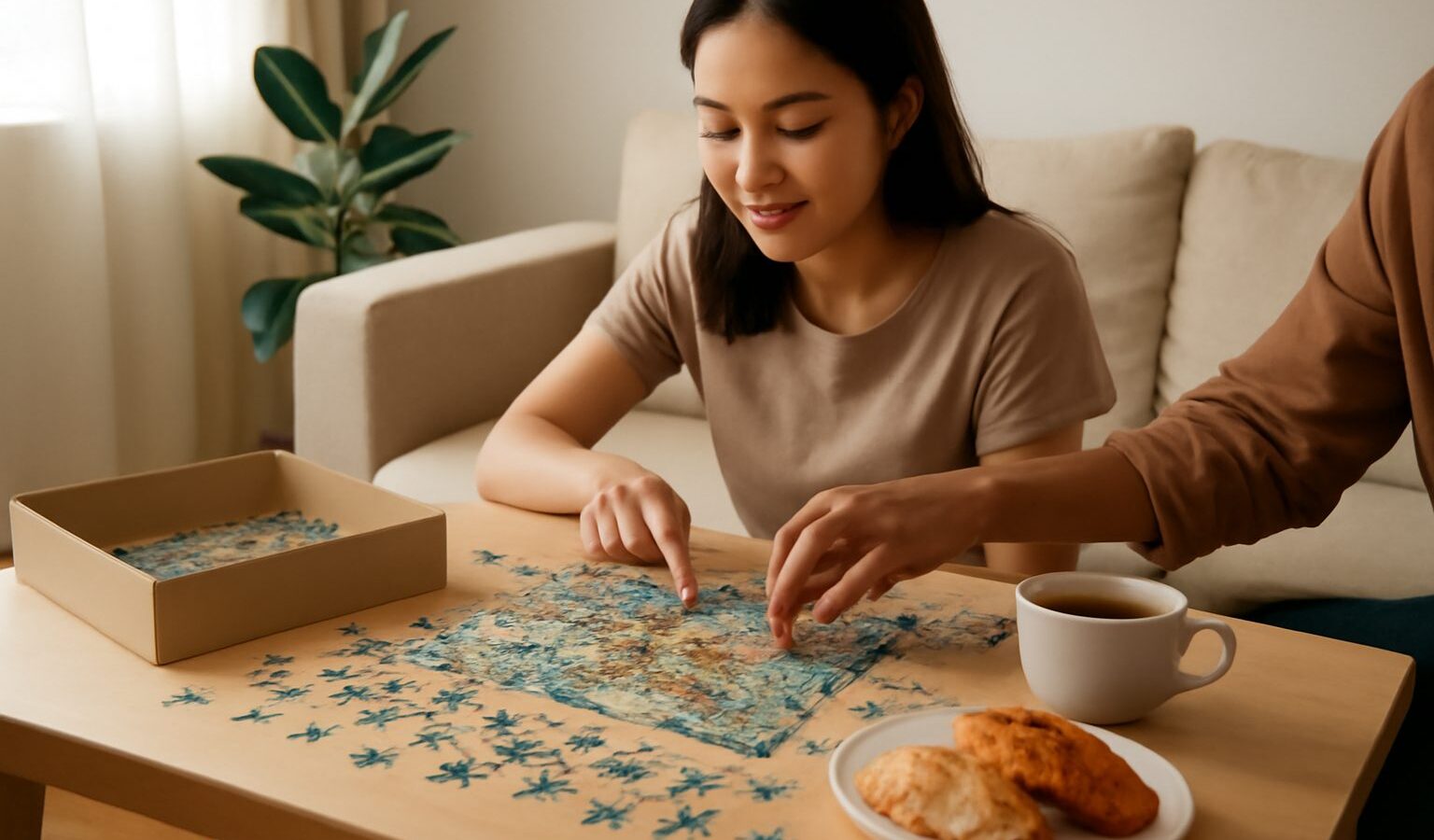
There is something quietly satisfying about tipping out a box, turning every piece face up, and slowly watching a picture appear. Jigsaw puzzles are one of the easiest hobbies to start in Singapore: no lessons, no club membership, and no expensive kit. You can begin this weekend with a single box from a nearby shop and a clear patch of table. This guide walks a total beginner through choosing a puzzle, the few bits of gear that help, and how to keep the hobby going in our warm and humid climate.
Puzzling is also gentle on small-space living. You do not need a studio or a garage, just a flat surface and a little patience. It suits quiet evenings, rainy afternoons, and shared family time, and it is a lovely screen-free way to unwind after a long day.
Why Jigsaw Puzzles Make a Great Hobby
A jigsaw puzzle rewards calm, steady attention. It is one of the few pastimes where slowing down is the whole point. Many people find it meditative: the mind settles as your hands sort, test, and place pieces one by one.
- Low barrier to entry. One box is enough to start, and you can begin the moment you get home.
- Flexible pace. Do ten minutes or two hours; leave it and come back later.
- Sociable or solo. Puzzle alone for quiet focus, or gather friends and family around a big one.
- All ages welcome. Grandparents and children can share the same table.
- Screen-free rest. A calming break from phones and notifications.
The sense of a small win, that click when a stubborn piece finally fits, keeps you coming back. Finish a puzzle and you feel you have made something, even if you break it apart the next week.
Choosing Your First Puzzle
The two things that shape difficulty are the piece count and the image. As a beginner, both matter more than the brand.
Piece count. A 300 to 500 piece puzzle is a friendly starting point: big enough to feel like an achievement, small enough to finish in a sitting or two. A 1000 piece puzzle is the classic adult size and a natural next step once you have the basics. Larger puzzles of 2000 pieces and beyond are for later, when you have the table space and the patience to match.
The image. Pictures with lots of variety, distinct objects, bold colours and clear areas are far easier than large expanses of one shade. A blue sky, a plain beach, or a bowl of similar-coloured sweets can be brutal for a first try. Look for scenes with buildings, animals, or busy markets where each region looks different.
Piece quality. Well-made puzzles have a firm click, minimal “puzzle dust”, and little false-fitting, where wrong pieces seem to slot together. Trusted puzzle brands tend to be more consistent, but plenty of budget puzzles are perfectly good for learning.
Here is a rough guide to matching a puzzle to your experience. Prices vary widely, so always check the shop for current figures.
| Piece count | Best for | Typical time | Table space |
|---|---|---|---|
| 300 to 500 | Total beginners and children | An afternoon | Small, a coffee table works |
| 1000 | Most adult hobbyists | A few sittings | Medium, a dining table |
| 1500 to 2000 | Confident puzzlers | Over a week or more | Large, a dedicated surface |
| 3000 plus | Patient enthusiasts | Weeks | Very large, ideally a puzzle board |
What You Need to Start
Honestly, very little. A puzzle and a table will do. That said, a few inexpensive extras make the hobby much more comfortable, especially in a flat where the dining table doubles as everything else.
- A puzzle mat or board. A roll-up felt mat lets you tidy the puzzle away between sessions without breaking it up, which is a lifesaver when you need the table for dinner. A rigid board does a similar job.
- Sorting trays. Shallow trays, or even reused food containers and box lids, help you group edge pieces and colours.
- Good lighting. A bright, even light reduces eye strain and helps you read subtle colour differences.
- A little patience with yourself. Starting with the border and sorting by colour are habits, not rules. Find what you enjoy.
You can assemble all of this cheaply. Reused containers, a spare bedsheet under the pieces, and the main ceiling light are enough to begin. Upgrade only once you know you love the hobby.
Where to Buy Puzzles in Singapore
You are never far from a puzzle here. For browsing in person, Popular and other bookshops carry a steady range, Spotlight stocks puzzles alongside craft supplies, and Daiso is a great low-cost way to try smaller puzzles without much outlay. Art Friend and general toy shops are worth a look too, and department stores often have a shelf or two.
Second-hand is a smart, thrifty route. Carousell and community “buy nothing” or thrift groups often have gently used puzzles going cheaply or free. Just accept that a pre-owned puzzle may be missing a piece, which is part of the deal.
For the widest choice, especially larger sizes and specific artwork, online marketplaces and dedicated hobby sellers ship across Singapore. Libraries and some community centres also run puzzle corners or lending, so ask at your nearest branch if you would rather borrow before you buy.
Caring for Puzzles in a Humid Climate
Our tropical humidity is the one real enemy of cardboard puzzles. Damp air can make pieces swell, warp, or grow spots of mould, and it can weaken that satisfying click over time.
- Store boxes off the floor and away from damp walls. A shelf in an air-conditioned or well-ventilated room is ideal.
- Add a desiccant. Pop a silica gel sachet or two into the box; save the ones that come with snacks and shoes.
- Keep puzzles out of direct sun, which fades colours and can warp pieces.
- Dry hands only. Handle pieces with clean, dry hands so you do not transfer moisture and oils.
If you fall in love with a finished picture, you can glue and mount it as wall art using puzzle glue or a suitable adhesive, then frame it behind glass to protect it from the damp. Follow the product instructions and work in a ventilated spot.
Building the Habit and Growing the Hobby
Once you have a puzzle or two under your belt, the hobby opens up. Some people collect a favourite artist or theme, others chase ever-larger piece counts, and some enjoy timed challenges or puzzle swaps with friends. Swapping is especially sensible: once a puzzle is done, passing it on keeps the cost down and the shelf clear.
If you enjoy the social side, look for casual puzzle and board game meet-ups, cafes, and community centre groups where people gather to play. Sharing a table with others turns a quiet hobby into a warm afternoon out, and it is a friendly gateway into the wider world of tabletop games.
Start small, pick a picture you genuinely like, and give yourself permission to leave pieces unsolved and return later. That is the whole charm of it.
Explore more
If puzzling has sparked your interest in tabletop hobbies, try our beginner’s guide to board games and our roundup of solo board games and puzzles for more quiet, one-player fun. When you fancy company, see where to play board games in Singapore.