

When a company cannot pay its debts as they fall due, liquidation is not the only outcome. Singapore law offers rescue routes designed to keep a viable business alive, protect value for creditors and give directors breathing room to restructure. The two main ones are judicial management and schemes of arrangement. This guide explains judicial management in Singapore, how a scheme works, and how both compare with winding up, from the point of view of the business owner whose company is in trouble.
It is general information, not legal or financial advice. Restructuring is technical and time-sensitive, and the right route depends on your company’s debts, assets and creditors. Speak to an insolvency lawyer or a licensed insolvency practitioner early.
The Legal Framework: the IRDA
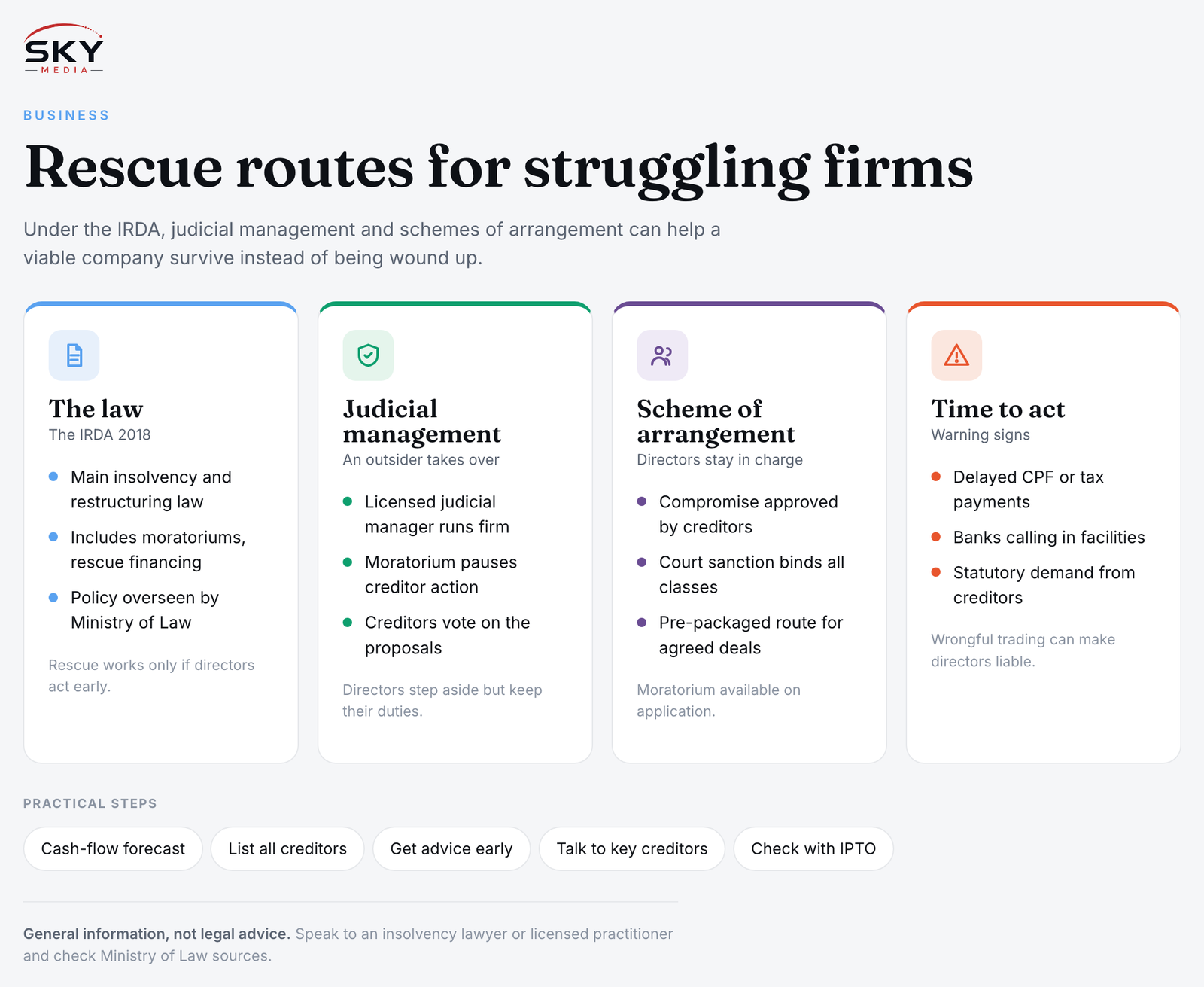
Singapore’s corporate insolvency and restructuring rules are mainly found in the Insolvency, Restructuring and Dissolution Act 2018 (IRDA). It brought together provisions that used to sit in the Companies Act and the Bankruptcy Act, and it includes tools inspired by other jurisdictions, such as court-ordered moratoriums and rescue financing. The Ministry of Law oversees the policy, and the Insolvency Office Holders who run these processes are regulated under the IRDA.
The rescue tools share one idea: if the business is worth more alive than broken up, the law should help it survive long enough to reorganise. That only works if directors act before the position becomes hopeless.
Judicial Management: an Independent Manager Takes Over
In judicial management (JM), an independent judicial manager, who must be a licensed insolvency practitioner, takes over the running of the company from the directors. The aim is usually one of these:
- Rescue the company, or part of its business, as a going concern
- Approve a compromise or scheme with creditors
- Achieve a better result for creditors than an immediate winding up would
A company, its directors or its creditors can apply to the court for a JM order. The IRDA also allows JM to be started out of court in some circumstances, through a creditors’ resolution, but the conditions are specific and need legal advice.
Key features to understand:
- Moratorium. Once an application is filed and while the company is under JM, creditors generally cannot start or continue legal action, enforce security or wind the company up without permission. This pause is often the main reason companies choose JM.
- Directors step aside. The judicial manager controls the company’s affairs and property. Directors remain subject to their legal duties and must cooperate, but they no longer make management decisions.
- A plan for creditors. The judicial manager prepares a statement of proposals that creditors vote on. If it does not succeed, liquidation may follow.
- Rescue financing. The court may give new lenders priority in some cases, which can make fresh money available to a business that could not otherwise borrow.
JM suits companies where trust between management and creditors has broken down, where the business needs an independent hand, or where a quick court-backed pause is essential.
Schemes of Arrangement: Directors Stay in Charge
A scheme of arrangement is a compromise between the company and its creditors (or classes of creditors), approved by the required majority of creditors and then sanctioned by the court. Once sanctioned, it binds every creditor in the affected classes, including those who voted against it.
Unlike JM, a scheme is usually “debtor in possession”: the existing management continues to run the business while negotiating. Typical scheme terms include:
- Stretching repayment periods
- Reducing the amount owed, or converting debt into shares
- Combining these with a sale of assets or a new investor
The IRDA strengthened schemes in several ways. Companies can apply for a moratorium while a scheme is being prepared, which protects them from creditor action during negotiations. The court can, in certain circumstances, approve a scheme even if a dissenting class votes against it (often called a “cram-down”), provided the statutory conditions are met. There is also a route for pre-packaged schemes, where the deal has been negotiated in advance and the court can sanction it without a full creditors’ meeting if conditions are satisfied.
Voting thresholds, class composition and the information creditors must receive are all set by law and closely scrutinised by the court, so this is not a do-it-yourself process.
Comparing Your Options
| Route | Who runs the company | Creditor protection | Typical aim | Main drawback |
|---|---|---|---|---|
| Judicial management | An independent judicial manager | Moratorium while under JM | Rescue the company or business, or get creditors a better result than liquidation | Directors lose control; professional costs |
| Scheme of arrangement | Existing directors and management | Moratorium available on application | Compromise debts and keep trading | Needs creditor support and careful legal preparation |
| Pre-packaged scheme | Existing management | Moratorium available | Fast approval of a deal already agreed with key creditors | Only works if support is lined up first |
| Liquidation (winding up) | A liquidator | Ends the company | Realise assets and distribute to creditors | The company ceases to exist |
Warning Signs That It Is Time to Act
Directors often wait too long, hoping the next big contract will fix things. Rescue routes work best when there is still a business to save. Consider professional advice if you see:
- Repeated cash-flow gaps that require personal loans or delayed CPF or tax payments
- Suppliers moving you onto cash terms, or banks calling in facilities
- A statutory demand or legal letters from creditors
- Losing key staff or customers because of uncertainty
- Accounts showing liabilities consistently exceeding assets
Directors also need to be careful about personal liability. The IRDA contains provisions on wrongful trading, which can expose directors who let a company incur debts when there was no reasonable prospect of paying them. Getting advice early is the best protection.
Keeping your books in good shape matters here too. Even if your company qualifies for audit exemption as a small company, creditors, practitioners and the court will need reliable, up-to-date accounts.
Practical Steps for a Business Owner
- Get a clear picture of the numbers. Prepare a cash-flow forecast, a list of creditors by amount and type, and a summary of assets and security given.
- Speak to an adviser before creditors force the issue. An insolvency lawyer or licensed practitioner can tell you whether JM, a scheme, an informal workout or liquidation is realistic.
- Talk to key creditors. Banks and major suppliers are often more open to a plan when they hear about problems early and from you.
- Look after your people. Restructuring is unsettling for staff. Clear, honest communication helps, and if roles change, handle it fairly; our guide on how to performance-manage a struggling employee covers fair processes for difficult conversations.
- Check for smaller-company options. Simplified insolvency and restructuring programmes for micro and small companies have been introduced in Singapore in the past; check with the Ministry of Law and the Insolvency and Public Trustee’s Office (IPTO) whether any such programme is currently available.
Judicial management in Singapore and schemes of arrangement exist precisely so that a cash crisis does not have to end the business. Fees, procedures and thresholds can change, so confirm the current position with a qualified adviser and official sources such as the Ministry of Law and IPTO before making decisions.
Frequently Asked Questions
Can a company keep trading while under judicial management? Yes, that is often the point. The judicial manager runs the company, usually aiming to rescue it or part of its business as a going concern. Directors step aside from management decisions but must cooperate, and creditors generally cannot take action without permission.
How much does judicial management cost a company? Costs vary with the size and complexity of the case, and the professional fees of the judicial manager are a real drawback. Ask an insolvency lawyer or licensed insolvency practitioner for an estimate early, and weigh it against what liquidation or a scheme would involve.
What happens to employees when a company enters judicial management? Employment issues depend on the company’s circumstances and the judicial manager’s plan, so there is no single answer. Staff should keep records of their contracts and pay, and can seek guidance from MOM. Clear, honest communication from the business helps during an unsettling time.
Is judicial management available to sole proprietors and partnerships? Judicial management is a corporate tool, so it applies to companies, not to individuals running a sole proprietorship. Personal debt problems follow a different framework. Check with the Ministry of Law, the Insolvency and Public Trustee’s Office (IPTO) or a lawyer on what applies to your structure.
Can I negotiate with creditors informally before choosing a formal route? Yes, and many directors try an informal workout first. Prepare a cash-flow forecast and a list of creditors, then speak to banks and major suppliers early, since they are often more open when they hear about problems directly from you. An adviser can tell you when to move to a formal route.