

Most of a small business’s spending now happens by bank transfer, PayNow or card. Yet many shops, clinics, studios and offices still keep a small box of cash for the odd courier tip, a box of printer paper, a parking coupon or a cleaning supply run. Good petty cash management keeps that box from becoming a hole in your accounts.
This guide covers how to set up a petty cash fund, how much float to hold, how vouchers and top-ups work, and the simple controls that stop small amounts going missing. It is about the company’s own cash box. If your staff pay out of their own pockets and claim the money back later, that is an expense reimbursement process, which works differently. This is general information, not accounting or tax advice; check with your accountant and the Inland Revenue Authority of Singapore (IRAS) on record-keeping specifics.
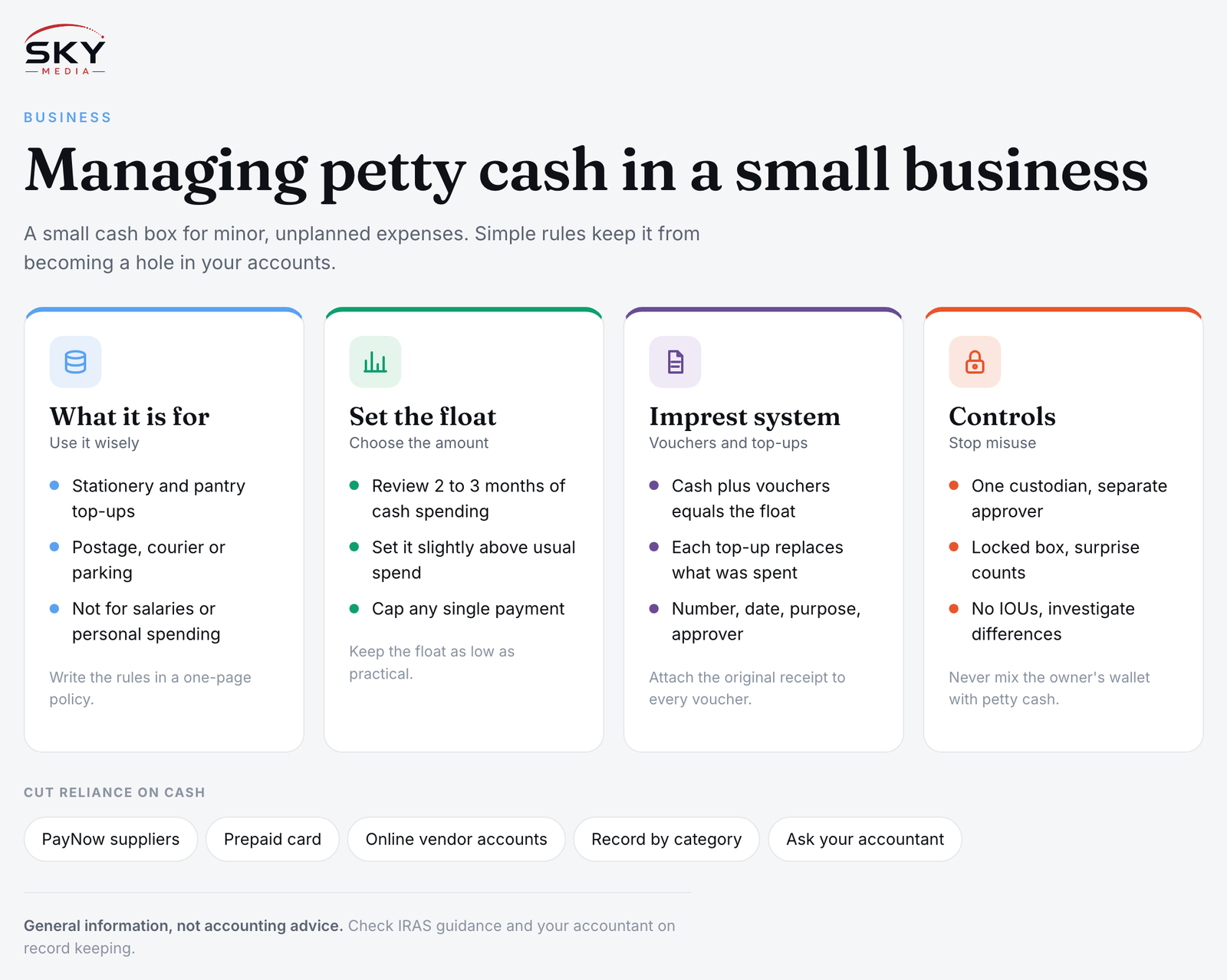
What Petty Cash Is For, and What It Is Not For
Petty cash is a small, fixed amount of physical cash kept on the premises for minor, unplanned business expenses that are inconvenient to pay any other way.
Reasonable uses:
- Small stationery or pantry top-ups
- Postage, courier or delivery fees paid on the spot
- Parking coupons or car park charges for business trips
- Minor repairs or cleaning supplies
- Small purchases from vendors that only accept cash
What petty cash should not be used for:
- Salaries, advances or loans to staff
- Payments to regular suppliers who can be paid by invoice
- Personal expenses of the owner or staff, even “temporarily”
- Large purchases that should go through your normal approval and payment process
- Cashing personal cheques or giving change for personal use
Write these rules down in a one-page petty cash policy. Even a two-person business benefits from a clear list, because it avoids awkward conversations later.
Setting the Float
The float is the fixed amount you keep in the petty cash box when it is full. There is no official figure; it depends on your business.
To choose a sensible amount:
- Look back over two or three months of small cash spending.
- Estimate how much you typically spend between top-ups (for example, in two weeks or a month).
- Set the float slightly above that, so you rarely run out but are not holding more cash than needed.
- Set a maximum amount for any single petty cash payment. Anything above it goes through your normal payment route.
Keep the float as low as practical. Less cash on the premises means less risk from theft, loss or mistakes. Review the amount every few months as your business changes.
Running the Fund With the Imprest System
Most small businesses use the imprest system. The idea is simple: the float stays at a fixed amount, and every top-up exactly replaces what was spent.
At any moment, cash in the box plus the total of vouchers and receipts should equal the float.
Here is how a cycle works:
| Stage | What happens | Record kept |
|---|---|---|
| Set up | Owner withdraws the float amount from the business bank account and hands it to the custodian | Bank withdrawal entry, signed handover note |
| Spending | Custodian pays out small expenses and gets a receipt for each | Petty cash voucher with receipt attached |
| Count | Custodian counts cash and adds up vouchers | Count sheet: cash plus vouchers should equal float |
| Top-up | Owner reviews vouchers, then withdraws exactly the amount spent | Bank entry, approved voucher bundle |
| Record | Expenses are entered into the accounts under the right categories | Ledger or accounting software entries |
Because each top-up equals the total of approved vouchers, any shortfall shows up immediately during the count.
Petty Cash Vouchers: What to Record
Every payment out of petty cash needs a voucher. You can use a printed voucher book or a simple template. Each voucher should show:
- A running voucher number
- Date
- Amount paid
- What it was for, described plainly (“A4 paper, 2 reams”, not just “supplies”)
- Who received the money
- Who approved it
- The original receipt or invoice attached
If there is genuinely no receipt (for example, some car park payments), note this on the voucher and have the person and an approver sign it. Treat missing receipts as exceptions, not habits. IRAS expects businesses to keep proper records supporting their expenses, and receipts are your evidence if questions arise later. Check IRAS guidance on how long to keep records.
Controls Against Misuse
Petty cash is small, but small amounts add up, and loose controls can create suspicion between colleagues. These controls work for most small businesses:
- One custodian. Name one person responsible for the box, with a backup for leave. Shared responsibility means no responsibility.
- Separate duties. The custodian pays out; someone else (often the owner) approves top-ups and reviews vouchers.
- Lock it up. Keep the cash in a locked box or drawer, with limited key holders.
- Spending limit per payment. Anything above the limit needs prior approval or goes through normal payment.
- Regular counts. Count at every top-up, and do occasional surprise counts by someone other than the custodian.
- No IOUs. Do not allow informal “I’ll put it back tomorrow” notes. If an advance is needed, put it through a proper process.
- Investigate differences. Small discrepancies happen, but record them and look for the cause. A pattern of shortages needs attention.
- Keep business and personal money apart. Never mix the owner’s wallet with the petty cash box.
Recording Petty Cash in Your Accounts
When you top up the fund, record each expense in the correct category, such as office supplies, transport or repairs, rather than lumping everything into one “petty cash” line. This makes your management accounts more useful and helps your accountant at year end.
If you use accounting software, set up a petty cash account so that withdrawals from the bank move into it, and vouchers move out of it into expense categories. If you are still deciding how your books should be kept, our guide to cash vs accrual accounting for small businesses explains the two main approaches. If GST registration applies to your business, ask your accountant how to handle GST on petty cash receipts, as you generally need valid tax invoices to support claims.
Reducing Your Reliance on Cash
Many businesses find they can shrink petty cash over time:
- Pay regular small suppliers by PayNow or bank transfer
- Use a company debit or prepaid card with a spending limit for staff errands
- Set up online accounts with stationery and supply vendors
Less cash means fewer counts and fewer opportunities for error, while still keeping a small float for genuine emergencies. For the bigger picture of where money goes in and out of your business, see managing business cash flow.
Explore more: Outsourcing for Small Business: A Singapore Guide, useful if you are considering handing bookkeeping to a professional.
Frequently Asked Questions
How do I decide how much cash to keep as a petty cash float? Look back over two or three months of small cash spending, estimate what you use between top-ups, and set the float slightly above that. There is no official figure. Keep it as low as practical, set a maximum for any single payment, and review it every few months.
What is the imprest system and why do small businesses use it? The float stays at a fixed amount, and each top-up exactly replaces what was spent, so cash in the box plus vouchers should always equal the float. Because of this, any shortfall shows up immediately at the count, which makes it simple to run.
What should I do when there is no receipt for a petty cash payment? Note it on the voucher and have both the person paid and an approver sign it. Treat missing receipts as exceptions, not habits, since IRAS expects businesses to keep proper records supporting their expenses. Check IRAS guidance on how long to keep records.
Who should look after the petty cash box? Name one custodian, with a backup for leave, because shared responsibility means no responsibility. Separate duties so that the custodian pays out while someone else, often the owner, approves top-ups and reviews vouchers. Keep the cash locked and limit who holds the key.
Can a small business cut back on petty cash altogether? Largely, yes. Pay regular small suppliers by PayNow or bank transfer, give staff a company debit or prepaid card with a spending limit for errands, and set up online accounts with suppliers. A small float is still useful for genuine emergencies.
Further reading: How to Do a Monthly Bank Reconciliation for Your Business · How to Set Up a Procurement Process for a Small Business · How to Prepare Your Small Business for the Year-End Sales Peak