

Many founders assume every Singapore company must pay for a statutory audit each year. In fact, a large share of private companies qualify for audit exemption. Singapore uses a “small company” concept under the Companies Act, administered by ACRA (the Accounting and Corporate Regulatory Authority), which lets qualifying private companies skip the audit while still preparing proper financial statements. This guide explains the criteria, how the group test works, and the situations where you still need an audit. It is general information, not legal or accounting advice. Thresholds and rules can change, so confirm the current position on ACRA’s website or with a qualified professional.
The Small Company Criteria
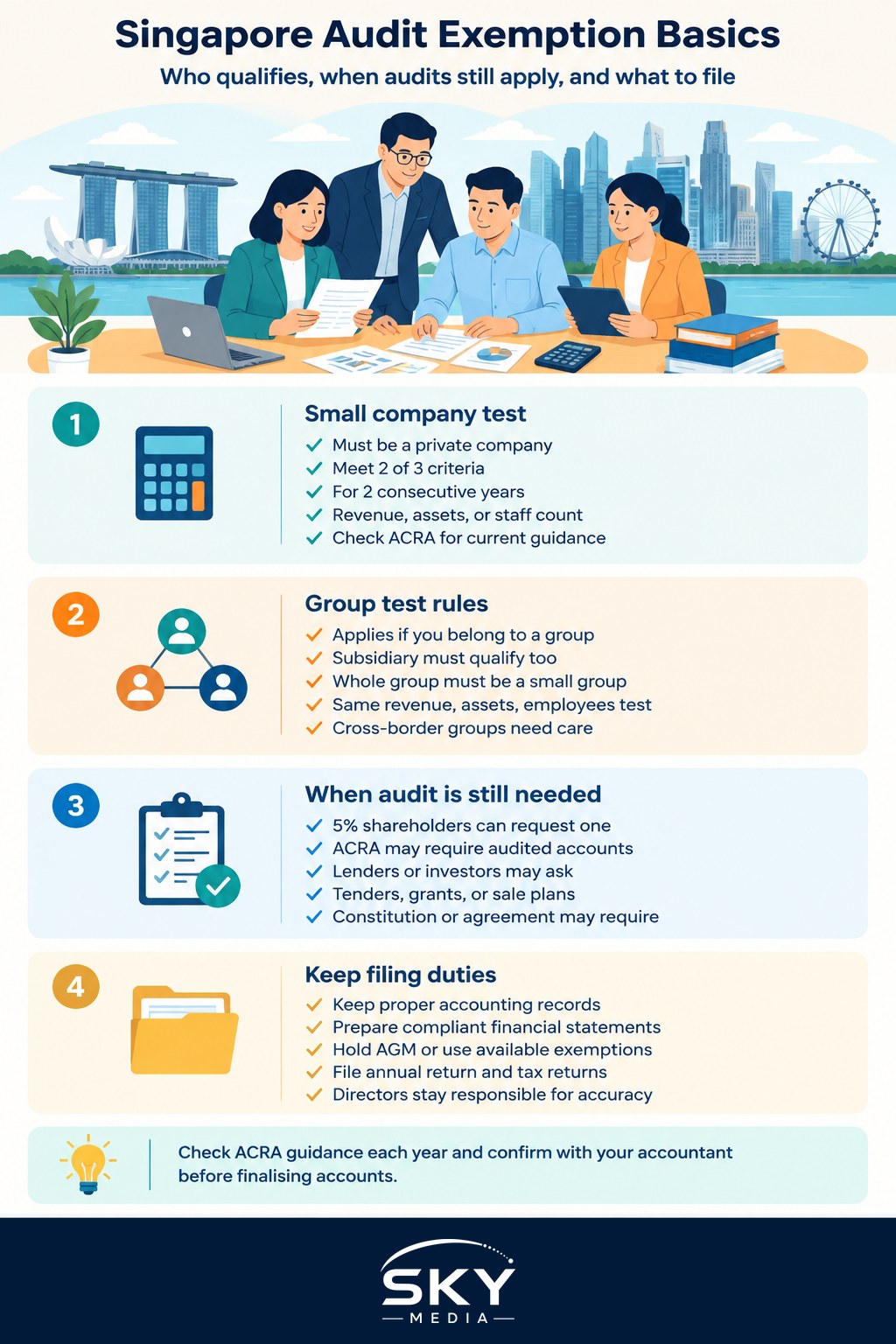
Under the current rules as published by ACRA, a company qualifies as a small company if:
- It is a private company throughout the financial year in question, and
- It meets at least two of these three criteria for each of the immediate past two consecutive financial years:
– Total annual revenue of not more than S$10 million
– Total assets of not more than S$10 million
– Number of employees not more than 50
A few practical points:
- “Two of three” is flexible. A company with high revenue but few staff and modest assets can still qualify.
- The two-year test smooths out one-off spikes. One unusually strong year does not immediately remove your exemption. Likewise, a company that stops being small generally needs to fall back within the criteria for two consecutive years to qualify again.
- New companies: how the test applies in a company’s first financial years is set out in ACRA’s guidance. Check it, rather than assuming.
Public companies cannot use the small company exemption.
The Group Test for Subsidiaries and Parents
If your company belongs to a group, there is an extra layer.
- A subsidiary must qualify as a small company itself and the entire group it belongs to must qualify as a “small group” to be exempt.
- A parent company that prepares consolidated accounts must likewise meet the criteria on a consolidated group basis.
- The group test uses the same three measures (revenue, assets and employees), applied to the group as a whole.
This catches founders who set up a small Singapore subsidiary under a larger overseas group. The Singapore entity may be tiny, but if the group is large, the subsidiary will usually still need an audit. ACRA explains how group figures are calculated, so read that guidance or speak to your accountant if you have any cross-border shareholding.
Small Company vs Audit Required: At a Glance
| Situation | Audit needed? | What still applies |
|---|---|---|
| Private company meeting 2 of 3 criteria for the past two years, not part of a large group | Generally exempt | Must prepare financial statements that comply with accounting standards, file annual return with ACRA |
| Small company whose shareholders with at least 5% of voting rights require an audit | Yes, for that year | Notice must be given within the timeframe set by law |
| Subsidiary of a group that does not qualify as a small group | Yes | Group figures decide the outcome, not just the local entity |
| Public company, or private company exceeding the criteria | Yes | Full statutory audit by a registered public accountant |
| Dormant company meeting ACRA’s dormant company conditions | Often exempt under separate rules | Must still keep records and meet filing obligations |
When You Still Need an Audit
Even if your company qualifies as small, you may still need, or want, audited accounts.
Shareholders can ask for one
Shareholders holding at least 5% of the total voting rights can require the company to have its accounts audited for a financial year, by giving notice within the period set out in the Companies Act. Minority investors sometimes do this when they want independent assurance.
ACRA can require one
The Registrar has powers to require a company to lodge audited financial statements in certain situations, for example where there are compliance concerns.
Commercial reasons
Audit exemption is about the law, not about what other parties expect. You may need audited accounts when:
- Raising investment: venture investors or acquirers may ask for audited figures during due diligence.
- Bank financing: some lenders require audited accounts for larger facilities.
- Tenders and grants: some government tenders, grant programmes and large corporate customers set their own financial reporting conditions.
- Planning a listing or sale: a history of audited accounts makes due diligence smoother.
- Your constitution or shareholders’ agreement: these may require an audit regardless of the statutory exemption.
If any of these apply, plan ahead. An audit for the first time can take longer, because the auditor needs to verify opening balances.
What Exempt Companies Must Still Do
Audit exemption is not an exemption from accounting. A small company must still:
- Keep proper accounting records and supporting documents, retained for the period required by law.
- Prepare financial statements that comply with the Singapore Financial Reporting Standards that apply to the company, together with a directors’ statement. The directors’ statement should reflect that the accounts are unaudited.
- Hold an AGM or use the exemptions available, and file the annual return with ACRA via Bizfile (ACRA’s online filing portal). Our guide to AGM rules for private companies covers the meeting side.
- File corporate income tax returns with IRAS (the Inland Revenue Authority of Singapore), including Estimated Chargeable Income filing where required. IRAS does not require audited accounts for the tax return, but your figures must be accurate and supportable.
- Check filing format: depending on the company type, financial statements may need to be filed in XBRL format or a simplified form. ACRA sets out which companies must file what.
Directors remain responsible for the accuracy of the accounts. Without an auditor, there is no outside check, so good bookkeeping matters even more. Keeping clean records also helps if IRAS reviews your return; see how to handle a tax audit for what that involves.
Keeping Track of Your Status Each Year
Because the test looks back two years, build a short annual check into your year-end routine:
- Record revenue, total assets and headcount at each financial year-end.
- Compare against the criteria for the current and previous year.
- If you are part of a group, get the group figures from your parent or group finance team.
- Note any shareholder requests for an audit, and any lender, investor or contract terms that require one.
- Confirm the outcome with your accountant or corporate secretary before the accounts are finalised.
A simple spreadsheet tracking these numbers over time makes it easy to see when growth is about to take you over the line, so you can budget and appoint an auditor in good time.
Getting the Basics Right
Audit exemption Singapore rules save many small private companies time and cost, but they come with conditions. Check the two-out-of-three test, apply the group test if you have related companies, and watch for shareholder, lender or investor requirements that override the exemption. When in doubt, read ACRA’s current guidance on the small company concept, and work with a qualified accountant or corporate service provider to make sure your filings are right.
Frequently Asked Questions
Do I have to apply for audit exemption, or is it automatic? It is based on meeting the small company criteria rather than a separate application, but the test is yours to check each year. Confirm the outcome with your accountant or corporate secretary before the accounts are finalised, and refer to ACRA’s current guidance.
How much does a statutory audit cost for a small company? Audit fees vary with the size, complexity and state of the books, so there is no standard figure. Ask several registered public accountants for written quotes, and find out what is included. A first-time audit can take longer because the auditor must verify opening balances.
Can an exempt company still choose to have an audit? Yes, exemption removes the legal requirement but does not forbid an audit. Many companies get one for investors, lenders, tenders or because their constitution or shareholders’ agreement requires it. If you may need audited figures soon, plan early.
When in the year should I check whether my company still qualifies? Check at each financial year-end, using revenue, total assets and headcount for the current and previous year. If you are in a group, get group figures from your parent. Doing this before the accounts are finalised leaves time to budget and appoint an auditor.
What are the risks of having no auditor? Directors remain responsible for the accuracy of the accounts, and with no auditor there is no outside check, so good bookkeeping matters even more. Clean records also help if IRAS reviews your tax return. A shareholder with enough voting rights can also still ask for an audit.
Official sources: ACRA
Further reading: Choosing Between Form C-S, Form C-S (Lite) and Form C