
Few things on a new parent’s list feel as official, or as easy to lose track of, as childhood vaccinations. Between night feeds, growth spurts and the general fog of the early months, an appointment card can slip to the bottom of a drawer. If that has happened to you, take a breath: you are not behind so much as busy, and Singapore’s system is built to help you catch up. This is general information to help you feel calm and organised, not medical advice. Your child’s doctor and the official schedule are always the final word for your family.
Vaccinations work by giving the immune system a safe preview of a germ, so that if your child ever meets the real thing, their body already knows how to fight it. In Singapore, they are also one of the more affordable parts of early parenting, and the routine of going for them can become a gentle rhythm in that first year or two.
Why the schedule exists and who sets it
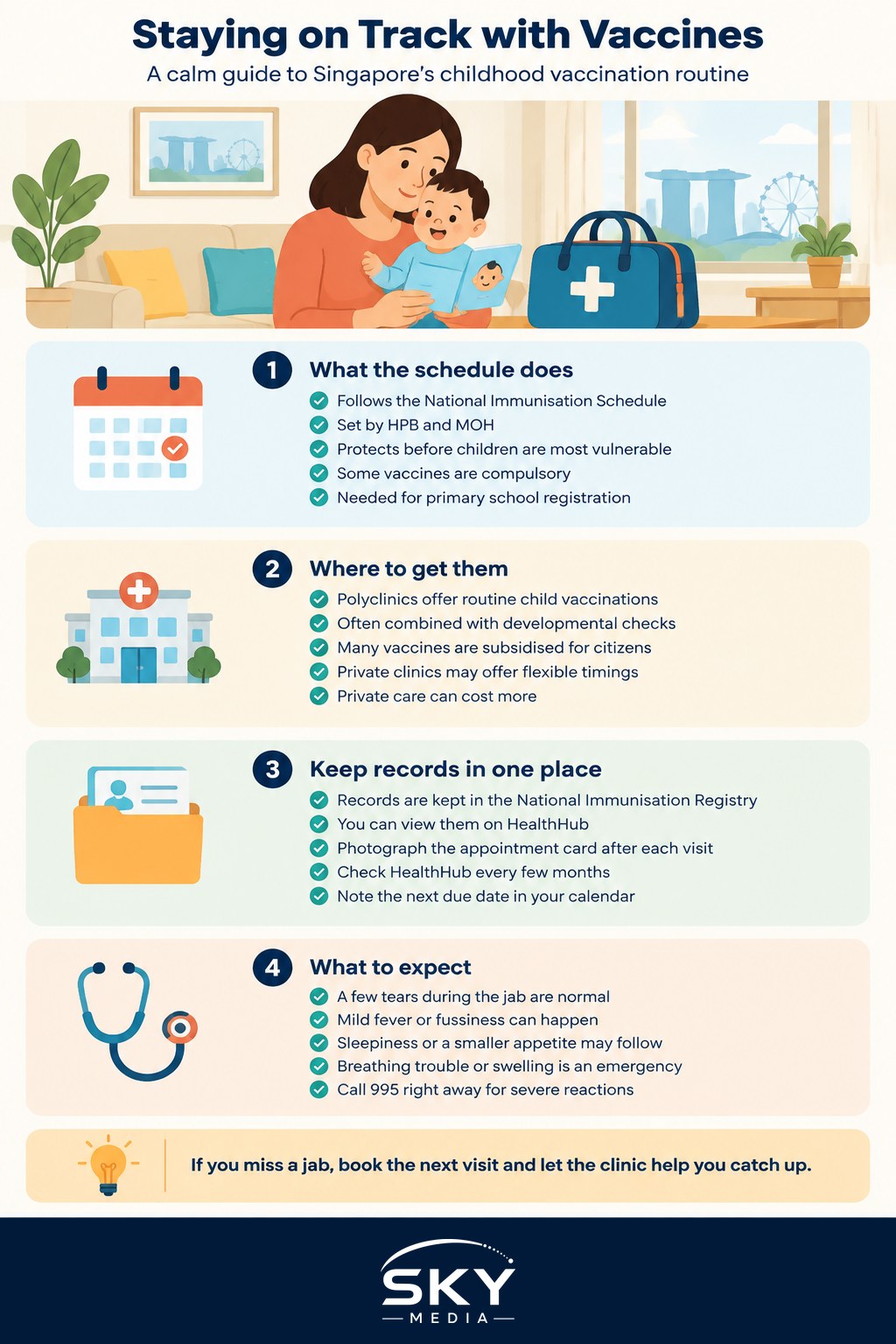
The list of jabs your child needs is not something each clinic invents. It follows the National Immunisation Schedule, set by the Health Promotion Board and the Ministry of Health, and it covers diseases that can be serious or even life threatening for young children. The schedule is timed so that protection arrives before the age when a child is most vulnerable to each illness.
Under the law, certain vaccinations are compulsory for children in Singapore, and completing the full schedule is also a practical requirement when you register for primary school. So while it can feel like a lot of appointments, each one is there for a clear reason, and the whole thing has been thought through by people whose job is to weigh the benefits and the risks carefully.
You do not need to memorise the schedule yourself. What helps most is knowing where it lives and trusting the reminders. The HealthHub app and website keep the official, current version, and your polyclinic or paediatrician will walk you through what is due at each visit.
Where to go and what it costs
You have two main routes, and both are perfectly good.
- Polyclinics run childhood vaccinations as part of routine child health visits, often alongside developmental checks. For Singapore citizens, many of the nationally recommended vaccines are heavily subsidised, and some are fully covered. This is the most common path and tends to be the most affordable.
- Private paediatricians and GP clinics offer the same core vaccines, sometimes with more flexible timings and additional optional vaccines, usually at a higher cost.
If money is on your mind, you are not alone, and it is worth checking what subsidies and schemes currently apply to your child, as these are updated from time to time. The official sources will have the latest figures. For a wider view of early costs, our guide to budgeting for a new baby may help you plan without panic.
Whichever route you choose, try to keep going to the same place where you can, so your child’s records stay in one clear thread.
Keeping records straight
This is the part that trips up tired parents, so it deserves its own attention. In Singapore, your child’s vaccination records are stored in the National Immunisation Registry, and you can view them through HealthHub. That means even if you lose the little booklet, the important information is safe.
A few habits make life easier:
- Photograph the appointment card after each visit and keep the images in one album on your phone.
- Check HealthHub every few months to confirm the records match what you remember, especially if you have switched clinics.
- Note the next due date in your calendar the moment you leave the clinic, while it is fresh.
- Keep one parent as the main tracker if that suits your household, so nothing falls between two people each assuming the other booked it.
If you have recently brought your baby home and are still finding your feet, our guide to bringing your newborn home sits naturally alongside this one.
What to expect on the day and afterwards
Most children handle vaccinations far better than their parents expect, though a few tears at the moment of the jab are completely normal. Feeding, a cuddle or a familiar toy can settle a baby quickly. For older toddlers, a calm and honest heads up (“there will be a quick pinch, then it is done”) often works better than a surprise.
Mild reactions in the day or two afterwards are common and usually a sign the immune system is doing its job. Serious reactions are rare. The table below sets out what parents often notice against what it usually means, but it is a general guide only, not a diagnosis. When in doubt, call your doctor.
| What you might notice | What it usually means | What tends to help |
|---|---|---|
| Redness or a small lump where the jab went in | A normal local reaction to the vaccine | A cool, clean touch and gentle handling; it settles on its own |
| A mild fever or fussiness for a day or so | The immune system responding as expected | Extra fluids, rest and comfort; follow your doctor’s advice on fever |
| Sleepiness or a smaller appetite briefly | A common, short lived response | Let your child rest and feed as they want |
| Trouble breathing, swelling of the face, floppiness or a rash spreading fast | A possible severe reaction, which is rare | Treat as an emergency and call 995 immediately |
That last row matters. Severe allergic reactions are uncommon, but if you ever see signs like difficulty breathing, swelling around the face or lips, or your child going limp, do not wait: call 995. For everyday worries that are not emergencies, our guide to knowing when to see a doctor for your child can help you judge the greyer moments.
If you have fallen behind
Missed appointments happen, and a delayed vaccine is not a disaster. The schedule is designed with catch-up in mind, and your doctor can work out a plan to get your child back on track without starting everything from scratch. What you should not do is quietly give up because it feels too late or too complicated. Book the visit, bring whatever records you have, and let the clinic take it from there.
If your family has been through a move, a new sibling or a stretch of illness that pushed health admin aside, be kind to yourself. Recognising a gap and acting on it is exactly the right response.
A calm, steady rhythm
The goal is not perfection but protection, kept up over time. Vaccinations sit alongside the other quiet routines of early parenting, and like feeding and sleep, they get easier once the pattern is set. Knowing the signs of everyday illness helps too, so you can tell an ordinary bug from something that needs attention; our guide to recognising common childhood illnesses is a useful companion here.
This article is general guidance only. For anything specific to your child, including which vaccines are due, how subsidies apply and how to manage a reaction, please speak to your paediatrician or polyclinic and follow the National Immunisation Schedule on HealthHub. They know your child, and they are the right people to guide you.
Frequently Asked Questions
Which vaccines are compulsory for my child in Singapore? The article only says that certain vaccinations are compulsory by law, so the exact list should come from official sources. Check the National Immunisation Schedule on HealthHub or ask your polyclinic or paediatrician which are due.
Can my child be vaccinated if they have a mild cold? This depends on how unwell they are, so ask the clinic or your doctor. Doctors often advise delaying if there is a significant fever or illness. A mild sniffle may not stop it, but let the doctor decide.
Are optional vaccines worth considering on top of the national schedule? Optional vaccines can offer extra protection against certain illnesses, and they are usually at your own cost. Whether they suit your child depends on health, lifestyle and budget. Discuss it with your paediatrician.
Will vaccination records follow my child to primary school? The article says that completing the schedule is a practical requirement when registering for primary school. Records are stored in the National Immunisation Registry and can be viewed on HealthHub. Check the details with MOE and the school nearer the time.
How can I make vaccination day less stressful for my baby? Feed or cuddle your baby before and after the jab, bring a familiar toy or blanket and stay calm yourself. Babies pick up on parental tension. For older toddlers, a short honest heads up works better than a surprise.
Official sources: HealthHub · Ministry of Health (MOH)
Further reading: How to Register a Child for Vaccinations in Singapore After You Arrive