

Bringing a baby home is one of the biggest, most tender changes any couple goes through, and it is completely normal if your relationship after a baby feels different from what it was before. You are running on broken sleep, your days revolve around feeds and nappies, and the easy time you once had for each other seems to have vanished overnight. If you have caught yourselves snapping over whose turn it is to get up, or feeling more like co-workers than partners, please know you are not failing. You are two exhausted people learning a brand new job with no handover notes. This is a warm, general guide, not medical or counselling advice, and it is here to help you stay close while you find your footing.
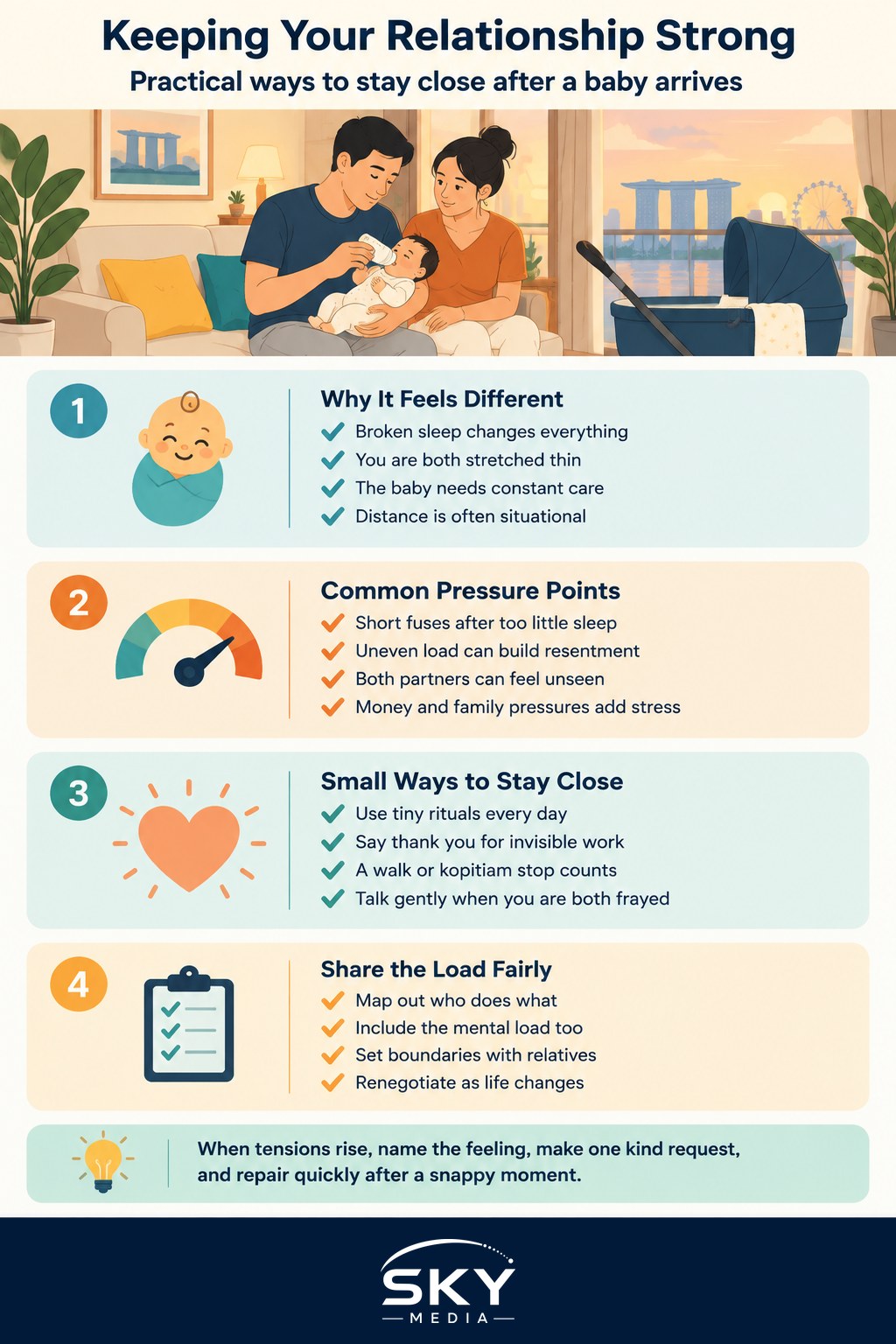
Why Things Feel Different After the Baby Arrives
A newborn reorganises everything, and it does so fast. The person who used to be the centre of your world now shares that spot with a tiny human who needs you constantly. In Singapore, the early weeks often come with extra layers: a confinement nanny in the flat, well meaning relatives with strong opinions, one of you back at work sooner than you would like once maternity or paternity leave runs out, and the quiet stress of infant care waitlists or costs. All of this is a lot to hold at once.
It helps to name what is really happening. You are not drifting apart because you have stopped loving each other. You are stretched thin, sleep deprived, and pouring almost everything you have into keeping a baby alive and well. Affection can feel like one more thing on an endless list. When you understand that the distance is situational rather than a verdict on your relationship, it becomes much easier to be gentle with each other and to trust that closeness can return.
The Common Pressure Points for New Parents
Most couples run into a similar set of friction points in the first year. Recognising them early takes away some of their sting.
- Sleep and short fuses. Exhaustion makes everyone reactive. A comment that would normally roll off can spark a full argument at 3am.
- An uneven load. One partner often ends up carrying more of the feeds, the mental planning, or the housework, and quiet resentment builds when that goes unspoken.
- Feeling unseen. The parent on leave can feel isolated and touched out, while the working parent can feel shut out of the baby bubble. Both are lonely in different ways.
- In-law involvement. Grandparents helping with the baby is a real gift, but it can also blur boundaries around how you want to parent.
- Money worries. New costs and a possible dip in household income add background tension.
None of these mean your relationship is broken. They are the ordinary weather of new parenthood, and they respond well to honest conversation and small, repeated adjustments.
Small Ways to Stay Connected When You Are Exhausted
You do not need date nights at a fancy restaurant to protect your bond, especially not in the newborn haze. What matters far more is a steady stream of small, warm moments. Connection is built in minutes, not grand gestures.
Try tiny rituals that survive real life: a proper hug when one of you gets home, a two minute check in before sleep, a text during the workday that is not about the baby. Say thank you out loud for the invisible work, because feeling appreciated is fuel when you are running on empty. When you do get a pocket of time, a walk around the estate with the pram or supper at the void deck kopitiam counts as a date. For more ideas on protecting your bond over the long haul, see our guide on keeping romance alive after years together, and our piece on expressing appreciation to your partner.
The way you speak to each other matters more than usual when you are both frayed. Here is a simple shift that helps.
| Instead of saying | Try saying |
|---|---|
| “You never help with the night feeds.” | “I am running on empty tonight. Could you take the next feed so I can sleep?” |
| “Why is the house always a mess?” | “Can we pick one thing to tidy together after he is down?” |
| “You don’t get how hard my day is.” | “I had a rough day. I just need you to listen for a minute.” |
| “You care more about the baby than me.” | “I miss us. Can we carve out ten minutes that is just for the two of us?” |
The right hand column works because it names a feeling and makes a clear, kind request, rather than firing a criticism. Nobody gets it right every time, and that is fine. Repairing quickly after a snappy moment matters more than never snapping at all.
Sharing the Load Fairly at Home
Resentment over an uneven load is one of the biggest strains on a relationship after a baby, and the fix is rarely about doing exactly half of everything. It is about feeling like a team. Sit down when you are both reasonably calm, not mid argument, and map out who does what. Include the invisible mental load too: remembering vaccinations, restocking milk powder, booking the infant care visit. That planning work is real work, and sharing it eases a quiet burden.
Be willing to renegotiate as things change, for example when leave ends or the baby starts sleeping longer. If grandparents or a helper are part of your setup, talk as a couple first about the boundaries you want, then present them together, so one partner is not left managing family tensions alone. Setting these agreements as a united front protects your relationship as much as it organises your week.
Intimacy and Affection When You Are Both Tired
Physical closeness often changes for a while after a baby, and there is no single normal timeline. Bodies are recovering, hormones are shifting, and sheer tiredness can dampen desire for either partner. The kindest thing you can do is talk about it openly and without pressure, so neither of you fills the silence with worry or rejection.
Remember that intimacy is far broader than sex. Holding hands, a back rub, lying together for ten minutes, a genuine kiss goodbye: these keep you feeling like a couple and rebuild closeness gently. Let affection return at its own pace, and keep talking about what each of you needs. Our guide on understanding different intimacy needs may help here. This is general guidance, not medical advice, so please see a doctor for any physical or recovery concern.
When to Reach Out for Help
Some strain is normal, but you should not white knuckle through everything alone. Reach out for support if you or your partner feel persistently low, hopeless, anxious, or disconnected for more than a couple of weeks, if arguments are escalating, or if either of you is struggling to bond with the baby. These are common experiences and help is available.
A good starting point is your GP or a polyclinic, who can guide you on postnatal mood support. Singapore has Family Service Centres, and you can reach mindline on 1771 or the Samaritans of Singapore (SOS) on 1767 if you or your partner are in emotional distress. If you would like structured support as a couple, our guide on when to consider couples counselling walks through what that looks like. And if anyone ever feels unsafe, or if control, threats or violence enter the picture, that is never acceptable and never your fault. You can call the National Anti-Violence and Sexual Harassment Helpline on 1800-777-0000, or the Police on 999 in an emergency.
The newborn stage is intense, but it does not last forever. Be patient with each other, keep the small kindnesses going, and remember that the tired, tender team you are becoming now is the same team that will carry you both for years to come.
Related across Sky Media: Keeping Your Relationship Strong in Singapore
Frequently Asked Questions
How long does it take for a couple to feel normal again after a baby? There is no set timeline, and many couples say it takes months rather than weeks. Feeling closer usually returns as sleep improves and routines settle. Small daily moments of connection help it along, so do not read a rough stretch as a lasting verdict on the relationship.
Is it normal to resent my partner after having a baby? Yes, it is very common, especially when sleep is short and the load feels uneven. Resentment usually grows when needs go unspoken. Choose a calm moment to say what is weighing on you, and agree on specific changes. If it keeps building, a counsellor can help.
Can new dads get postnatal depression too? Yes, fathers and partners can experience it as well, though it often goes unnoticed. Signs include persistent low mood, irritability, withdrawal or feeling overwhelmed for weeks. A GP or polyclinic is a good first stop, and mindline on 1771 is available for emotional support.
How do we split night feeds fairly when one of us is back at work? Fairness does not have to mean exactly half. Many couples take turns on set nights, or divide by shift so each person gets one longer block of sleep. Talk it through when you are both calm and revisit the plan as the baby’s sleep changes.
Will couples counselling help new parents? It can, particularly when arguments keep repeating or you feel like strangers. A counsellor gives you a calm space to talk and practical ways to communicate under stress. You do not have to wait for a crisis, and starting early often makes the work easier.
Further reading: Building a Strong Marriage While Raising Young Kids