

“I cooked three times this week.” “I drove your parents to the airport.” “I gave up my weekend for your company dinner.” If conversations with your partner sound like an accounting report, you may be keeping score in a relationship. It is a very common habit, and it usually starts from a reasonable place: wanting things to feel fair. The trouble is that a running tally rarely makes anyone feel more loved. It tends to turn a partnership into a quiet competition, with resentment as the prize.
This guide looks specifically at the scoreboard: the mental ledger of effort, favours and sacrifices. It explains why it forms, how to notice it, and what to do instead.
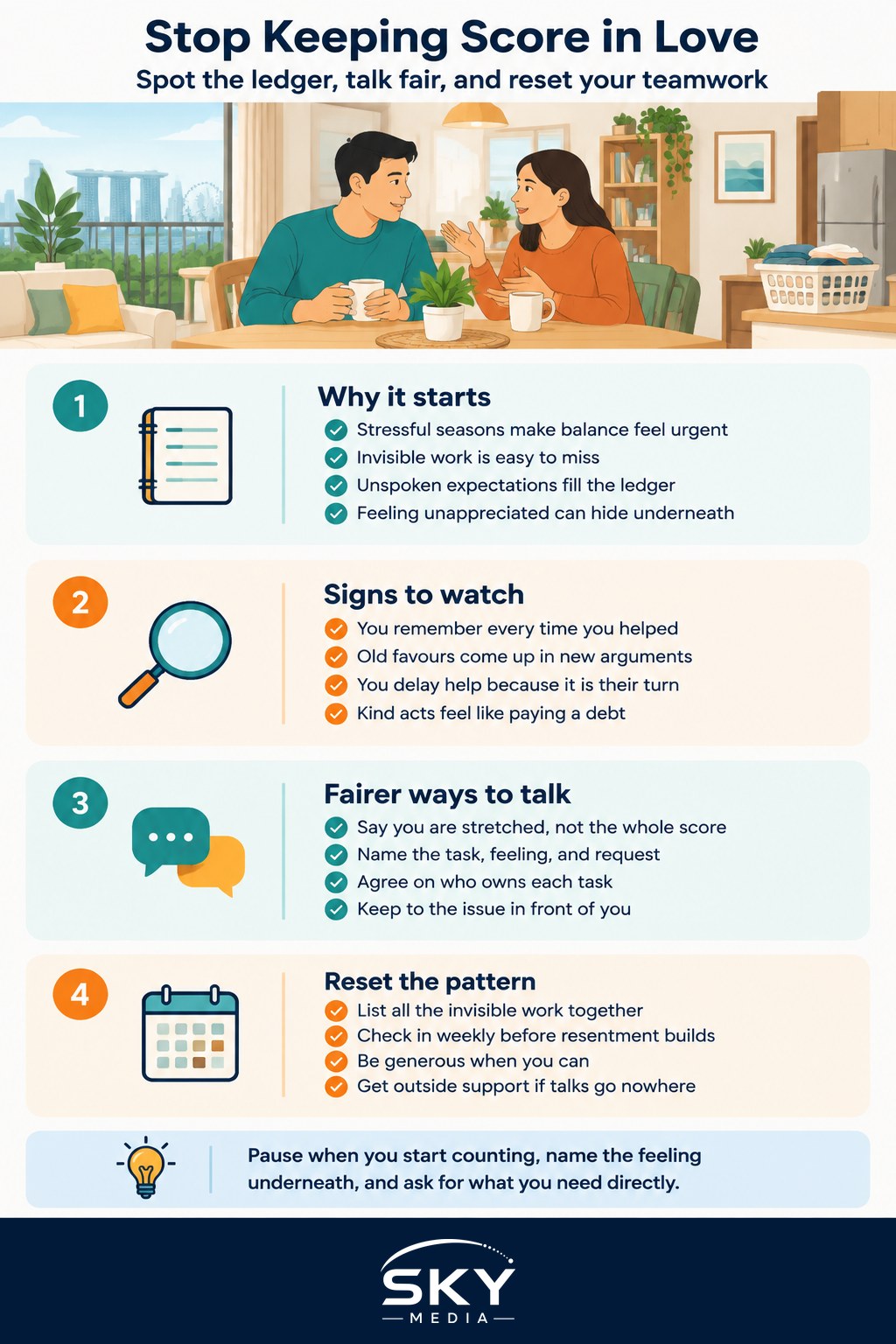
Why Couples Start Keeping a Scoreboard
Few people decide to keep score. It creeps in, often during periods of stress. Common triggers include:
- An unequal season. A new baby, a demanding job, caring for an elderly parent, or one partner studying while the other works. One person carries more for a while, and starts counting.
- Invisible work. Remembering birthdays, booking the aircon servicing, tracking school forms and planning family visits all take effort that is easy for the other person to miss. When work goes unseen, people keep their own records.
- Unspoken expectations. Many of us grow up with ideas about who should handle money, cooking or in-law relationships. When a partner does not meet an expectation they never agreed to, the ledger fills up.
- Feeling unappreciated. Often the score is not really about chores. It is a way of saying “notice me” without saying it.
In Singapore, long working hours, small living spaces and close ties with extended family can make all of this sharper. When both partners are tired, small imbalances feel big.
Signs the Tally Has Taken Over
Some fairness talk is healthy. A scoreboard is different. You may be keeping score if:
- You remember exactly how many times you did something, and how many times your partner did not.
- You bring up old favours during unrelated arguments.
- You hesitate to help because “it is their turn”.
- Kind gestures come with an invisible invoice attached.
- You feel a small sense of victory when your partner falls behind.
If two or more of these sound familiar, the scoreboard is probably shaping how you see your partner, not just how you divide the work.
Scorekeeping Versus Healthy Fairness
Wanting balance is not the problem. The difference lies in how you deal with it. This comparison may help you spot which mode you are in.
| Situation | Scorekeeping response | Healthy fairness response |
|---|---|---|
| You have done most of the housework this week | Silently note it and bring it up later as evidence | Say you are stretched and ask to rebalance next week |
| Your partner forgets a promised task | Add it to the list of their failings | Ask what got in the way and agree on a reminder |
| You make a sacrifice for their family | Expect an equal sacrifice back at some point | Say what it cost you and what support would help |
| Your partner does something thoughtful | Treat it as paying off a debt | Thank them for it on its own merits |
| An argument starts about one issue | Pull in months of past grievances | Keep to the one issue in front of you |
The healthy column is not about being a pushover. It still names the imbalance. It just does so openly and early, instead of storing it up.
How to Stop Keeping Score: Practical Steps
Notice the ledger in your head
Start by catching yourself. When you find yourself counting, pause and ask, “What am I actually feeling right now?” The answer is often tiredness, loneliness or feeling taken for granted. Naming that is more useful than adding another entry.
Say the need, not the number
“I have done the laundry six times” invites a defensive reply. “I am exhausted and I need you to take the laundry this week” invites help. Lead with the feeling and the request, and leave the statistics out.
Make invisible work visible
Sit down together and list everything it takes to run your home and your life, including planning, remembering and organising. Many couples are surprised by how long the list is. Then agree on who owns which tasks from start to finish, rather than one person managing and the other “helping”.
Agree on what fair looks like for you
Fair rarely means fifty-fifty every day. It might mean one partner handles more housework while the other covers more of the commute, the night feeds or the family admin. What matters is that both of you agree to the arrangement and feel free to revisit it.
Check in regularly
A short weekly check-in, perhaps over Sunday breakfast, gives you a place to raise imbalances while they are still small. Ask each other: What felt heavy this week? What do you need next week? Small, frequent adjustments stop the ledger from building up.
Give freely when you can
Try doing something kind without registering it. Pick up their favourite snack, take over a chore when they are unwell. If you notice yourself expecting credit, gently let that go. Generosity tends to invite generosity back, while scorekeeping tends to invite more scorekeeping.
When Your Partner Is the One Keeping Score
It can be painful to be on the receiving end. Try not to respond with your own counter-list, which only raises the stakes. Instead:
- Listen for the need underneath their tally. “You never help with my parents” may mean “I feel alone handling them”.
- Acknowledge the effort they have put in, even if you see things differently.
- Suggest the check-in habit, so both of you have a fair place to raise concerns.
If one partner genuinely contributes much less over a long period, that is a real issue in its own right. Our guide on how to handle unequal effort in a relationship focuses on that problem directly. If you tend to agree to everything and then quietly resent it, How to Stop People-Pleasing may help you say what you need earlier.
When to Get Outside Support
Sometimes the scoreboard reflects deeper hurt: a betrayal, long-term neglect, or patterns carried over from family life. If you have tried to talk and keep going in circles, or if arguments regularly become hostile, a couples counsellor or family service centre can help you both feel heard. Seeking support is not a sign the relationship is failing. It is a sign you both want it to work.
If you ever feel unsafe, or if the score is being used to control or punish you, reach out to a professional or a support helpline for help.
A Different Way to Measure Your Relationship
Instead of asking “Who did more?”, try asking “Are we both okay?” and “Do we feel like a team?” These questions shift the focus from debts to wellbeing. Relationships go through seasons where one partner carries more. What keeps them strong is trust that the balance will be restored, and the habit of talking about it before resentment takes hold.
Explore more: Keeping Your Relationship Strong in Singapore and How to Stop Overthinking in Relationships.
Further reading: How to Pace a New Relationship Without Rushing It · What Really Makes a Relationship Last