

Walk into almost any home during Hari Raya Puasa and you will find a coffee table lined with jars of cookies. These festive bites, known as kuih raya, are part of the welcome for every visitor. Shop-bought jars are convenient, but baking your own is a rewarding tradition, and three classics are well within reach of a home oven. This kuih raya recipe guide covers melt-in-the-mouth makmur, airy coconut bangkit and piped butter semprit, plus a bake-ahead timeline and storage tips so everything stays crisp for the whole month of Syawal.
Quantities below make roughly one medium jar each. Oven temperatures vary, so treat times as a guide and watch your first tray closely.
Before You Start: Tools and Ingredients
A little preparation makes Raya baking much smoother.
- Tools: a mixing bowl, a hand or stand mixer, baking trays with baking paper, a cookie press or piping bag with a star nozzle (for semprit), small cookie cutters or a bangkit mould, a sieve and airtight jars.
- Butter and ghee: good butter matters in all three cookies. Ghee gives makmur its traditional fragrance.
- Flours: plain flour for makmur and semprit; tapioca flour (sometimes sold as sago flour in Singapore) for bangkit.
- Coconut milk: use fresh or packet coconut milk for bangkit.
- Pandan leaves: for perfuming the bangkit flour.
Most of these are easy to find in supermarkets and baking supply shops around Singapore, and the shelves fill up with Raya baking ingredients in the weeks before the festival.
Kuih Makmur: Butter Cookies With a Peanut Filling
Makmur means “prosperous”, and these soft, crumbly domes coated in icing sugar are a Raya favourite.
Ingredients
- 250g plain flour
- 125g ghee and 50g butter, softened
- 40g icing sugar, plus extra for coating
- A pinch of salt
- Filling: 100g roasted peanuts, finely ground, mixed with 30g sugar
Method
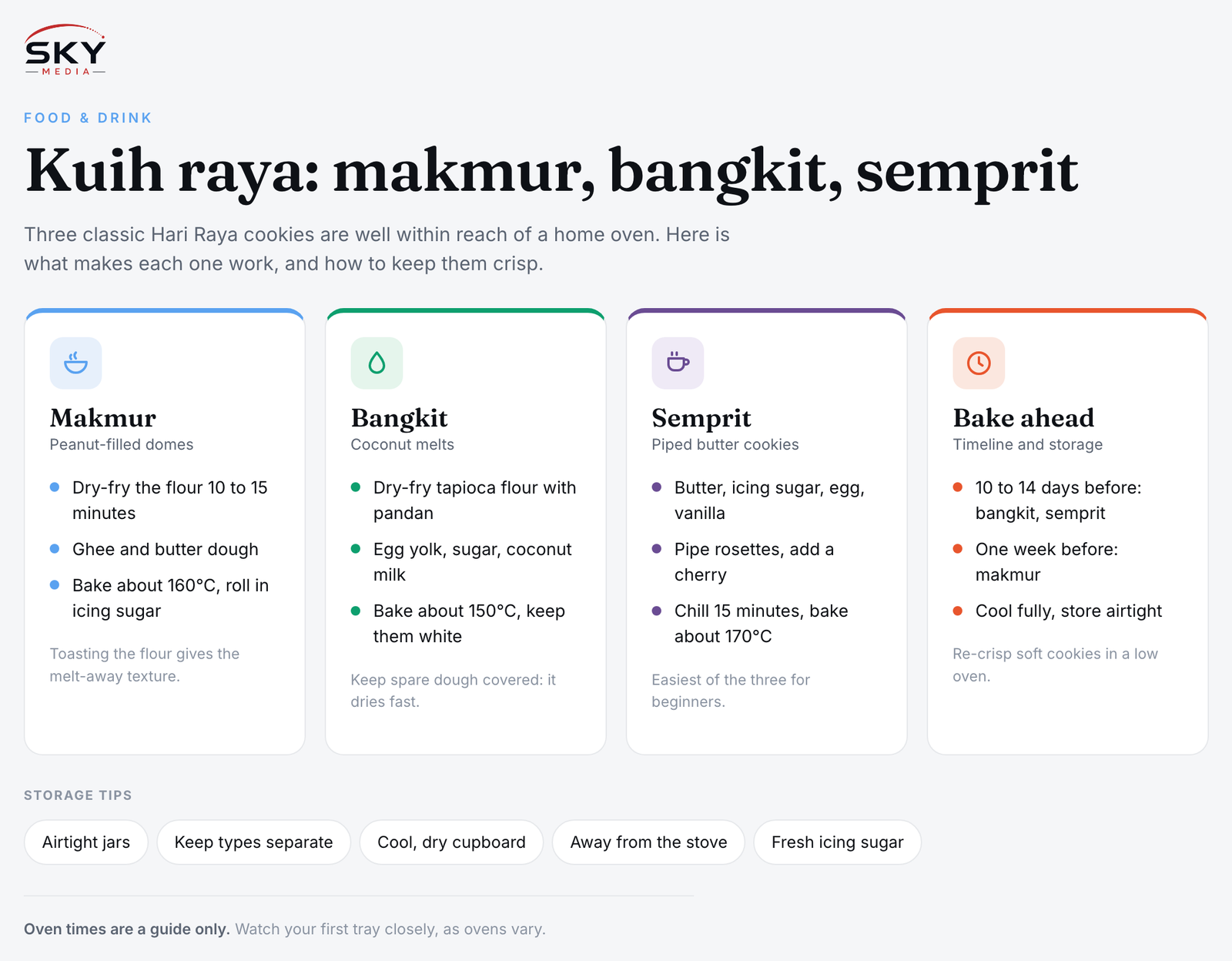
- Dry-fry the flour in a wok over low heat for about 10 to 15 minutes, stirring constantly, until it is very light and fragrant but not browned. Let it cool completely, then sift.
- Cream the ghee, butter, icing sugar and salt until pale.
- Add the cooled flour gradually and mix into a soft dough that holds together when pressed.
- Take a small piece of dough, flatten it, place a little peanut filling in the centre and seal it into a ball or small oval. Many bakers pinch a pattern on top with small tweezers.
- Bake at about 160°C for 18 to 25 minutes. Makmur should stay pale.
- Let them cool a few minutes, then roll gently in icing sugar while still slightly warm. Coat again once fully cool.
Toasting the flour is the step that gives makmur its melt-away texture. Do not rush it.
Kuih Bangkit: Coconut Cookies That Melt on the Tongue
Bangkit are light, white cookies that dissolve almost instantly. They are made from tapioca flour, which must be very dry for the right texture.
Ingredients
- 300g tapioca flour
- 4 to 5 pandan leaves, cut into pieces
- 2 egg yolks
- 100g icing sugar
- About 100ml thick coconut milk, plus a little more if needed
Method
- Dry-fry the tapioca flour with the pandan leaves over low heat for 30 minutes or more, until the flour feels very light and the leaves are crisp. Some bakers bake the flour in a low oven instead. Cool completely, then sift and discard the leaves.
- Whisk the egg yolks with the icing sugar until thick and pale.
- Add the coconut milk and mix.
- Fold in the cooled flour a little at a time, adding a splash more coconut milk if the dough is too dry. It should be soft and pliable but not sticky.
- Roll out to about 1cm thick, then cut or press into shapes with a bangkit mould or small cutters. Many bakers dot the top with a red food colouring point.
- Bake at about 150°C for 15 to 20 minutes. They should stay white with only a faint colour underneath.
Work in small batches and keep the rest of the dough covered, as it dries quickly.
Biskut Semprit: Piped Butter Cookies
Semprit are pretty, piped butter cookies, often finished with a small piece of glacé cherry or a dot of jam.
Ingredients
- 200g butter, softened
- 80g icing sugar
- 1 egg
- 1 teaspoon vanilla essence
- 250g plain flour
- 30g cornflour
- Glacé cherries, chopped, for decoration
Method
- Cream the butter and icing sugar until light and fluffy.
- Beat in the egg and vanilla.
- Sift in the plain flour and cornflour and mix until just combined. The dough should be soft enough to pipe.
- Fill a cookie press or a piping bag with a star nozzle and pipe small rosettes onto lined trays.
- Press a small piece of cherry into the centre of each.
- Chill the trays for 15 minutes so the cookies hold their shape, then bake at about 170°C for 12 to 15 minutes, until the edges are just golden.
If the dough is too stiff to pipe, let it warm slightly. If it spreads too much in the oven, chill longer.
Comparing the Three Classics
| Cookie | Main flour | Texture | Difficulty |
|---|---|---|---|
| Makmur | Toasted plain flour | Soft, crumbly, melts in the mouth | Moderate, shaping takes time |
| Bangkit | Dried tapioca flour | Light and airy, dissolves on the tongue | Moderate to tricky, flour must be very dry |
| Semprit | Plain flour and cornflour | Crisp, buttery | Easiest for beginners |
If you are new to Raya baking, start with semprit, then move on to makmur and bangkit once you are comfortable.
A Bake-Ahead Timeline and Storage Tips
Kuih raya keep well, which is why many families bake in the last two weeks of Ramadan. A simple plan:
- Two to three weeks before Raya: buy ingredients, test one small batch and buy airtight jars.
- Ten to fourteen days before: bake bangkit and semprit, which keep particularly well.
- One week before: bake makmur, then coat with fresh icing sugar just before serving.
- The week of Raya: refill jars, top up icing sugar on makmur and set aside a few jars for gifts.
Storage tips for Singapore’s humid weather:
- Cool completely before storing. Any warmth traps steam and softens cookies.
- Use truly airtight jars or containers. Humidity is the biggest enemy of crisp cookies.
- Keep types separate. Bangkit and makmur absorb moisture and flavours from other cookies.
- Store away from the stove and window. A cool, dry cupboard is best. Air-conditioned rooms help.
- Re-crisp if needed. Cookies that go slightly soft can often be refreshed in a low oven for a few minutes, then cooled again.
Well stored, most of these cookies stay at their best for a few weeks. Trust your senses: if a cookie smells off or tastes stale, discard it.
Tips for Fasting Bakers
Baking while fasting has its challenges, since you cannot taste as you go.
- Bake after iftar or in the early morning if daytime baking is tiring.
- Measure carefully and follow tested quantities, since you cannot adjust by taste.
- Ask a non-fasting family member to taste-test, or set aside a few cookies to try after breaking fast.
- Share the work. Kuih raya baking is a lovely family activity, with children helping to press cookies or add cherries.
Homemade kuih raya make a heartfelt gift for neighbours and friends too. If you are planning a wider Raya feast, pair your cookies with a pot of beef rendang or sayur lodeh, and for Hari Raya Haji later in the year, try these mutton dishes.
Frequently Asked Questions
Can I bake kuih raya without ghee? You can use all butter, though the traditional fragrance of makmur will be a little different. Use good-quality butter, and keep to the same dough method. If you substitute ingredients, test a small batch first so you can adjust before baking for guests.
Why are my bangkit cookies hard instead of melting in the mouth? The usual culprit is flour that is not dry enough, as tapioca flour must be very dry for the right texture. Too much liquid or too high an oven can also make them hard. Dry-fry the flour longer, work in small batches and bake gently.
How do I check that my kuih raya ingredients are halal? Look for a recognised halal certification mark on packaged ingredients such as butter, ghee, essence and glacé cherries, and read the label. If you are unsure, check with MUIS or the manufacturer. This matters especially if you plan to give cookies as gifts.
Can I bake kuih raya if I only have a small oven? Yes. Bake in smaller batches on one tray at a time, and watch the first tray closely since small ovens run hot. Keep the unbaked dough covered and cool between rounds. It takes longer, so start earlier in the baking timeline.
Can I use an air fryer to bake kuih raya? Some bakers do, but results vary because air fryers cook with strong circulating heat. Use lower temperatures, small batches and baking paper, and check often. Test one batch before baking a whole jar, especially delicate bangkit.
Further reading: Where to Buy Kuih Raya and Raya Cookies in Singapore · How to Make Murukku at Home: A Step-by-Step Recipe · Kueh Bangkit and Love Letters Guide