
In the cool weeks before Chinese New Year, some Buddhist temples in Singapore set up huge pots, and volunteers ladle out bowls of thick, sweet porridge packed with grains, beans and nuts to anyone who queues. This is the Laba festival, a quieter date on the Chinese calendar that many people have heard of only through its porridge. This guide explains what the day means, what goes into laba porridge, and what to expect if you visit a temple for it.
When Is the Laba Festival?
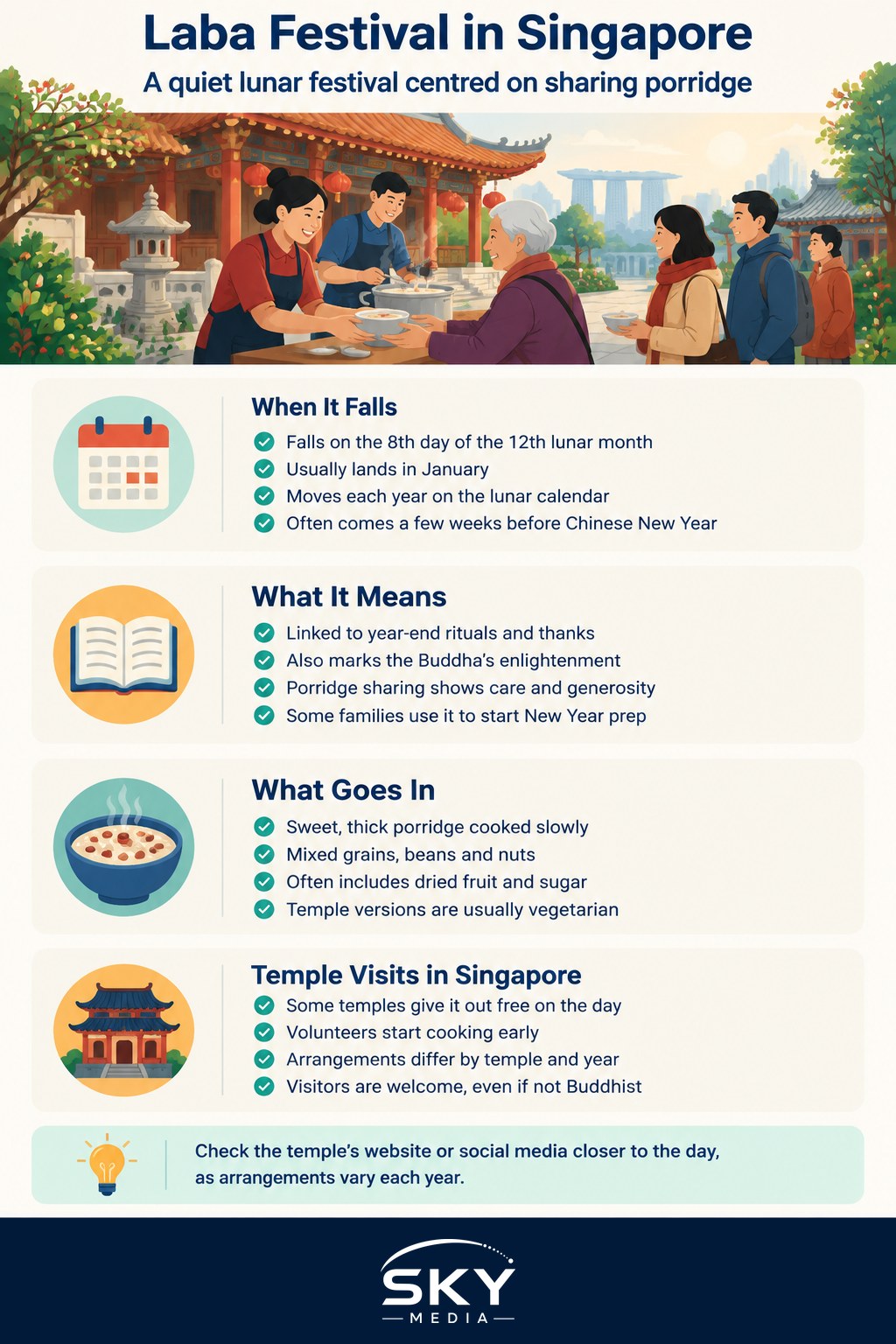
The name says it all. “La” (腊) refers to the 12th month of the Chinese lunar calendar, often called the La month, and “ba” (八) means eight. The Laba festival (腊八节) falls on the eighth day of the 12th lunar month.
Because the lunar calendar does not line up neatly with the Gregorian one, the date moves each year, usually landing in January, a few weeks before Chinese New Year. Check a current lunar calendar or your temple’s notices for the exact date in any given year.
For many families, Laba also works as an informal starting gun for Lunar New Year. There is an old saying in parts of China that once Laba arrives, the New Year is not far behind, and households traditionally began cleaning, preparing food and planning reunions around this time.
The Meaning Behind the Day
Laba draws on several strands of history and belief, and different families and communities emphasise different ones.
Ancient year-end rituals. Long before Buddhism reached China, the end of the year was a time for offerings to ancestors and deities, giving thanks for the harvest and praying for good fortune in the coming year. The La month itself is linked with these year-end sacrifices.
The Buddha’s enlightenment. In Chinese Mahayana Buddhist tradition, the eighth day of the 12th lunar month is observed as the day Siddhartha Gautama attained enlightenment. A well-known story tells of the ascetic, weak from fasting, being offered a bowl of milk rice porridge by a village girl, which restored his strength before he meditated under the Bodhi tree. Chinese Buddhist temples came to mark the day by cooking porridge and sharing it, and this is the main reason temples are so closely associated with Laba today.
Sharing and generosity. Over time, giving porridge away became a way to share blessings and care for the poor during the cold season in northern China. That spirit of generosity is what you see in temple giveaways in Singapore.
As with many festivals, practices vary from family to family. Some observe Laba carefully, others only know it as “the porridge day”, and many younger Singaporeans may not mark it at all.
What Goes Into Laba Porridge
Laba porridge (腊八粥, la ba zhou) is sometimes called eight treasure porridge, although the number of ingredients is not fixed. The idea is abundance: many grains and good things cooked together in one pot.
Common ingredients include:
- Glutinous rice and regular rice
- Grains such as millet, barley or oats
- Red beans, mung beans or other pulses
- Peanuts, lotus seeds and gingko nuts
- Dried longan, red dates (jujubes) and raisins
- Chestnuts or other nuts
- Rock sugar or brown sugar for sweetness
Most versions are sweet, slow-cooked until thick and creamy. Temple porridge is typically vegetarian, in keeping with Buddhist practice. Some families in northern China also make a savoury version, and in some regions people pickle garlic in vinegar on Laba (Laba garlic) to eat with dumplings at New Year.
If you want to try making it at home, the technique is similar to other slow-cooked congees: soak the harder beans and grains first, simmer them until soft, then add quicker-cooking items and sweeten towards the end. Our guide on how to make congee and porridge at home covers the basic method and ratios.
| Laba porridge | Everyday Chinese congee |
|---|---|
| Usually sweet, sweetened with rock or brown sugar | Usually savoury, eaten with side dishes |
| Many grains, beans, nuts and dried fruit | Mostly plain rice with water or stock |
| Traditionally vegetarian when cooked at temples | Often includes meat, fish or century egg |
| Linked to one date and its meaning | Eaten any day, for breakfast or when unwell |
For more on how porridge features in Singapore’s everyday food culture, from Cantonese congee to Teochew muay, see our guide to porridge and congee.
Temple Porridge Giveaways in Singapore
In Singapore, a number of Chinese Buddhist temples and associations cook laba porridge in large quantities and give it away free on the day, sometimes alongside prayers or chanting. Volunteers often start cooking in the early hours, and distribution can begin early in the morning and continue until the porridge runs out.
Arrangements differ from temple to temple and from year to year, so check the temple’s own website or social media pages, or ask at the temple office, for details closer to the date. Some may distribute in packets for you to take home, others serve it on site, and some may not hold a giveaway every year.
If you plan to go, a few practical pointers:
- Go early. Popular giveaways can draw long queues, and supply is limited.
- Bring a container if invited. Some temples encourage visitors to bring their own reusable container; follow whatever the temple asks.
- Dress modestly. Covered shoulders and knees are appreciated in temple spaces.
- Follow the queue and volunteers. They are managing large crowds, so patience helps.
- Be mindful of shrines. Speak softly near prayer halls and avoid pointing cameras at people praying.
- Consider a donation. Many temples rely on donations to fund events like this. Giving is welcome but not expected of visitors.
You do not need to be Buddhist or Chinese to receive a bowl. The spirit of the day is sharing, and guests are generally welcomed warmly.
Marking Laba at Home
If you cannot get to a temple, there are simple ways to mark the day:
- Cook a pot of porridge with family. Let children choose the “treasures” to add, and explain why the dish is shared.
- Share with neighbours or relatives. In keeping with the custom, give away a portion to those around you.
- Start your New Year preparations. Use the day as a cue to start spring cleaning, write your shopping list for reunion dinner, or plan visits.
- Learn the stories. Talk to older relatives about how they or their parents observed Laba; customs from different dialect groups and hometowns can vary.
Laba is a small festival, but it carries a generous idea: that the best way to close the year is with a warm bowl and something to share. If you enjoy exploring Singapore’s calendar of harvest and thanksgiving traditions across communities, you may also like our guide to the Pongal festival.