
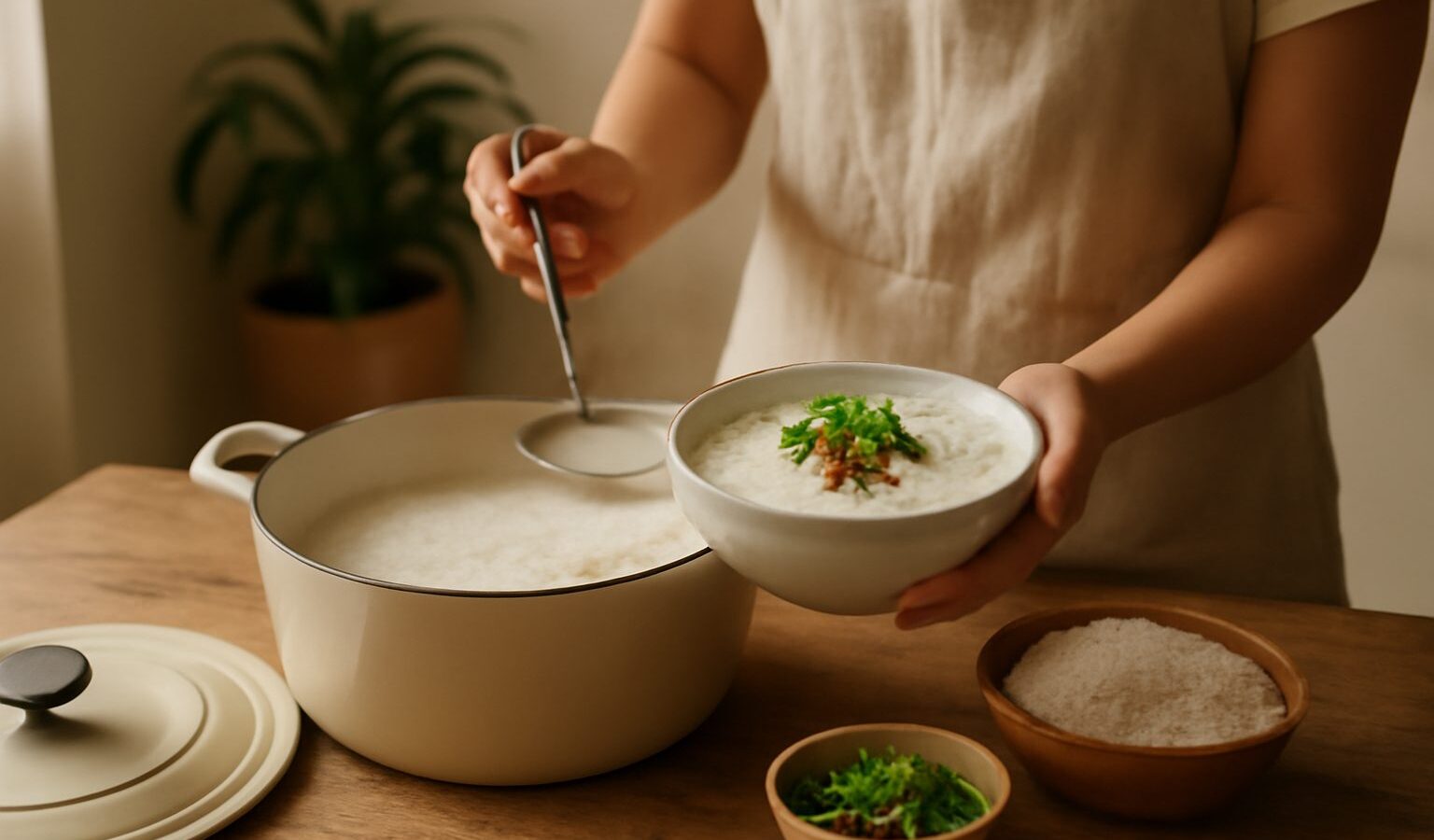
Few things comfort quite like a warm bowl of congee. Whether you grew up calling it porridge, muay, or juk, learning to make congee at home means you always have something soothing to reach for when you are unwell, tired, or simply craving a gentle meal. The dish is humble by design, just rice and water coaxed into a soft, silky bowl, yet the difference between a thin, watery version and a properly creamy one comes down to a few simple techniques. The good news is that congee is almost impossible to get badly wrong once you understand the ratios and the patience it asks for.
This guide covers the rice to water ratios that shape your texture, the slow simmer that makes congee luxurious, how to build flavour with toppings, and how to store and reheat leftovers safely. Let us get a pot going.
Understanding Rice and Water Ratios
The single most important decision in making congee is the ratio of rice to water, because it decides everything about the final texture. More water gives you a thinner, more soup-like congee, while less water gives a thick, spoon-coating porridge. There is no single correct answer, only your preference.
As a rough guide, a ratio of around one part rice to eight or nine parts water gives a classic, flowing Cantonese style congee where the grains have all but dissolved. If you prefer a thicker Teochew style muay where the grains stay a little more intact, use less water, closer to one part rice to six or seven parts water. It is always easier to loosen a thick congee by stirring in more hot water later than it is to rescue one that has gone too watery, so if in doubt, start on the thicker side.
Any long or medium grain white rice works well, and plain jasmine rice is a common and reliable choice. Rinse the rice first to wash off excess surface starch and any dust, then, if you have time, let it soak for half an hour or so. Soaking is optional but it helps the grains break down faster and gives a smoother result. Some cooks also stir in a few drops of oil, which is said to help the congee turn creamy.
The Slow Simmer
Congee cannot be rushed, and that is really its only demand. Bring your rice and water to a rolling boil in a large, heavy pot, then immediately turn the heat down to a gentle simmer. A large pot matters here, because congee can bubble up and boil over if the pot is too full or the heat too high.
Now comes the patience. Let it simmer gently, partially covered, for anywhere from around forty five minutes to well over an hour, depending on how broken down you like the grains. Stir it every so often, especially towards the end, to stop the rice sticking and catching on the base of the pot. As it cooks, the grains swell, split and release their starch, thickening the liquid into that signature silky, creamy body. You will see it transform from loose rice in water into a unified, glossy porridge.
If it thickens more than you want, simply stir in a splash of hot water or stock. If it is still too thin for you, keep simmering with the lid off and let some liquid cook away. Cooking congee in a good stock rather than plain water adds a savoury depth, and it is one of the easiest ways to lift a plain bowl into something special.
Plain Water Versus Stock
Whether you cook your congee in water or stock changes the character of the dish considerably. The table below lays out the main options.
| Cooking liquid | Flavour | Best for | Notes |
|---|---|---|---|
| Plain water | Clean and neutral | Sick days, plain comfort | Lets toppings shine |
| Chicken stock | Savoury and rounded | Everyday savoury congee | A popular all rounder |
| Pork or bone stock | Deep and rich | Hearty, filling bowls | Great with meat toppings |
| Ikan bilis stock | Light and umami | A local savoury twist | Strain out the bones first |
Plain water is perfectly good and lets your toppings take centre stage, but a homemade stock rewards you with a bowl that tastes complete on its own. Either way, season towards the end of cooking rather than the start.
Toppings, Storing and Safe Reheating
Congee is really a blank canvas, and the toppings are where you make it your own. Classic additions include shredded poached chicken, sliced fish, minced pork, century egg, and a soft or raw egg stirred through the hot porridge. Aromatic finishes bring it alive, so scatter over chopped spring onion, fried shallots, julienned ginger, a drizzle of sesame oil, a dash of white pepper and a splash of light soy sauce. Crunchy elements like you tiao, or fried dough fritters, and roasted peanuts add welcome texture.
When you add raw or lightly cooked ingredients such as sliced fish or a cracked egg, drop them into the congee while it is piping hot and give it a minute so the residual heat cooks them through. If you are cooking with chicken, pork or seafood, make sure the meat is properly cooked before serving.
Congee keeps well, which makes it excellent for batch cooking, but leftovers need sensible handling. Cool leftover congee reasonably quickly rather than leaving it sitting out, and get it into the fridge rather than leaving it at room temperature for a long stretch. It will thicken considerably once chilled, which is completely normal. When you reheat it, add a little water or stock to loosen it back to the texture you like, and heat it thoroughly all the way through until it is steaming hot, stirring so it warms evenly. Do not reheat it half-heartedly or repeatedly. Warm only what you plan to eat, and if any batch smells off, throw it out. This is general food safety guidance rather than a substitute for official advice.
With the ratios understood, a patient simmer, and a few good toppings, congee becomes one of the most useful dishes in your repertoire. It stretches a little rice a long way, soothes almost any ailment, and welcomes whatever you have in the fridge. Once you have made it a few times, you will find your own perfect thickness and never quite look at a bowl of shop porridge the same way again.
Explore more
Porridge and Congee in Singapore
How to Make Stock and Broth from Scratch
How to Make Yogurt at Home
How to Make Nasi Lemak at Home