

Getting laid off in Singapore is stressful, and the first few days often feel like a blur. Emotions matter, but this guide is deliberately practical. It is a checklist of the things to sort out quickly, covering your exit paperwork, money, CPF and insurance, references and the job search, so nothing slips through while you are still processing the news.
This is general information, not legal or financial advice. Employment rules, government support schemes and eligibility criteria change, so check the current details with the Ministry of Manpower (MOM), CPF Board, IRAS and the Skills and Workforce Development Agency (SWDA, formed in 2026 from Workforce Singapore and SkillsFuture Singapore).
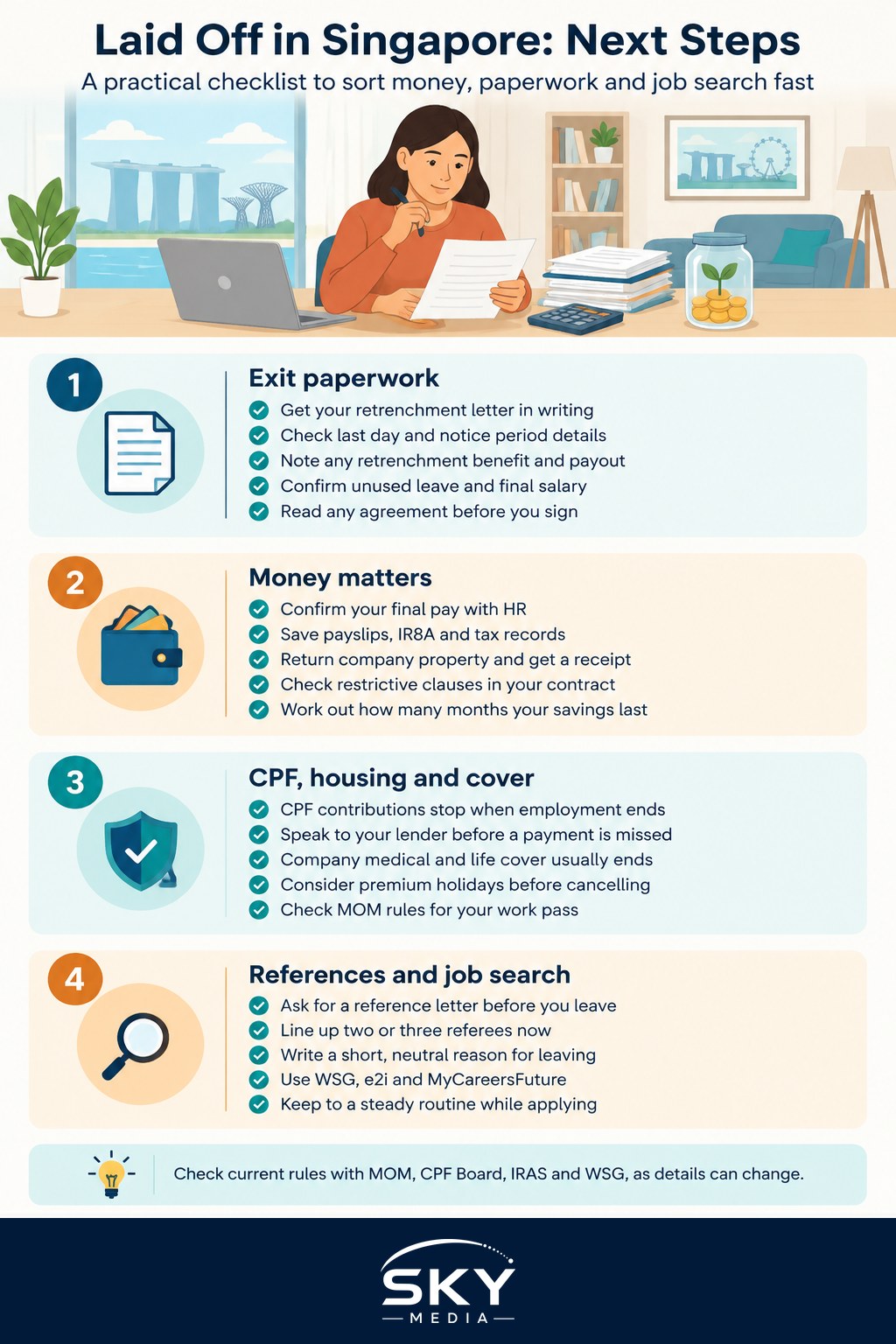
Before You Leave the Building: Get It in Writing
The first conversation usually happens fast. Stay calm, and before you sign anything, make sure you have the key facts in writing:
- The termination or retrenchment letter, stating your last day of employment and the reason.
- Notice period details, including whether you will work it out or receive salary in lieu of notice.
- Retrenchment benefit, if any, and how it was calculated.
- Unused annual leave, and whether it will be paid out or must be cleared.
- Final salary date and what it will include, such as pro-rated pay, commission or bonus.
- Any agreement you are asked to sign, such as a settlement or release. Take time to read it, and seek advice if anything is unclear.
Under the tripartite guidelines on responsible retrenchment, employers are encouraged to pay retrenchment benefits to eligible employees, with the amount commonly linked to years of service and the company’s situation. Whether you are entitled, and how much, depends on your contract, any collective agreement and your length of service. MOM’s website explains the current guidelines.
Your First Week: Money and Paperwork
Once the immediate shock settles, turn to the paperwork that has deadlines or affects your cash flow.
- Confirm your final pay. The Employment Act sets out when salary must be paid on termination. If payment is late or incorrect, raise it with HR first, then with MOM or TADM (the Tripartite Alliance for Dispute Management) if it is not resolved.
- Return company property and get written acknowledgement, so it cannot later be deducted from your pay.
- Save your records. Download your payslips, IR8A or tax records, appraisals and any awards from internal systems before access is cut. Avoid copying confidential company data.
- Review restrictive clauses. Check your contract for non-compete, non-solicitation or confidentiality terms that may affect your next role.
- Work out your runway. List monthly fixed costs and divide your savings plus final payout by that figure. This tells you how many months you can search without strain.
Taxes on different exit payments are not all treated the same way. IRAS explains which payments, such as salary in lieu of notice and compensation for loss of employment, are taxable, so check before assuming a lump sum is tax free.
CPF, Housing and Insurance
Losing a job affects more than your monthly salary. Look at these areas in the first fortnight:
- CPF contributions stop once your employment ends. If your housing loan instalments are paid from your CPF Ordinary Account, they will continue drawing on the existing balance until it runs low, after which you would need cash. Check your balance on the CPF website.
- Talk to your lender early. If you foresee difficulty with mortgage payments, banks and HDB generally prefer to hear from you before you miss a payment. HDB has assistance options for flat owners facing financial difficulty.
- Group insurance ends. Company medical, hospitalisation and life cover usually stop on your last day or shortly after. MediShield Life continues to cover Singapore Citizens and PRs, but check whether you need personal cover for anything the company plan used to provide.
- Pause, do not cancel, if unsure. For investment-linked policies or regular savings plans, ask your insurer or bank about premium holidays rather than surrendering in a hurry.
If you hold an Employment Pass or S Pass, your pass will be cancelled by your employer after employment ends. MOM sets out what happens next and whether you can stay in Singapore for a period to look for work, so check the current rules on the MOM website immediately.
References, Records and Your Story
Your next employer will want to know why you left and who can vouch for you. Sort this out while relationships are fresh:
- Ask for a reference letter or testimonial from your manager before your last day. A short letter on company letterhead stating your role, dates and key strengths is valuable.
- Line up two or three referees who agree to take calls, and confirm their preferred contact details.
- Request LinkedIn recommendations from colleagues while your work is recent in their minds.
- Write a one-line explanation of your departure. “My role was made redundant as part of a restructuring” is honest, neutral and common. Practise saying it until it feels natural.
The Job Search: Support You Can Use
Singapore has several public support channels for people who have been laid off:
- SWDA (formerly Workforce Singapore) runs career centres and career matching services, with coaching on CVs and interviews.
- NTUC’s Employment and Employability Institute (e2i) offers job matching and career advice, including for union members.
- MyCareersFuture is the government job portal where many employers list roles.
- SkillsFuture credits and subsidised courses can help you upskill. The SkillsFuture Jobseeker Support scheme offers temporary financial support to eligible involuntarily unemployed residents who are actively looking for work, subject to its criteria. Check eligibility on the official website.
| Timeframe | Focus | Key actions |
|---|---|---|
| Day 1 to 2 | Exit terms | Get letters in writing, read before signing, note last day |
| Week 1 | Pay and records | Confirm final pay, save documents, return property |
| Week 2 | CPF, housing, insurance | Check CPF balance, speak to lender, review cover |
| Weeks 2 to 4 | References and story | Collect references, update CV and LinkedIn |
| Month 1 onwards | Job search | Register with SWDA or e2i, apply steadily, consider courses |
Keeping a Steady Routine
A job search goes better with structure. Set fixed hours for applications, networking and learning, and keep weekends free. Track applications in a simple spreadsheet so follow-ups do not slip. If your routine slides during a tough week, our guide on how to get back on track after falling off has practical ways to restart without guilt.
Look after your health too. Regular exercise, sleep and time with friends help you stay sharp in interviews. If stress feels overwhelming, speak to your doctor or a counsellor; support is available and asking for it is a sign of good judgement, not weakness.
Common Mistakes in the First Month
- Signing exit documents on the spot without reading them.
- Leaving without references and struggling to reach managers later.
- Spending the payout quickly before you know how long the search will take.
- Letting insurance lapse without checking the gap.
- Applying everywhere at once with the same CV instead of tailoring it.
Being laid off is common across industries and says little about your ability. Work through the checklist, use the support available and check the official sources for the rules that apply to you.
Explore more: Retrenchment Rights and Support in Singapore and Managing Your Finances Between Jobs.
Frequently Asked Questions
Is there unemployment insurance in Singapore? There is no general national unemployment insurance scheme. Support instead comes through schemes for eligible residents, such as SkillsFuture Jobseeker Support, along with career services and the retrenchment benefits some employers pay. Check eligibility and current details with the SWDA, MOM and CPF Board.
Can I withdraw my CPF to cover bills while I am unemployed? Generally not. CPF savings are meant for retirement, housing and healthcare, and withdrawal is only allowed in specific situations. Being laid off does not by itself unlock your balance. Check what you can and cannot do with the CPF Board before making plans around those funds.
Should I accept the retrenchment package or try to negotiate? Read the terms carefully before you sign, and don’t feel rushed. You can ask how the amount was calculated and whether anything is negotiable. If you are unsure, a union, a lawyer or TADM can advise. Never sign a release on the spot if you do not understand what you are giving up.
My boss asked me to resign instead of being retrenched. Should I? Be cautious. Resigning can affect any retrenchment benefits you might otherwise receive, so do not decide on the spot. Ask for the offer in writing, understand what you would receive either way, and get advice from MOM, TADM or a lawyer before you agree.
How long can I stay in Singapore after my work pass is cancelled? It depends on your pass type and the rules at the time, so check MOM’s website straight away rather than assuming. MOM sets out whether a grace period is allowed to look for work, and what you need to do. Your employer is also required to cancel the pass after employment ends.
Official sources: Ministry of Manpower (MOM) · MyCareersFuture