

Labour Day is a good moment to check something many employees are unsure about: what exactly are you owed when a public holiday comes round? Public holiday pay in Singapore follows clear rules for most employees, but the details change depending on whether you work that day, whether the holiday lands on your rest day or off day, and what your contract says.
This guide focuses on public holidays only. Overtime and rest day pay follow separate rules, and the site’s existing guides on those topics cover them. Everything here is general information, not legal advice. The Ministry of Manpower (MOM) is the authority on employment rules, so check its website for the current position on your situation.
Who Is Covered by the Public Holiday Rules
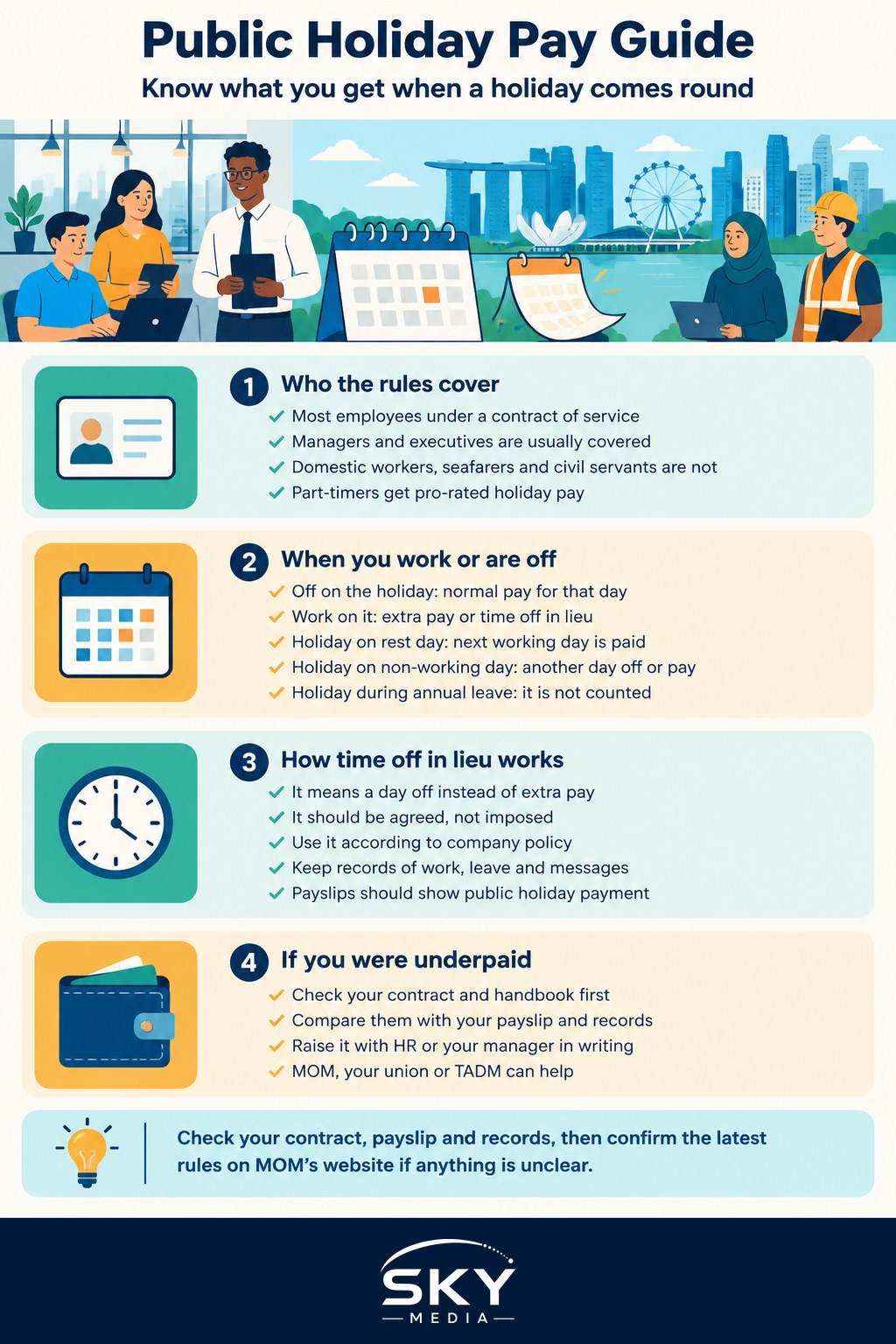
The public holiday provisions sit in the Employment Act, Singapore’s main employment law. Most employees working under a contract of service in Singapore are covered, including managers and executives. Some groups are not, notably domestic workers, seafarers and civil servants, who have their own terms or legislation.
If you are covered, you are entitled to the gazetted public holidays each year with pay. Singapore has 11 gazetted public holidays, covering New Year’s Day, Chinese New Year (two days), Good Friday, Labour Day, Hari Raya Puasa, Vesak Day, Hari Raya Haji, National Day, Deepavali and Christmas Day. For dates in any given year, see our Singapore public holidays guide.
A few points that often surprise people:
- Part-time employees are also entitled to public holidays, but the pay is generally worked out on a pro-rated basis according to their working pattern. MOM publishes guidance on how this is calculated.
- Your employer can agree to swap a public holiday for another day with you. The swapped day then becomes your paid holiday instead.
- Absence around the holiday can matter. Under MOM’s rules, an employee who is absent without the employer’s consent or a reasonable excuse on the working day immediately before or after a public holiday may lose the holiday pay. Check MOM’s guidance for the precise wording.
What You Are Owed in Each Situation
The core rules are easier to understand side by side. This table summarises the general position for employees covered by the Employment Act.
| Situation | What you are generally entitled to | Notes |
|---|---|---|
| You are off on the public holiday as normal | Your normal pay for that day | This is the standard paid holiday |
| You are asked to work on the public holiday | An extra day’s salary at your basic rate of pay, or a day off in lieu | Time off in lieu needs agreement between you and your employer |
| The public holiday falls on your rest day | The next working day becomes a paid holiday | Rest day is your weekly day of rest, often Sunday |
| The public holiday falls on your non-working day | Another day off in lieu, or an extra day’s salary | Common for five-day workers when a holiday lands on a Saturday |
| The public holiday falls during your annual leave | The holiday is not counted as annual leave | You keep that day of leave |
A separate point applies when a public holiday falls on a Sunday. In that case the following Monday is usually declared a public holiday for everyone. MOM confirms these dates each year.
How Time Off in Lieu Works
Time off in lieu means getting a day off on another date, instead of extra pay, to make up for working on a public holiday or for a holiday that fell on a non-working day. It is common in industries that run every day, such as retail, hospitality, healthcare and logistics.
Some practical points to understand:
- It should be agreed, not imposed. For work on a public holiday, MOM’s rules allow a day off in lieu instead of extra pay where the employer and employee agree. Many companies set this out in the employment contract or handbook.
- Ask when you can take it. Your employer may have a policy on how soon the day must be used, and whether unused days are paid out or lapse. Get this in writing.
- Keep records. Note the date you worked, the date you took off in lieu and any related messages. If there is a dispute later, clear records make it much easier to resolve.
- Check your payslip. Employers must issue itemised payslips, so you can see whether a public holiday payment has been made.
If your contract offers something more generous than the law, such as extra pay at a higher rate, the contract applies. If your contract offers less than the law, the legal minimum still applies to employees covered by the Employment Act.
Working Long Hours on a Public Holiday
Some employees end up working more than their normal hours on a public holiday. For employees covered by Part IV of the Employment Act, which deals with hours of work and overtime for workmen and lower-earning non-workmen, overtime rules may also apply on top of the public holiday entitlement. Whether you are covered by Part IV depends on your role and salary, and the thresholds can change, so check MOM’s current guidance.
Managers and executives are generally not covered by Part IV, so overtime pay depends on their contract. They are still entitled to public holidays under the main provisions of the Employment Act.
Shift Workers, Rest Days and Off Days
The difference between a rest day and a non-working day trips many people up.
- A rest day is your weekly day of rest, usually one day a week. For many office workers this is Sunday.
- A non-working day is a day you do not normally work that is not your rest day, such as Saturday for someone on a five-day week.
If you work shifts, your rest day may change from week to week. It helps to ask your employer to confirm in writing which day counts as your rest day each week, so that holiday entitlements can be worked out correctly. For planning around holiday dates, our guide to planning long weekends in Singapore can help you see which holidays fall where.
Students, Casual and Contract Workers
Students working part-time and holiday jobs often work through public holidays, especially in food and beverage and retail. If you are employed under a contract of service, the Employment Act generally applies to you too, with pro-rated entitlements for part-timers.
Freelancers and self-employed persons are in a different position. They work under a contract for service, so the Employment Act holiday rules do not apply. Any holiday rates depend on what is agreed with the client.
What to Do if You Think You Were Underpaid
Start with a calm, factual approach:
- Check your contract and handbook to see what has been promised on public holidays and time off in lieu.
- Compare with your payslip and records of days worked.
- Raise it with HR or your manager in writing, giving dates and amounts. Many issues are simple payroll errors.
- Seek advice if it is not resolved. Union members can approach their union. Employees can also contact MOM or the Tripartite Alliance for Dispute Management (TADM), which handles salary-related claims and mediation. Check their websites for the current process, eligibility and time limits for making a claim.
The Takeaway on Public Holiday Pay
For most employees in Singapore, the rules come down to this: a public holiday is paid, working on one earns you an extra day’s pay or a day off in lieu by agreement, and a holiday that lands on a rest day or off day still gives you a benefit. Know your contract, keep your records and check MOM’s website for the latest rules, and you will be in a good position to get what you are owed.
Official sources: Ministry of Manpower (MOM)
Further reading: No-Pay Leave in Singapore: How It Works and How It Affects Your Pay