

A tenant not paying rent is one of the most stressful situations a landlord in Singapore can face. The mortgage or loan instalment still goes out every month, and it is tempting to react by changing the locks or switching off the utilities. Do not. Singapore has a clear, lawful path for recovering rent arrears, and following it in the right order protects both your money and your position if the matter ends up before a tribunal or court.
This guide walks through that path: a documented reminder, a formal letter of demand, using the security deposit properly, the Small Claims Tribunals and the court process known as distress for rent. It is general information, not legal advice. For anything beyond a straightforward claim, speak to a lawyer, and check current rules and limits on the official Judiciary and State Courts websites.
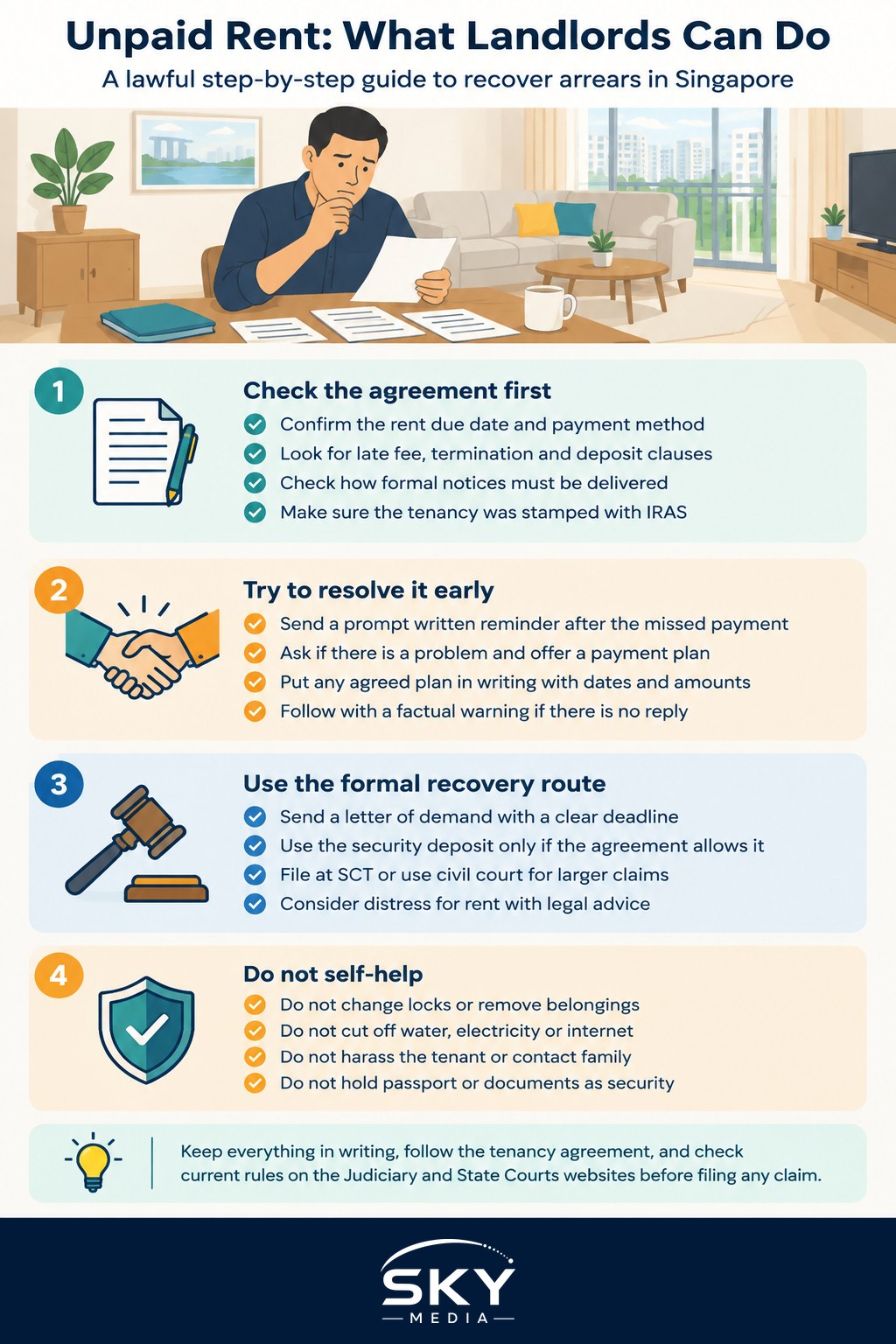
Before You Act: Check the Tenancy Agreement and Your Records
Everything you do next rests on two things: what the tenancy agreement says, and what you can prove.
Pull out the signed agreement and look for:
- The rent due date and payment method, so you can show exactly when the default began.
- A late payment or interest clause, if any. You can usually only charge what the agreement provides for.
- The termination clause, which often lets the landlord end the tenancy if rent is unpaid for a stated number of days after it falls due.
- The security deposit clause, including whether the deposit may be used to cover unpaid rent during the tenancy.
- The notice clause, which sets out how formal notices must be delivered, for example by email, by registered post or by hand.
Next, confirm the agreement was stamped with IRAS (the Inland Revenue Authority of Singapore). An unstamped document may need to be stamped, possibly with a penalty, before you can rely on it in proceedings.
Finally, build a simple arrears record: each rent due date, the amount due, any part payments and the date of each message you sent. Bank statements and chat screenshots are useful evidence.
Step by Step: From Friendly Reminder to Formal Claim
1. A prompt, polite reminder. Send a written message within a few days of the missed payment. Ask whether there is a problem. A short, agreed payment plan is often cheaper and faster than any legal route. If you agree a plan, put it in writing with specific dates and amounts.
2. A written warning that refers to the agreement. If the reminder is ignored, write again, quoting the relevant clauses and stating the total outstanding. Keep the tone factual. Avoid threats you cannot lawfully carry out.
3. A formal letter of demand. This sets out the amount owed, the basis for the claim, a clear deadline for payment and what you will do if the deadline passes, such as filing a claim or terminating the tenancy under the agreement. You can write it yourself or have a lawyer send it. Our guide on using a letter of demand for unpaid invoices explains the structure, which works for rent too. Deliver it in the way the notice clause requires and keep proof of delivery.
4. Termination, if the agreement allows it. If rent remains unpaid, you may be able to give notice to end the tenancy under the termination clause. Terminating does not wipe out the debt. You can still claim the arrears, and potentially other losses the agreement allows for.
5. A claim or court process. If the tenant still does not pay, move to the Small Claims Tribunals or, for larger or more complex matters, the civil courts, and consider distress for rent. These are covered below.
Using the Security Deposit the Right Way
Many landlords assume they can simply keep the deposit. It is more nuanced than that.
- During the tenancy, you can only use the deposit against unpaid rent if the agreement allows it. Many standard agreements say the deposit is not to be used as rent, and some allow the landlord to deduct and then require the tenant to top it back up.
- At the end of the tenancy, the deposit is normally applied against unpaid rent, utility bills and the cost of repairing damage beyond fair wear and tear, with the balance returned.
- Always account in writing. Send the tenant a breakdown of what you deducted and why, with receipts for repairs. An unexplained forfeiture invites a counterclaim.
If the arrears exceed the deposit, the deposit only reduces your claim.
Small Claims Tribunals and Distress for Rent Compared
The Small Claims Tribunals (SCT), part of the State Courts, handle many residential tenancy disputes, including claims for unpaid rent, provided the claim falls within the tribunals’ monetary limit and the tenancy meets the length requirement. Filing is done online, and the process usually begins with consultation, a form of mediation, before any hearing. Lawyers generally do not appear for parties at the SCT, which keeps costs down. Check the current claim limits, filing fees and eligibility on the Judiciary website before you file.
Distress for rent is an older, landlord-specific remedy under the Distress Act. In broad terms, the landlord applies to court for a writ of distress, and a court bailiff can then seize the tenant’s movable property on the premises, which may be sold to cover the arrears if the debt is not paid. It is a court process: a landlord must never seize belongings personally. There are limits on how far back the arrears can go and on what can be seized, so take legal advice before applying.
| Route | What it does | Best suited to | Points to check |
|---|---|---|---|
| Payment plan | Agreed schedule to clear arrears | Tenants with a temporary money problem | Put dates and amounts in writing |
| Letter of demand | Formal notice with a deadline | Every case before filing a claim | Delivery method in the notice clause |
| Small Claims Tribunals | Mediation, then an order to pay | Residential rent claims within the limit | Current monetary limit and fees |
| Distress for rent | Court bailiff seizes goods on the premises | Tenant still in the unit with goods of value | Legal advice, time limits, exempt items |
| Civil court claim | Full litigation, usually with a lawyer | Large sums or complex disputes | Legal costs against the amount owed |
Winning an order is not the same as being paid. If a tenant ignores an SCT order, there are enforcement steps through the courts, so keep your paperwork organised.
What Landlords Must Not Do
Self-help can turn a strong claim into a weak one, and some actions may expose you to civil or criminal liability.
- Do not change the locks or remove the tenant’s belongings while the tenancy is running. Recovering possession of an occupied unit against the tenant’s will requires a court order.
- Do not cut off water, electricity or internet to pressure the tenant.
- Do not harass the tenant or contact their employer or family to shame them.
- Do not hold their passport or other documents as security.
If the relationship has broken down in other ways, such as noise, damage or unauthorised occupants, see our separate guide on handling a difficult tenant. This article focuses only on money owed.
Reducing the Risk Next Time
Arrears are easier to prevent than to recover. Screen tenants properly, checking employment, pass validity and previous landlord references, using our guide to screening and choosing a tenant. Collect rent by bank transfer or GIRO so every payment leaves a record, and chase a missed payment within days rather than months. If you are new to letting, our beginner’s guide to being a landlord in Singapore covers the wider responsibilities.
When a tenant stops paying, stay calm, document everything and use the lawful steps in order. For current limits, fees and procedures, rely on the Judiciary and State Courts websites, and consult a lawyer where the sums or facts are complicated.
Official sources: Singapore Courts
Further reading: Renting a Landed House in Singapore: What Tenants Should Know · How to Evict a Tenant in Singapore: Notice, Termination and Legal Steps · Hiring a Property Manager for Your Rental Home