

For most Singapore home owners, the property tax bill is the first official bill of the year. It lands around the end of December, it is usually due by the end of January, and it is easy to forget in the rush of school starts and new-year plans. If you want to pay property tax by GIRO, or you are simply not sure how the bill works, this guide walks you through the timeline, your payment options and what happens if you pay late.
This article is about paying the bill, not calculating it. Property tax is worked out from the Annual Value (AV) of your property and the tax rates set by the government, which differ for owner-occupied and other properties. If you want to understand how your figure was reached, check the explanation on your bill and the property tax pages on the Inland Revenue Authority of Singapore (IRAS) website.
This is general information, not financial or tax advice. Rules, rates and payment arrangements can change, so confirm the current details with IRAS.
When the Property Tax Bill Arrives
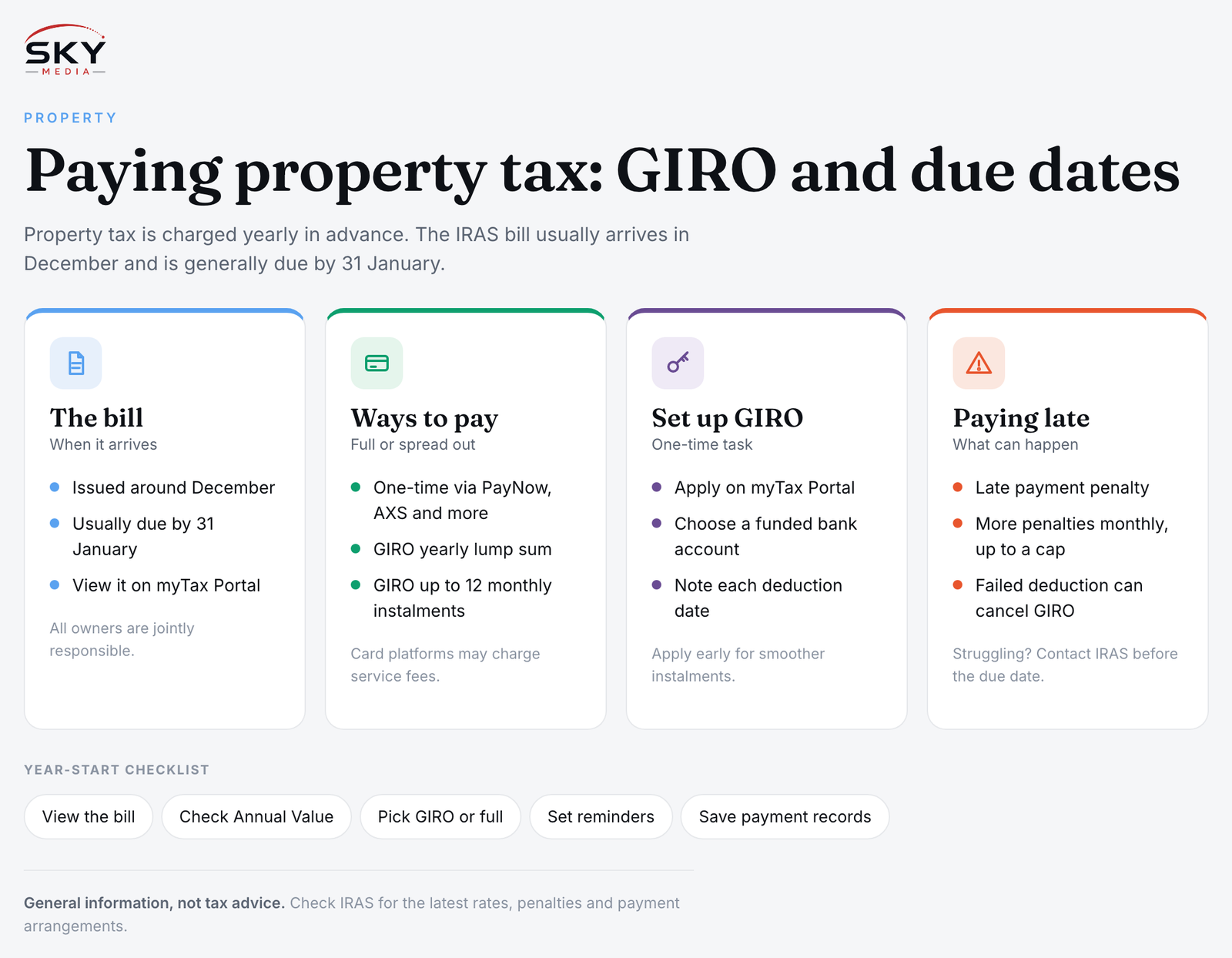
Property tax in Singapore is charged yearly in advance. IRAS typically issues the bill for the coming year in December, and the payment is generally due by 31 January. The exact due date is printed on your bill and in your notice on myTax Portal, IRAS’s online portal, which you log in to with Singpass.
A few points worth knowing:
- Bills are often digital first. IRAS sends many notices electronically. If you have opted for digital notices, you may get an alert via the Singpass app or email asking you to view your bill on myTax Portal, rather than a paper letter.
- Every owner of the property is jointly responsible. If you own a flat with your spouse, either owner can pay, but both are liable if it goes unpaid.
- Bills can change mid-year. If the Annual Value of your property is revised, or the owner-occupier status changes, IRAS may issue an amended bill. Read any new notice carefully, as it can change the amount or the instalments.
If you have not seen your bill by early January, log in to myTax Portal to check rather than assuming nothing is due.
Paying in Full vs GIRO Instalments
You have two broad ways to settle the bill: pay the whole amount by the due date, or spread it out with GIRO. GIRO (General Interbank Recurring Order) is an automatic bank deduction you authorise once. IRAS offers GIRO for property tax with up to 12 monthly instalments, interest-free, for eligible accounts. The number of instalments you get depends on when your GIRO arrangement starts and IRAS’s current rules, so check your GIRO plan on myTax Portal.
| Option | How it works | Best for | Watch out for |
|---|---|---|---|
| One-time payment | Pay the full bill by the due date via PayNow, internet banking, AXS or other modes IRAS lists | People with the cash ready who prefer one payment | Missing the January due date in the holiday rush |
| GIRO, yearly lump sum | IRAS deducts the full amount from your bank account on the deduction date | People who want it automatic but in one go | Keeping enough balance on the deduction date |
| GIRO, monthly instalments | IRAS deducts a smaller amount each month across the year | Households smoothing cash flow across the year | A failed deduction can cancel the GIRO plan |
| Credit card via third-party platform | A payment service charges your card and pays IRAS | People chasing card rewards | Service fees that may outweigh the rewards |
If you are weighing the last option, our guide to paying rent, tax and bills by credit card explains how those fees usually stack up.
How to Set Up GIRO for Property Tax
Setting up GIRO is a one-time task, and the arrangement generally carries on each year until you cancel it.
- Log in to myTax Portal with Singpass and look for the GIRO application option for property tax. Many major banks support online GIRO applications, so the approval can be quick.
- Choose your bank account. Use an account you keep funded. Some people use a dedicated bills account so deductions never clash with daily spending.
- Pick instalments or full payment, where the option is offered.
- Check the deduction schedule shown on myTax Portal after approval. Note the deduction date in your calendar.
- Keep the bank balance topped up a few days before each deduction date.
If your bank does not support online sign-up, IRAS lists alternative ways to apply, such as a paper form sent to the bank. Our general guide to setting up GIRO for your bills covers the wider process across utilities and other bills.
A practical tip: if you apply for GIRO after the bill is issued, the first deduction may be larger, or you may get fewer instalments, because the full year’s tax still needs to be collected within the year. Apply early if you want the smoothest monthly amounts.
What Happens if You Pay Late
IRAS treats property tax deadlines seriously. If the bill is not paid by the due date, a late payment penalty is usually imposed. If it stays unpaid, further penalties can be added for each month it remains outstanding, up to a cap set by law. The current penalty percentages and cap are published on the IRAS website, and our guide to IRAS late payment penalties explains the general approach.
Beyond penalties, IRAS has enforcement powers for long-overdue tax. These can include appointing agents such as tenants or banks to pay the tax on your behalf, and other legal action. Selling or transferring the property also becomes harder when tax is outstanding, because property tax arrears must be settled.
For GIRO users, the main risk is a failed deduction. If your account does not have enough money on the deduction date, IRAS may cancel your GIRO plan and ask you to pay the outstanding amount in one go. Penalties can then apply if you do not pay by the stated deadline.
If You Cannot Pay on Time
Life happens. If you know you will struggle to pay, act early rather than ignoring the bill.
- Contact IRAS before the due date. IRAS may consider a longer GIRO plan or other arrangement in genuine cases of financial difficulty. There is no guarantee, and it depends on your circumstances, but asking early gives you the best chance.
- Check whether your bill is correct. If your property’s use changed, for example you moved in and it is now owner-occupied, the rates may be different. Raise this with IRAS rather than simply withholding payment.
- Look at your wider finances. If property tax is one of several bills you cannot cover, our guide on what to do if you can’t pay your bills has practical first steps.
Do not stop paying while you wait for a reply on a query. In most cases, the tax is still due by the date on the bill.
A Simple Year-Start Property Tax Checklist
Use this list in late December or early January each year.
- Log in to myTax Portal and view this year’s property tax bill
- Check the property address, the Annual Value and owner-occupier status
- Decide between full payment and GIRO instalments
- If using GIRO, confirm the deduction schedule and the bank account
- Set calendar reminders a few days before each deduction date
- Save a copy of the bill and payment record with your household documents
- If anything looks wrong, contact IRAS early
Property tax is one of the most predictable bills a home owner faces. Once you pay property tax by GIRO and keep the account funded, it becomes one less thing to think about in January.
Frequently Asked Questions
Can I pay my property tax with PayNow or internet banking? Yes, IRAS lists several payment modes, including PayNow, internet banking and AXS, for paying in full by the due date. Check the current list on IRAS’s website or on your bill, as options can change. Whichever you choose, keep the payment record with your household documents.
Who gets the property tax bill if I just bought a flat? The bill goes to the owner of the property, and IRAS may issue an amended bill if ownership or owner-occupier status changes mid-year. Check myTax Portal rather than waiting for a letter. If you are unsure how the tax is split with the seller, ask your lawyer or IRAS.
Does a failed GIRO deduction cancel my instalment plan? It can. If your account lacks enough money on the deduction date, IRAS may cancel the GIRO plan and ask you to pay the outstanding amount at once, with penalties if you miss the stated deadline. Keep your balance topped up a few days before each deduction.
Do I pay property tax if I rent out my flat? Yes, property tax is still due on the property, but rates differ between owner-occupied and non-owner-occupied homes. Tell IRAS if the use of the property changes, since this can affect the bill. Check the rate details on IRAS’s property tax pages.
Can IRAS recover unpaid property tax from my tenant or bank? IRAS has enforcement powers for long-overdue tax, which can include appointing agents such as tenants or banks to pay the tax on your behalf, alongside other legal action. Arrears must also be settled before a sale or transfer, so contact IRAS early if you cannot pay.
Official sources: IRAS
Further reading: How to Claim the Owner-Occupier Property Tax Rate on Your Home