

Most people in Singapore pay their income tax without a second thought, usually through GIRO. But a changed bank account, a forgotten bill or a bigger than expected tax amount can leave a payment overdue, and an IRAS late payment penalty can start adding to what you owe surprisingly quickly.
This guide explains how late payment works for individual income tax, what IRAS (the Inland Revenue Authority of Singapore) can do if tax stays unpaid, how GIRO instalments help you avoid the problem, and what to do if you have already missed a deadline. It is general information, not tax or financial advice. Penalty rates and procedures can change, so always confirm the current position on the IRAS website or myTax Portal.
When Your Tax Is Actually Due
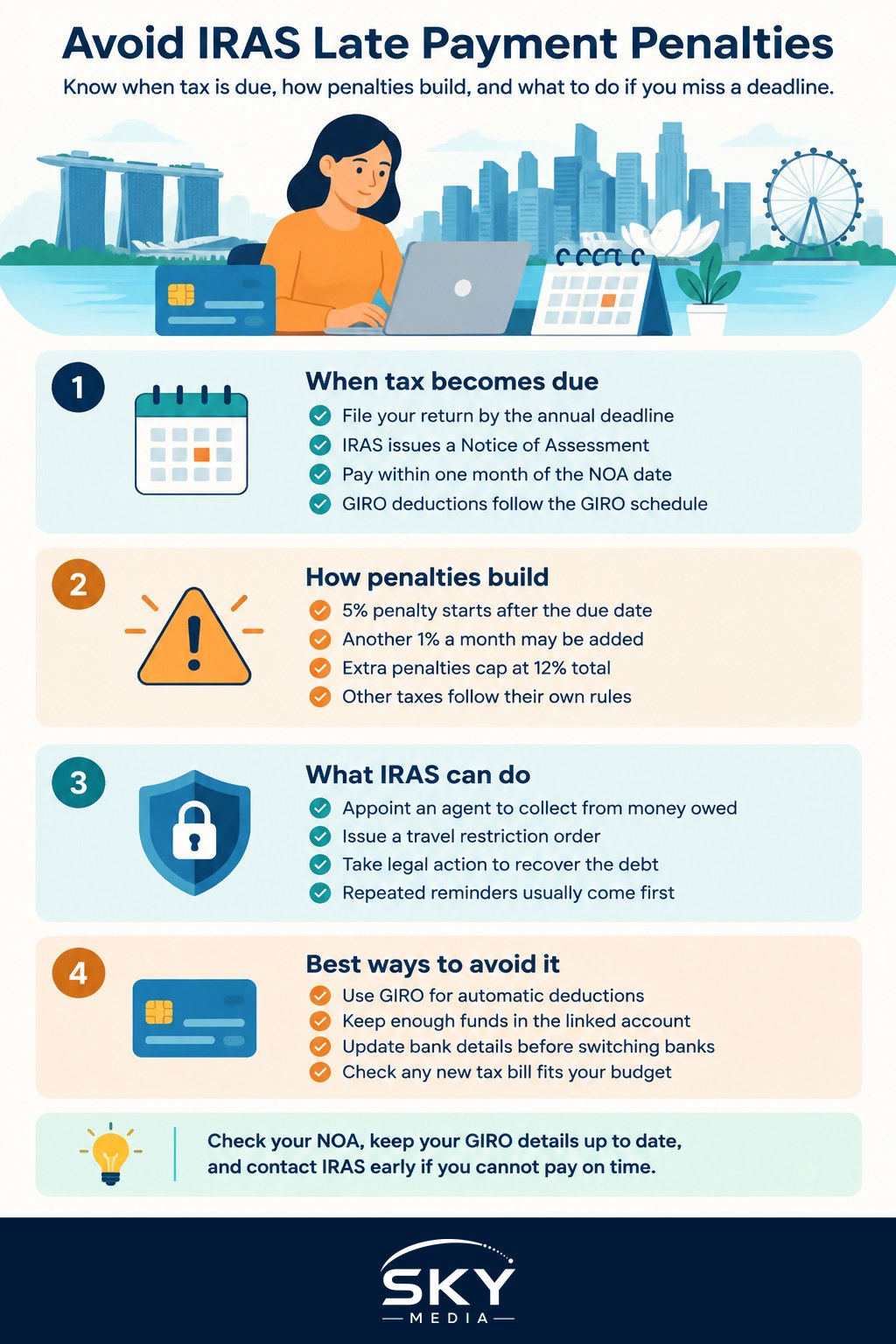
For individuals, the timeline usually runs like this:
- You file your return through myTax Portal, IRAS’s online portal, by the annual filing deadline. Many employees on the No-Filing Service (NFS) are not required to file, but should still check their pre-filled income.
- IRAS issues a Notice of Assessment (NOA), the official bill showing how much tax you owe.
- Payment is due within one month of the date on the NOA, unless you are already on a GIRO plan, in which case deductions follow the GIRO schedule.
Late payment penalties relate to paying after the due date on your NOA. Late filing is a separate matter with its own consequences, covered further below. If you are unsure how filing works, our guide to filing your taxes online with IRAS walks through the process.
How the Late Payment Penalty Builds Up
At the time of writing, IRAS describes a two-stage penalty for individual income tax that is not paid by the due date:
- An initial penalty of 5% of the unpaid tax is imposed once the due date passes.
- A further penalty of 1% per month may be added on the tax still unpaid, if it remains outstanding 60 days after the 5% penalty, up to a maximum total additional penalty of 12%.
Taken together, a bill left unpaid long enough can grow meaningfully. Other taxes, such as GST for businesses or property tax, follow their own penalty rules, so business owners and property owners should check the specific page for each tax on the IRAS website rather than assume the income tax figures apply.
Penalties are only part of the picture. If tax remains unpaid, IRAS has enforcement tools, which can include:
- Appointing an agent, such as your employer, bank or tenant, to pay IRAS directly from money owed to you.
- Issuing a travel restriction order, which can stop you from leaving Singapore until the tax is settled.
- Taking legal action to recover the amount owed.
These are typically used after repeated reminders, but they show why ignoring an overdue tax bill is never a good idea.
Late Payment Scenarios and What to Do
| Situation | What usually happens | What you should do |
|---|---|---|
| Missed the due date by a few days | 5% penalty imposed on the unpaid tax | Pay the full amount, including the penalty, as soon as possible |
| GIRO deduction failed | IRAS may cancel the GIRO plan and the full balance can become payable | Top up your account, contact IRAS and ask about restoring the plan |
| Cannot afford the full amount | Penalties continue to build on what is unpaid | Apply for a GIRO plan or ask IRAS for a payment arrangement early |
| Disputing the assessment | Tax is still payable by the due date | File an objection and pay on time while it is reviewed |
| Not filed at all | IRAS may issue an estimated assessment and take action for late filing | File your return as soon as possible and pay the resulting tax |
Why GIRO Instalments Are the Easiest Fix
GIRO, short for General Interbank Recurring Order, lets IRAS deduct tax directly from your bank account on a set schedule. For individual income tax, IRAS offers interest-free GIRO instalment plans, and many taxpayers can spread payments over up to 12 months, depending on when they apply and when the NOA is issued. The exact number of instalments available can vary, so check what you are offered when you sign up.
Benefits of paying by GIRO:
- No missed deadlines. Deductions happen automatically, so you are not relying on memory.
- Smoother cash flow. A large bill becomes manageable monthly amounts.
- The plan usually carries on to future years, so you only need to set it up once.
What can go wrong:
- Insufficient funds. If deductions fail, IRAS may cancel the plan and require the outstanding balance to be paid in full. Keep a buffer in the linked account around deduction dates.
- Closed or changed accounts. If you switch banks, set up a new GIRO arrangement before closing the old account.
- Changed income. If your tax bill rises sharply, for example after declaring new income such as rental income to IRAS, check the new instalment amount fits your budget.
You can apply for GIRO through myTax Portal or through your bank’s internet banking, depending on the bank.
What to Do If You Have Missed a Deadline
If you realise a payment is overdue, act quickly. Penalties grow with time, and early contact with IRAS usually leads to a better outcome.
- Log in to myTax Portal and check your account summary, including the tax payable and any penalty already imposed.
- Pay what you can immediately, using the payment modes IRAS lists, such as PayNow QR, internet banking or AXS (the network of payment kiosks and online payment services).
- If you cannot pay in full, contact IRAS to ask about an instalment plan or payment arrangement. Explain your circumstances honestly. IRAS may consider requests case by case, but nothing is guaranteed.
- Ask about penalty remission only if you have a genuine reason, such as serious illness or a documented error. IRAS decides these requests on their merits.
- Set up GIRO so the same problem does not happen next year.
If you have not filed at all, file first. IRAS may raise an estimated assessment based on available information, and that estimated tax must still be paid by the due date even while you file your actual return. Late filing can also lead to separate penalties or composition fines, so treat the filing deadline as seriously as the payment deadline.
Habits That Keep You Clear of Penalties
- Update your contact details in myTax Portal so you receive NOAs and reminders. Many notices now arrive digitally.
- Check your income records each filing season, especially if you have side income, freelance work or rental earnings.
- Set aside money monthly if you are self-employed, since no employer withholds tax for you. If clients pay you late, our guide on handling late paying clients in Singapore can help steady your cash flow.
- Do not wait for objections to resolve before paying. If you disagree with an assessment, you can file an objection, but the tax is generally still payable on time and IRAS refunds any overpayment if the objection succeeds.
- Keep records of payments and correspondence with IRAS for future reference.
An IRAS late payment penalty is almost always avoidable. A GIRO plan, an updated bank account and a quick look at your NOA each year are usually all it takes. If you do fall behind, reach out to IRAS early, pay what you can and set up a plan. For the latest rates, deadlines and payment options, the IRAS website remains the authoritative source.
Official sources: IRAS
Further reading: IRAS Late Filing Penalty for a Company: What Happens and How to Fix It