

Payday comes and goes, and the money is not in your account. A late salary in Singapore is stressful, especially when rent, loans and family transfers depend on it. The good news is that there is a clear path for employees: check the facts, raise it in writing, and, if it is still not resolved, use the official channels set up for exactly this problem.
This guide walks through those steps in order. It is general information, not legal advice. Employment rules can change, so confirm the current position with the Ministry of Manpower (MOM) before you act on anything here.
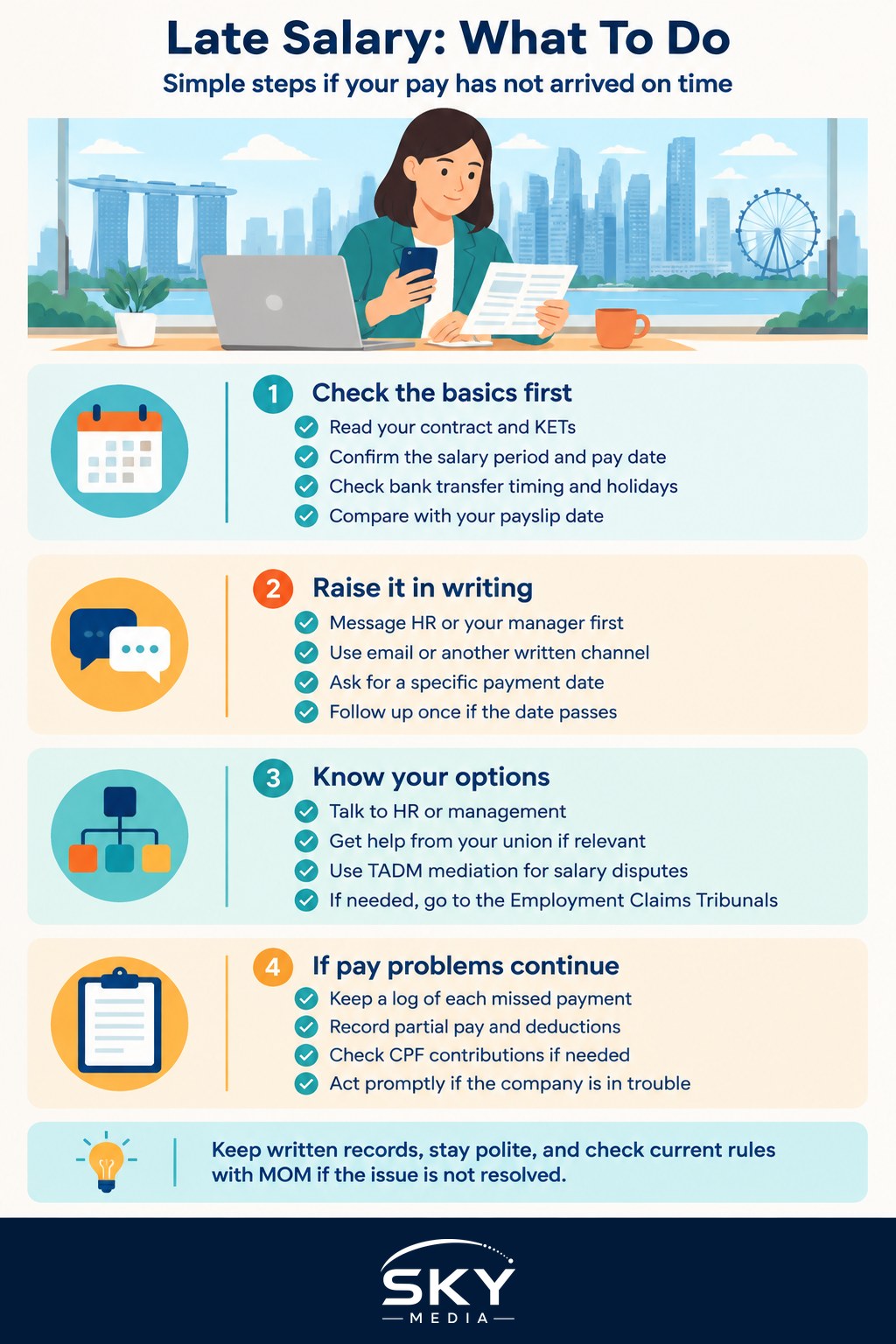
First, Check Whether Your Salary Is Actually Late
Before raising the alarm, confirm the basics. Some “late salary” worries turn out to be a bank delay or a misunderstanding about the pay cycle.
- Read your contract and Key Employment Terms (KETs). KETs are the written summary of your main terms, such as salary, salary period and payment date, that most employers must give employees. Your salary period (usually monthly) and payment date should be stated there.
- Know the general rule. For employees covered by the Employment Act, MOM states that salary must be paid at least once a month and within 7 days after the end of the salary period. Overtime pay has its own, longer deadline. Check MOM’s website for the current rules and whether you are covered.
- Check the payment method. GIRO and bank transfers can take a working day or two, and public holidays can push credits back.
- Look at your payslip. Employers covered by the Employment Act must issue itemised payslips. If the payslip shows a payment date that has passed with no credit, keep a copy.
If the payment date in your contract has clearly passed and nothing has arrived, treat it as late and move to the next step.
Raise It With Your Employer, In Writing
Most late payments are fixed at this stage. A calm, written message gets a faster answer than corridor complaints and also creates a record.
- Message HR or your manager first. Keep it factual: the salary period, the payment date in your contract, and that the amount has not been received. Ask when it will be paid.
- Use email or a written channel. A WhatsApp message is better than a phone call, but email to an official company address is best. Save screenshots and replies.
- Ask for a specific date. “Soon” is not an answer. Ask for the date the salary will be credited and whether the full amount will be paid.
- Follow up once. If the promised date passes, follow up in writing and say you will need to seek advice if it is not resolved.
Keep working normally while you wait, unless you have been told otherwise in writing. Walking out without notice can create separate problems around notice periods and final pay.
Your Options, Side by Side
If talking to your employer does not work, Singapore has a structured process. Here is how the main routes compare.
| Route | What it is | When it fits |
|---|---|---|
| Talk to HR or management | Internal, informal request with a written trail | First step for any late or short payment |
| Union help | If you are a union member, your union may represent or advise you | Unionised workplaces, or if you joined a union individually |
| Tripartite Alliance for Dispute Management (TADM) | Mediation service for salary and employment disputes | Salary still unpaid after you raised it internally |
| Employment Claims Tribunals (ECT) | Part of the State Courts, hears salary claims that are not settled at mediation | When TADM mediation does not resolve the claim |
| Report to MOM | Flag possible breaches of employment law | Repeated or widespread non-payment, or other breaches |
TADM mediation generally comes before the tribunal for salary claims. The aim is to settle the matter quickly and cheaply without a hearing. Check the TADM and State Courts websites for eligibility, time limits, any fees and the documents needed, since these details can change.
Filing a Salary Claim With TADM
If your employer does not pay after your written requests, filing a claim is the main formal step for most employees. MOM and TADM provide online services for this, usually through Singpass.
What to prepare:
- Your employment contract and KETs
- Payslips, including any for months that were paid on time, to show your usual pay
- Bank statements showing when salary was or was not credited
- Your written messages to HR or your manager, and any replies
- A simple timeline: salary period, due date, dates you followed up
What usually happens next: TADM arranges mediation between you and your employer. A mediator helps both sides reach an agreement, such as payment by a fixed date. If you settle, the agreement is recorded. If you do not, you may be issued a claim referral certificate to take the matter to the Employment Claims Tribunals.
Time limits matter. There are deadlines for filing salary claims, and they differ depending on whether you are still employed or have left. Do not wait for months hoping things improve. Check the current time limits with TADM as soon as you realise the problem is not going away.
Special Situations Worth Knowing
Partial payment. If you received only part of your salary, the unpaid portion can still be claimed. Record exactly what was paid and when.
Salary “deducted” without agreement. Employers can only make certain authorised deductions. If your pay is short because of unexplained deductions, ask for a breakdown in writing. MOM’s website lists what deductions are allowed.
CPF contributions. Late salary sometimes comes with missing CPF contributions. Log in to the CPF website with Singpass to check your contribution history. If contributions are missing, you can report it to the CPF Board. Our guide to understanding CPF and your salary explains how contributions are worked out.
Foreign employees. Work pass holders also have the right to be paid on time, and MOM’s website explains the help available to foreign employees with salary disputes. If you are worried about how a claim could affect your pass, contact MOM directly before you act.
The company is in trouble. If you hear that the business is closing or being wound up, act faster. Keep all records and file a claim promptly. Claims against companies in liquidation follow a different process, so ask TADM or MOM for guidance.
Protecting Yourself While You Wait
A late salary hits household cash flow hard. A few practical moves can soften the impact.
- Tell your bank or landlord early if a payment will be late. Many will agree to a short arrangement if you ask before the due date, not after.
- Avoid high-interest borrowing to cover the gap. Moneylender debt can grow much faster than a delayed salary.
- Keep emotions out of messages. Firm and polite is more effective than angry, and your messages may be read by a mediator later.
- Update your CV quietly. If late pay becomes a pattern, it is often a sign of deeper problems. Looking around is sensible. Our guide to understanding salary benchmarks in Singapore can help you see what similar roles pay.
When Late Pay Keeps Happening
One late payment can be a genuine mistake. A monthly pattern of late salary is different, and you do not have to accept it as normal.
Keep a simple log of every payment date against the contractual date. If the pattern continues after you raise it, that log becomes strong evidence for a claim. It also helps you decide whether to stay. If you do resign, make sure you understand your notice period and that your final salary and any unused leave pay are calculated correctly, and check MOM’s guidance on when final pay must be made.
If you move to a new role, use the chance to ask about payroll timing during the offer stage. Our tips on salary negotiation in Singapore cover how to discuss pay terms with confidence.
Late pay is not something you have to quietly absorb. Start with a clear written request, keep good records, and use TADM and MOM if your employer does not put it right.
Official sources: Ministry of Manpower (MOM)