

Learning korean in singapore has become hugely popular, and it is easy to see why. K-dramas, K-pop, Korean food, and travel have made the language part of everyday life here for many people. If you have ever wanted to understand your favourite show without reading subtitles, or to order confidently at a Korean restaurant, this guide is for you. We will look at what Korean is really like, a realistic path for beginners, and the small habits that turn interest into steady progress.
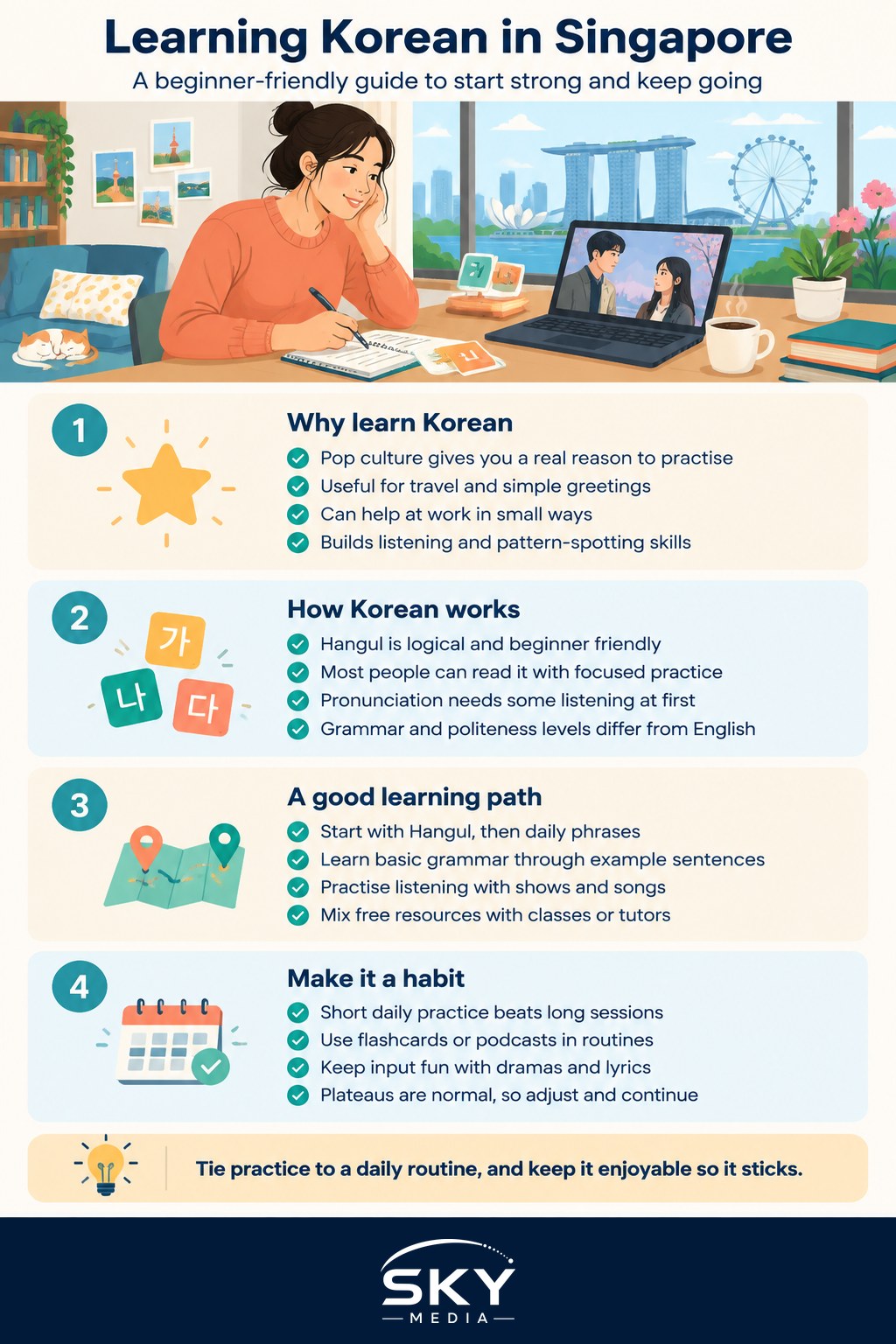
Why Korean Is Worth Learning
For most beginners in Singapore, the pull is cultural. Music, films, variety shows, and food create a genuine reason to keep going, and that everyday enthusiasm is one of your biggest advantages. When practice feels connected to something you already love, it stops feeling like homework.
Korean is also a practical choice. Korean brands and companies have a strong presence in the region, and even a basic ability to greet people and read signs can enrich travel and open small doors at work. On top of that, studying a language with a different structure sharpens your listening, patience, and pattern spotting, skills that help with any subject. If you are still choosing which language suits you, our overview on learning a new language is a good starting point.
How Korean Actually Works
Here is the reassuring part. Korean has one of the most beginner friendly writing systems in the world. Hangul, the Korean alphabet, was designed to be logical and learnable, and most people can read it, slowly at first, within a week or two of focused practice. Unlike Japanese or Chinese, you are not facing thousands of characters. Once you can sound out Hangul, the whole language opens up faster because you can read new words aloud even before you know their meaning.
Pronunciation takes a little getting used to. There are a few sounds that do not exist in English, and some consonants come in soft, tense, and aspirated versions that sound similar to a new ear. This improves quickly with listening and imitation, so do not worry if it feels tricky at first.
Grammar runs in a different order from English, with the verb usually at the end and small particles marking the role of each word. Korean also uses different levels of politeness depending on who you are speaking to, which feels unusual but becomes natural with exposure. As with any language, learning through simple example sentences works far better than memorising rules in isolation.
A Realistic Path for Beginners
Be gentle with your expectations. Reaching comfortable everyday conversation usually takes a sustained stretch of regular study, often a year or more, rather than a few weeks. Progress comes in waves, with quick early wins followed by slower stretches, and that is completely normal.
A sensible order looks like this:
- Learn to read and write Hangul first, since it unlocks everything else.
- Build a core of daily phrases for greetings, food, and simple questions.
- Add basic grammar patterns one at a time through example sentences.
- Practise listening early using shows and songs you already enjoy.
You can mix free and paid routes freely. Free options include library resources, online videos, and language exchange meetups where you practise with real people. Paid options such as structured classes and tutors give you feedback and a steady rhythm. Neither is compulsory, and many learners blend both. If trading practice with others appeals to you, see our tips on finding a language exchange.
If you later want to measure your level, Korean has a well known official proficiency test. Rather than relying on hearsay about its format or fees, check the official organising body for the current levels, schedule, and costs.
Building a Daily Habit That Sticks
Little and often wins. Fifteen focused minutes each day will carry you further than one long, exhausting session now and then. Tie your practice to a routine you already have, such as reviewing flashcards on your commute or listening to a simple podcast while doing chores.
Keep the input enjoyable so it stays sustainable. Watch dramas with subtitles, follow along with lyrics, and say new phrases out loud so your mouth learns the shapes. Expect plateaus, and treat them as a nudge to change your method rather than a reason to stop. For the longer journey beyond the beginner stage, read our guide on how to become fluent in a language.
Most of all, be patient and kind with yourself. Learning korean in singapore is a marathon you can genuinely enjoy, and every word you begin to catch in a song or show is proof that your effort is working.
Further reading: Preparing for the TOPIK Korean Exam in Singapore