

If you have been learning Korean for a while, sitting the TOPIK exam in Singapore is a good way to measure your progress and earn a certificate that universities and employers in Korea recognise. TOPIK, the Test of Proficiency in Korean, is the standard Korean language test for non native speakers. This guide explains how the levels work, how to find test dates and venues in Singapore, how to register, and how to build a study plan for the level you are aiming for.
If you are still at the very start, our beginner’s guide to learning Korean in Singapore covers classes, apps and first steps. This article picks up where that one ends: the exam itself.
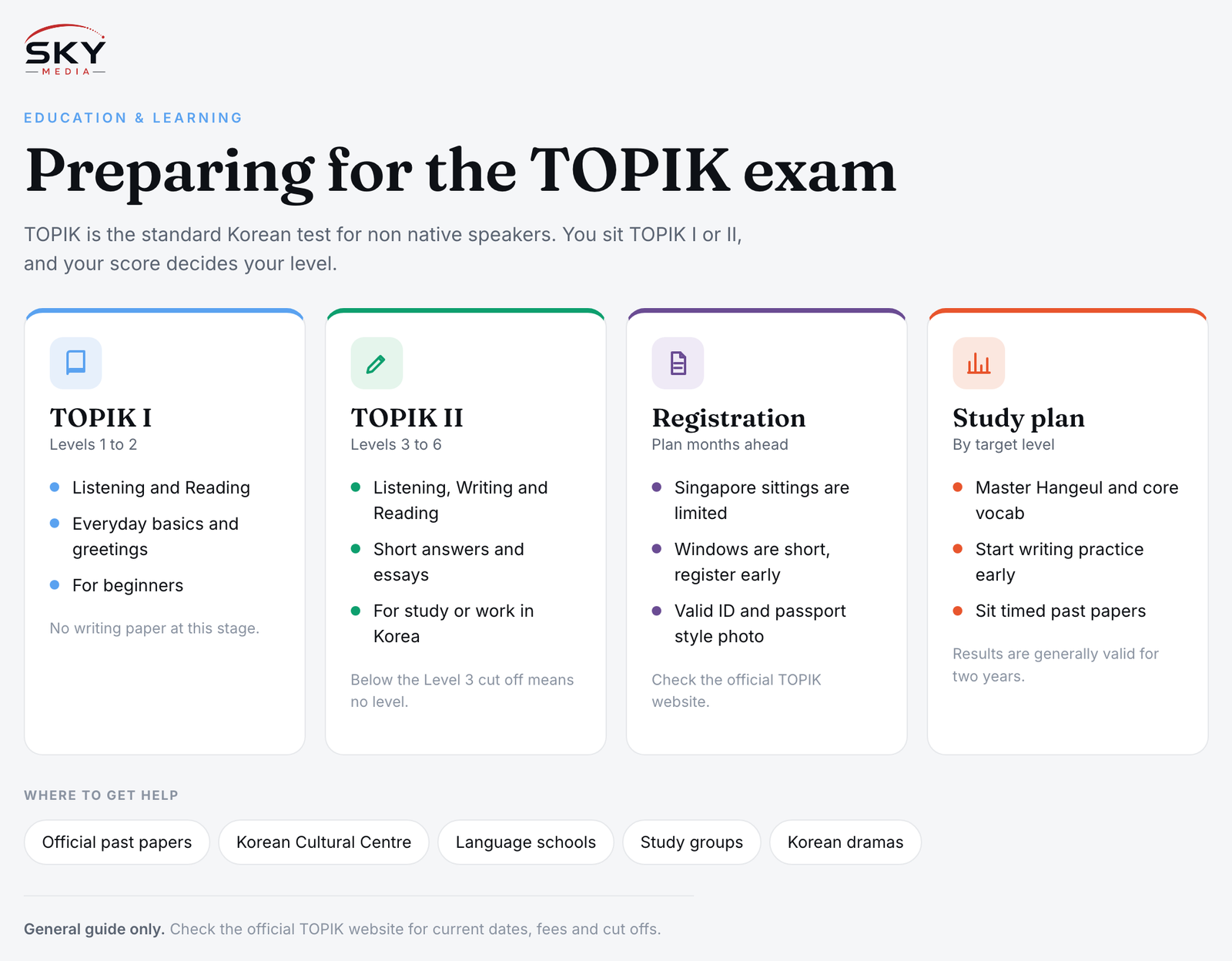
What TOPIK Is and Who Uses It
TOPIK is administered by South Korea’s National Institute for International Education (NIIED), which sets the papers and issues results. It is used for:
- University admission in Korea, where many undergraduate and graduate programmes ask for a minimum TOPIK level
- Scholarships, including government scholarship programmes for international students
- Jobs and visas, as some Korean employers and certain visa categories consider TOPIK results
- Personal goals, such as proving your progress to yourself or adding a credential to your CV
Results are generally valid for two years from the date they are announced, so time your sitting around when you will actually need the certificate. Check the official TOPIK website for the current validity rules.
How TOPIK Levels Work
TOPIK is split into two tests. You choose which one to sit, and your score then places you within a range of levels.
| Test | Levels covered | Sections | Who it suits |
|---|---|---|---|
| TOPIK I | Level 1 to Level 2 | Listening and Reading | Beginners who can handle everyday basics, greetings, shopping and simple conversations |
| TOPIK II | Level 3 to Level 6 | Listening, Writing and Reading | Intermediate to advanced learners aiming for study or work in Korea |
| Below threshold | No level awarded | Same as the test sat | Candidates whose total score falls under the lowest cut off |
A few points that confuse first timers:
- You do not sit a separate exam for each level. You sit TOPIK I or TOPIK II, and your total score decides your level.
- Writing appears only in TOPIK II. It includes short answer items and longer essay style questions, so intermediate learners need to practise writing in Korean, not just recognising it.
- Choosing too high a test can backfire. If your score on TOPIK II falls below the Level 3 cut off, you receive no level, even if you would have passed TOPIK I comfortably.
Pass marks and score ranges are set by NIIED. Check the official TOPIK website for the current cut offs.
Test Dates, Venues and Registration in Singapore
TOPIK is held several times a year worldwide, but not every overseas test centre runs every sitting. Singapore typically has a limited number of sittings each year, so plan months ahead.
How to find accurate information:
- The official TOPIK website lists the annual exam schedule and the overseas test centres.
- The Korean Cultural Centre in Singapore and the Embassy of the Republic of Korea are good places to check for local announcements.
- Your Korean language school or university language centre often shares registration notices with students.
Registration tips:
- Registration windows are short and seats can be limited. Note the opening date and register early.
- Prepare your documents, usually a valid photo ID (passport or NRIC, depending on the local requirements) and a recent passport style photo meeting the specifications.
- Check the fee and payment method at the time of registration, as these can change.
- Confirm the venue and reporting time on your admission ticket. Allow extra time to find the room on exam day.
Some countries now offer an internet based version of TOPIK. Whether it is available in Singapore, and on which dates, can change, so check the official channels rather than relying on older forum posts.
A Study Plan by Target Level
How long you need depends on your starting point, how often you study and whether you are taking classes. These are realistic outlines, not guarantees.
Aiming for TOPIK I (Level 1 or 2)
- Master Hangeul fully, including reading quickly without sounding out each syllable.
- Build a core vocabulary of everyday words: food, transport, shopping, time, family, weather.
- Learn basic grammar patterns for present, past and future tenses, polite speech, and common connectors.
- Do listening practice daily with slow, clear audio such as textbook recordings.
- In the last month, sit at least two full past papers under timed conditions.
Aiming for TOPIK II Level 3 or 4
- Expand vocabulary into work, study, health, news and social issues.
- Learn intermediate grammar such as expressing reasons, conditions, assumptions and contrasting ideas.
- Practise reading short articles, notices and opinion pieces, and summarise them in Korean.
- Start writing early. Practise short answer completion and 200 to 300 character paragraphs, then get feedback from a teacher or tutor.
- Train your listening with Korean news, podcasts and dramas with Korean subtitles.
Aiming for TOPIK II Level 5 or 6
- Read widely: newspaper editorials, essays and academic style texts.
- Practise the longer essay question with a clear structure: introduction, argument, examples and conclusion.
- Learn formal written style and connectors that make essays flow.
- Time yourself strictly. At advanced levels, running out of time is a common reason for losing marks.
Exam Day Strategy
- Arrive early with your admission ticket and the correct ID.
- Bring the stationery allowed and follow the rules on answer sheets and marking pens exactly as instructed.
- Do not get stuck. Skip hard questions and come back to them. Every question carries marks, and a guess is better than a blank in multiple choice.
- In the writing paper, plan your essay for a few minutes before writing. A clear, simple structure scores better than complex sentences full of errors.
- Watch spacing and spelling in Korean, as these affect how readable your writing is.
Resources and Support in Singapore
- Official past papers. NIIED releases past papers and sample questions on the official TOPIK website. These are the best practice material.
- Classes. Language schools, community centres and university language centres in Singapore offer Korean classes, some with TOPIK preparation tracks. Compare class size, teacher qualifications and whether mock tests are included.
- Study groups. Practising with friends who are also sitting the exam keeps you motivated and gives you speaking partners.
- Culture as practice. Ordering at a Korean restaurant, reading menus and watching dramas with Korean subtitles all count. Our guide to Korean food in Singapore is a fun way to put vocabulary to use.
If you have taken other language exams, the approach will feel familiar. Our guides to the JLPT Japanese exam and the HSK Chinese proficiency exams share many of the same study habits.
Common Mistakes to Avoid
- Registering for TOPIK II too early and scoring below Level 3
- Ignoring writing practice until the final weeks
- Studying only vocabulary lists without listening and reading in context
- Missing the registration window because Singapore sittings are limited
- Not checking whether your university or employer needs a specific level by a specific date
With a clear target level, early registration and steady practice, the TOPIK exam is a very achievable goal. Start with past papers, be honest about your level, and give yourself enough months to prepare properly.
Further reading: Preparing for the DELF French Exam in Singapore