
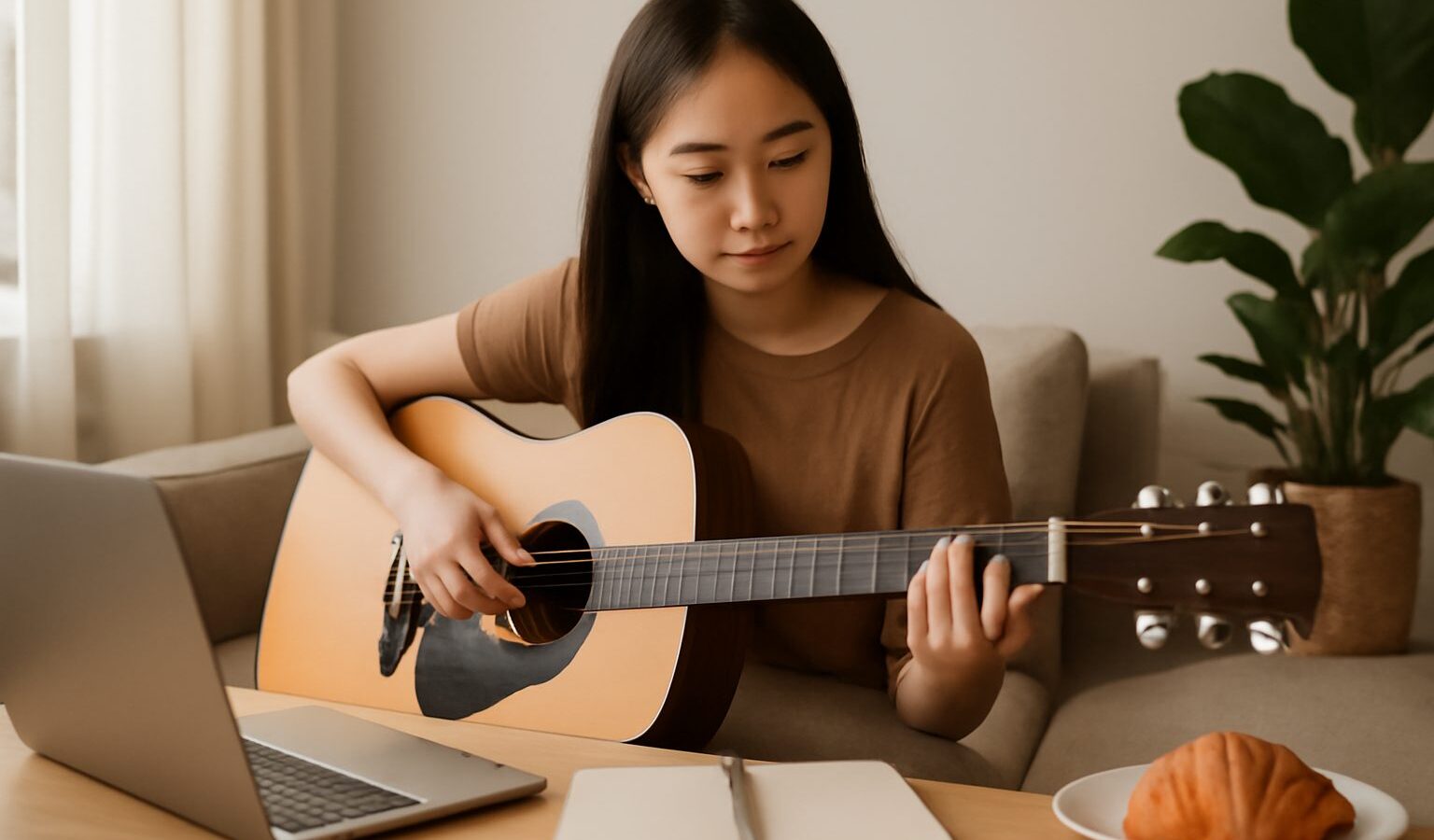
Learning the guitar is one of the most popular ways into music, and for good reason. A guitar is portable, sociable and can play both the tune and the accompaniment at once. You can strum a few chords around a barbecue, pick out a melody quietly at home, or plug in and play with a band. This guide is for the complete beginner in Singapore, covering how to choose an instrument, the first skills to build, and how to practise in a flat without disturbing anyone.
The early weeks of guitar are honest about one thing: your fingertips will be sore. Pressing metal or nylon strings against the fretboard takes getting used to, and in a few weeks light calluses form and it stops hurting. Almost everyone goes through this, so do not take tender fingers as a sign you are not cut out for it.
Acoustic, classical or electric
There are three broad families, and the right one depends on the music you love and your practice space.
- Steel-string acoustic. The classic all-rounder for pop, folk and singalongs. It is loud enough to play unplugged and needs no extra gear, though steel strings feel firmer under new fingers.
- Classical (nylon-string). Softer, wider-necked and gentler on the fingertips. Great for classical and fingerstyle playing, and a kind choice for young or sensitive hands.
- Electric. Thin strings that are easy to press, but it needs an amplifier to be heard properly. The upside for flat living is that a small amp or a headphone amp lets you practise almost silently.
There is no single “best beginner guitar”. Specifications, models and prices change often, so treat any figure as a rough snapshot and try a few instruments in person at a local music shop. What matters most is that the guitar is comfortable to hold, plays in tune and has been set up so the strings are not painfully high off the fretboard. A quick setup by the shop can make a cheap guitar far easier to learn on.
What else you need to start
You can begin with very little, but a few inexpensive extras help:
- A clip-on tuner or a free tuner app. Playing an out-of-tune guitar teaches your ear the wrong things, so tune every time you pick it up.
- A few plectrums (picks). These are cheap; buy a variety of thicknesses and see what suits you.
- A capo. A small clamp that raises the pitch, letting you play in different keys with the same easy chord shapes.
- A strap and a spare set of strings. Strings wear out and occasionally snap, so having spares saves a stalled practice.
- For electric players, an amp or headphone amp. The headphone route is ideal for HDB flats.
Keep the guitar somewhere visible on a stand rather than zipped in its case. An instrument you can grab in seconds gets played far more often. In our humidity, avoid leaving it in direct sun or against an outside wall, and loosen nothing drastic; just wipe the strings after playing to slow down corrosion.
Your first skills, step by step
Structure beats random noodling in the early days. Work through these in roughly this order:
- Tune up and name the strings. Learn the six open string names so you can follow lessons.
- Fretting cleanly. Press just behind the fret, with fingertips arched, so notes ring clearly without buzzing.
- Two or three easy chords. A chord is several notes sounded together. A small set of open chords already unlocks countless songs.
- Changing chords. The real beginner challenge is switching between chords smoothly. Practise the change itself, slowly, on repeat.
- A simple strumming pattern. Start with steady downstrokes in time, then add upstrokes.
- Your first song. Pick something with two or three chords you love, and play along.
Use a metronome, which is simply a click that keeps a steady tempo (tempo means speed), free as a phone app. Playing slowly and in time is far more useful than playing fast and messy. When a change trips you up, isolate those two chords and drill only that move for a minute.
Practising in an HDB flat
Guitar is one of the more neighbour-friendly instruments, which is a real bonus for flat living. An acoustic played at normal volume is rarely a problem during the day, and an electric through headphones is effectively silent to everyone else. Still, be considerate at night: fingerpicking and quiet practice are fine late, but heavy strumming or a cranked amp is not.
Short, frequent sessions win. Fifteen focused minutes daily builds calluses and muscle memory faster than one long weekend session. Keep a practice routine simple: a minute tuning, a few minutes on a tricky chord change, then time on a song for the joy of it. Ending on something fun keeps you coming back.
Learning alone or with a teacher
Plenty of guitarists are self-taught using apps, videos and chord sheets, and you can get a long way that way. The risk is picking up awkward habits, such as a cramped fretting hand or sloppy timing, that are harder to unlearn later. A teacher watches your hands, fixes those early and keeps you accountable when motivation dips.
| What to try when | Best option | Why it fits |
|---|---|---|
| You want a cheap, flexible start | Self-teaching with apps and videos | Learn on your own schedule and budget |
| You struggle to stay consistent | Regular lessons, in person or online | Structure and accountability keep you going |
| You aim at a style or an exam | A teacher plus a clear syllabus | Milestones and expert feedback |
| You enjoy learning with others | Group classes or a jam group | Shared cost and the fun of playing together |
Many learners mix the two: an occasional lesson to correct course, with daily self-practice in between. If you decide you want guidance, Singapore has everything from home tutors to established music schools, and you can find a teacher who suits your budget and goals.
Keeping it fun for the long haul
Motivation, not talent, decides who sticks with the guitar. The people who last are the ones who play music they actually enjoy early, even in a simplified form. Learn the chords to a song you love in week one, and you have living proof that the sore fingers are worth it.
Set small, concrete goals: “change smoothly between these two chords by Friday” beats “get good at guitar”. Record yourself occasionally, because hearing last month’s playing shows real progress that daily practice hides. Forgive the plateaus, keep the sessions short and regular, and let the habit carry you. Before long, learning the guitar turns from a chore into the best part of your day.
Explore more
- /how-to-choose-your-first-instrument/
- /learning-an-instrument-as-an-adult/
- /learning-the-ukulele/
- /finding-a-music-teacher-in-singapore/
- /how-to-practise-music-effectively/