
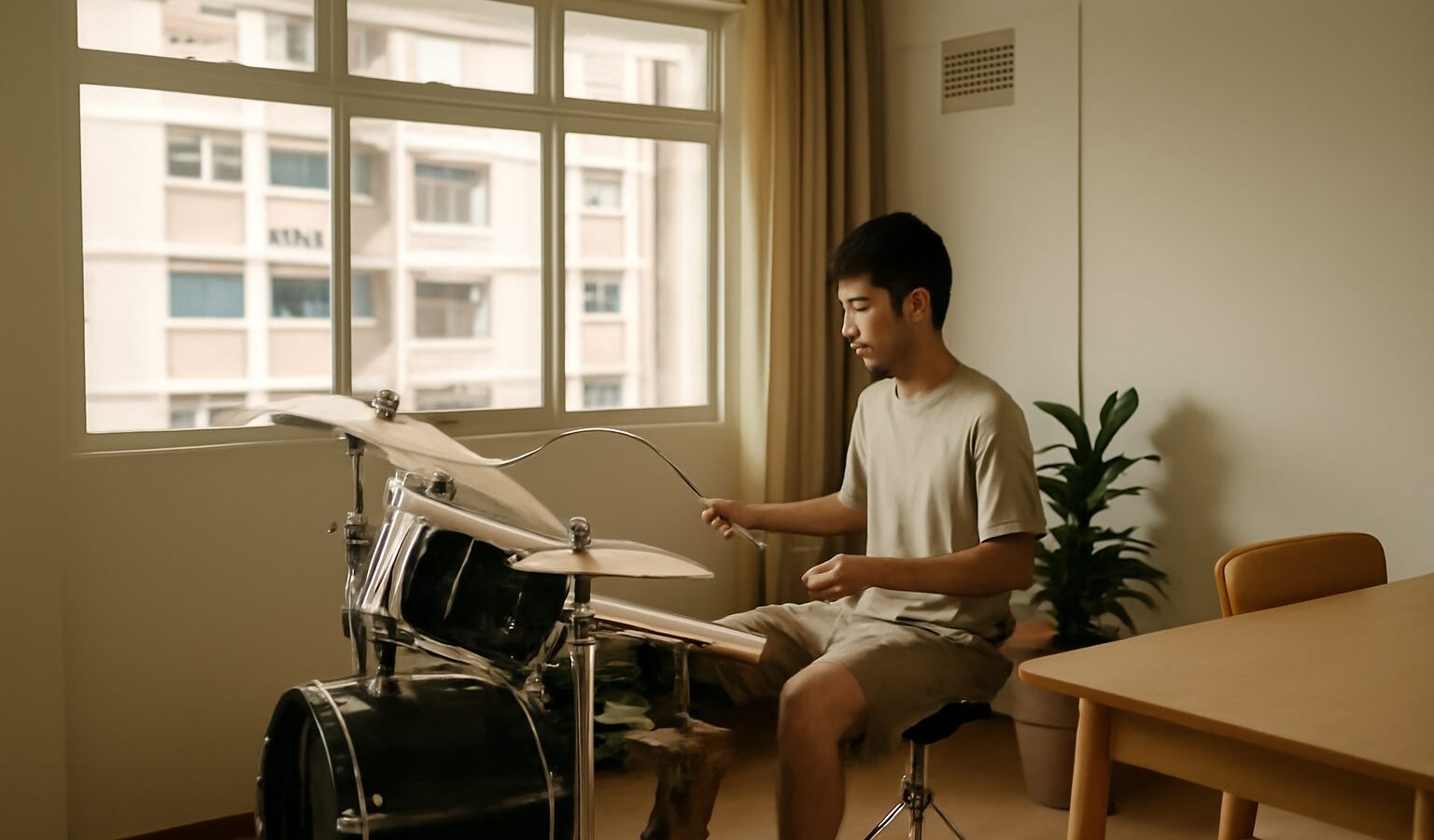
Drums have a reputation for being the one instrument you simply cannot play at home. In a landed house with a spare room, maybe. In a typical HDB flat, with neighbours through a shared wall and a family in the next room, an acoustic kit at full volume is a genuine problem. The good news is that learning the drums in an HDB flat is very doable in 2026, as long as you choose the right tools and respect the people around you. This guide walks a complete beginner through quiet options that keep your progress moving and your block peaceful.
The Honest Truth About Drums and Neighbours
Let us be clear from the start. A full acoustic drum kit played with sticks is loud, and it sends low-frequency vibration straight through concrete floors and party walls. No cushion, rug or egg carton makes that acceptable in a flat with attached neighbours. Attempting it will upset the people around you and can lead to complaints, which nobody wants.
Singapore does not set a single fixed decibel limit for every home activity, but the principle is simple and enforced through community norms and, if needed, the authorities. Be considerate, keep noise down, and avoid disturbing others, especially at night. A widely respected rule of thumb is to treat roughly 10:30pm to early morning as quiet hours, and to keep any practice well within sociable daytime hours. When in doubt, knock on your neighbour’s door, introduce yourself and ask what works for them. A short, friendly conversation prevents most disputes before they start.
The takeaway is not that you cannot drum at home. It is that the acoustic-kit-at-volume version is off the table, and the quiet versions below are what make drumming realistic in an HDB flat.
Quiet Ways to Play: Your Real Options
Here are the main routes a home learner can take, from silent to nearly silent, with the trade-offs laid out plainly.
| Setup | How quiet | Feels like real drums? | Good for |
|---|---|---|---|
| Practice pad | Very quiet, a soft tap | Sticks only, no kit feel | Technique, rudiments, tiny budget |
| Electronic kit with headphones | Quiet to others, normal in your ears | Close, especially with mesh heads | Full learning at home, most people |
| Acoustic kit with low-volume heads and mutes | Much softer, still audible | Fairly real stick response | Those who already own an acoustic kit |
| Acoustic kit at volume | Loud | Fully real | Studios and rehearsal rooms only |
For most people in a flat, an electronic drum kit with headphones is the answer. The pads are struck with normal sticks, but the sound comes out through your headphones instead of a resonating shell. To others in the room, you mostly hear the quiet knock of sticks on rubber or mesh pads. Mesh-head pads feel closer to a real drum and are quieter than older rubber pads, so look for those if you can.
A practice pad is the cheapest starting point of all. It is a small rubber or gum disc, sometimes on a stand, that you hit with sticks to build hand technique. It teaches you grip, timing and the core patterns called rudiments. It will not teach you coordination across a full kit, but it is nearly silent, costs very little and travels anywhere. Many drummers keep one for warming up their whole lives.
If you already own an acoustic kit, you can tame it with low-volume mesh heads and rubber mutes that sit on the drums and cymbals. These cut the volume and vibration a lot, though the kit is still audible and still sends some thump through the floor, so this is a compromise rather than a silent solution.
Setting Up an Electronic Kit Without Annoying Anyone
The biggest surprise for new electronic drummers is that the pads themselves are quiet, but the vibration through the floor is not. Every kick of the bass pedal and every stomp travels downward to the flat below. Managing that is the real skill of drumming in an HDB block.
- Put the whole kit on a proper drum riser or a thick, dense mat. A layer of high-density foam or a purpose-made isolation platform under the kit absorbs a lot of the thump before it reaches the floor.
- Use a rug under that, and consider tennis balls cut and fitted under the rack feet, or commercial anti-vibration pads, to decouple the stand from the concrete.
- Choose a quieter beater for the kick pedal, and play with a lighter foot. Heavy stomping is what neighbours below feel most.
- Always use closed-back headphones so the sound stays with you. Keep the volume at a safe level to protect your hearing over long sessions.
- Position the kit against an internal wall rather than a shared party wall where practical.
Even with all of this, keep your sessions within daytime hours and let your immediate neighbours know your rough practice times. Consideration costs nothing and buys a lot of goodwill.
What a Beginner Actually Needs to Start
You do not need a fancy setup to begin learning the drums. A modest electronic kit, or even a single practice pad, plus a pair of sticks and headphones, is enough to build real skill for months. Prices and models change constantly, so check current options at a local music shop or online, and do not chase the most expensive gear before you know you will stick with it.
Focus your early practice on these fundamentals:
- Grip and posture, so you play relaxed and avoid strain.
- Keeping steady time with a metronome, which is the single most valuable drumming habit.
- Basic rudiments such as single strokes, double strokes and paradiddles on a pad.
- Simple rock and pop beats that combine kick, snare and hi-hat.
- Playing along to songs you love, which trains your ear and your groove.
Short, regular sessions beat rare marathons. Twenty focused minutes a day, within considerate hours, will take you a long way in a few months.
Learning With Guidance, Not Just Alone
You can start with free lessons online, and there is a wealth of beginner drumming content to learn beats and rudiments at home. Pairing that with a real teacher, though, fixes bad habits early and keeps you motivated. Many drum schools and private teachers in Singapore offer lessons on kits in properly treated studios, which means you get to feel a real acoustic kit without any noise worry at home.
A common and sensible pattern is to practise quietly on your electronic kit or pad at home, then have a weekly lesson on a full kit at a studio. You get the best of both, steady daily reps and expert feedback, without ever disturbing a neighbour.
Learning the drums in an HDB flat is not about fighting your living situation. It is about choosing quiet tools, respecting quiet hours, talking to the people around you and putting in small, consistent sessions. Do that and you will be grooving happily, block and all.
Explore more
New to all this? Start with how to choose your first instrument and, if you are past school age, learning an instrument as an adult. To find the right coach for the kit, see finding a music teacher in Singapore, and once you have the basics, read how to practise music effectively and music exams and grades explained.