
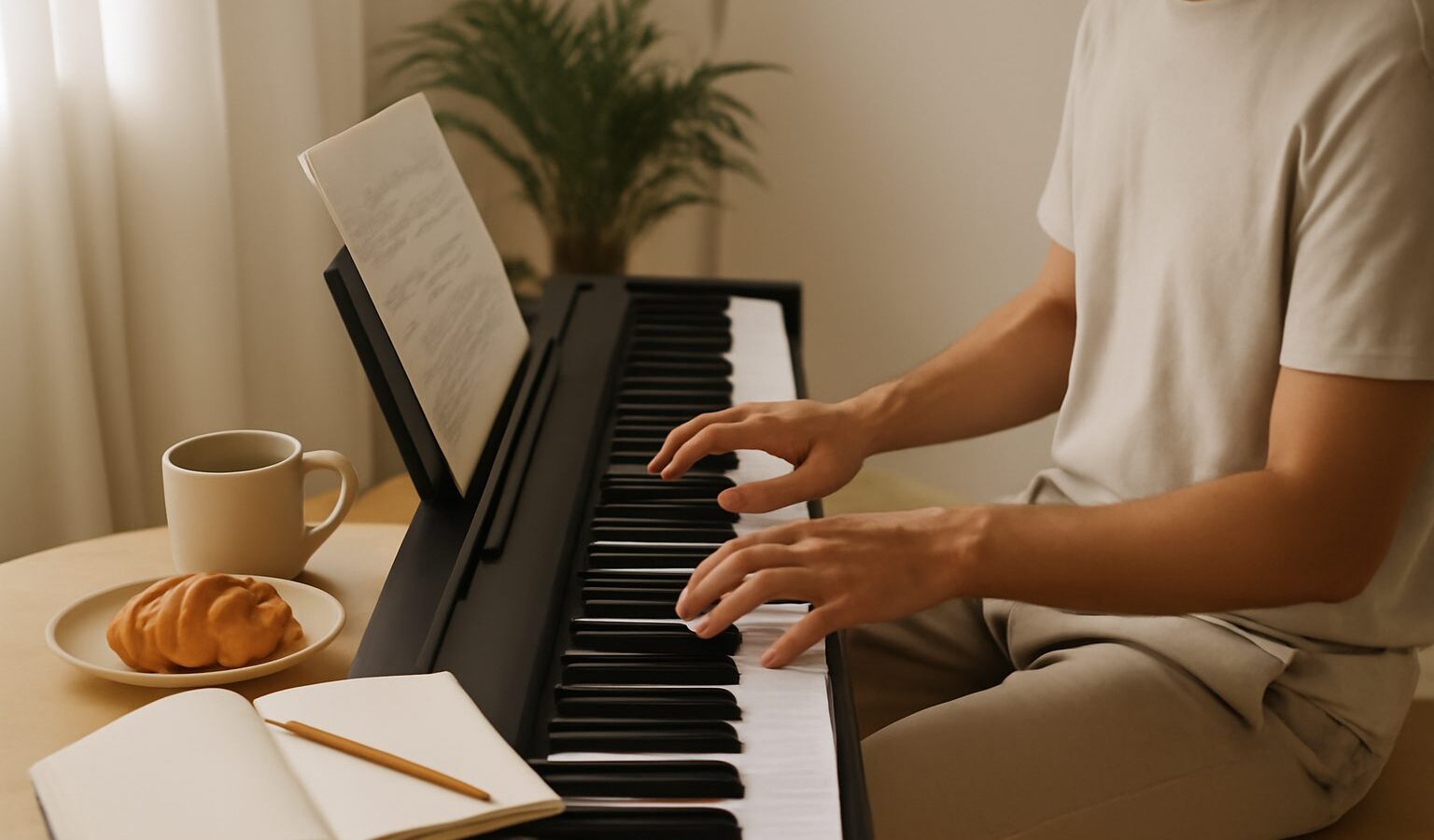
Learning the piano is one of the most rewarding things you can start at any age, and Singapore makes it surprisingly easy to begin. You do not need a grand instrument, a music degree or a spare room. You need a workable keyboard, a little space in your flat and a habit of showing up for short, regular practice. This guide walks a complete beginner through the choices, the first skills to build and the local realities of practising in an HDB flat without upsetting your neighbours.
The piano is a friendly first instrument because everything is laid out in front of you. Every note has its own key, in order, low on the left and high on the right. You can see the pattern of the black keys repeating, and once you understand that pattern you can find any note. That visual clarity is why so many people start here before branching out to other instruments.
Piano or keyboard: what you actually need
The words get used loosely, so it helps to be clear. An acoustic piano makes sound with hammers striking strings; it is large, heavy and needs tuning. A digital piano copies that feel and sound electronically, usually with 88 keys that are “weighted” (they push back like real piano keys). A keyboard is lighter and more portable, often with fewer keys and many built-in sounds, but the keys may be springy rather than weighted.
For most beginners in Singapore, a digital piano or a decent keyboard is the sensible starting point. It stays in tune, copes with our humidity better than an acoustic, and can be played through headphones. Prices and models change constantly, so treat any figure you see as a snapshot and compare current options at a local music shop before buying.
A few features genuinely matter when you are learning:
- Weighted or semi-weighted keys. These build proper finger strength and let you control how loud each note sounds. Fully unweighted keys feel toy-like and are harder to progress on.
- Touch sensitivity. The instrument should play louder when you press harder, so you can shape a melody.
- Full-size keys. Standard-width keys mean your hands learn the correct spacing from day one.
- 88 keys if you can. You can start on 61, but 88 keys give you room to grow without rebuying.
- A headphone socket. In a flat, this is close to essential.
Setting up to practise in an HDB flat
The great advantage of a digital instrument is quiet practice. Plug in a pair of headphones and you can play at eleven at night without a single neighbour hearing you. That said, be considerate about anything that carries through floors and walls: the thump of a stand, a wobbly table, or an acoustic piano’s real volume. Keep to reasonable hours, and if you own an acoustic piano, avoid heavy playing late at night.
Set your instrument up somewhere you will actually use it. A keyboard shoved in a cupboard gets played once a month; one left out on a sturdy stand at the right height gets played daily. Aim for a seat where your forearms are roughly level with the keys and your feet reach the floor. Good posture now saves aching wrists later.
Humidity is the other local factor. Keep the instrument out of direct sun and away from windows that let in rain. For acoustic pianos especially, a stable, air-conditioned or well-ventilated room helps protect the wood and the tuning.
First skills, in a sensible order
It is tempting to rush at a favourite song, but a little structure pays off fast. Focus on these building blocks in your first weeks:
- Find your way around. Learn to spot middle C and name the white keys using the repeating black-key pattern.
- Steady hands. Practise simple five-finger patterns with each hand so your fingers move independently.
- Tempo. Tempo just means speed. Play slowly and evenly; a metronome (a click that keeps time, free as a phone app) is your friend.
- Reading basics. Learn to read a few notes on the staff, even if you also use letter names at first.
- Chords. A chord is several notes played together. A handful of common chords lets you accompany dozens of songs.
- Hands together. Combine a simple melody in one hand with a chord or bass note in the other.
Keep sessions short and frequent. Fifteen focused minutes a day beats a rushed two-hour cram at the weekend. Practise the hard bar slowly on its own rather than playing the whole piece from the top each time.
Teaching yourself versus taking lessons
You can make real progress at home with apps, books and video lessons, and many people do. The trade-off is that no one is watching your hands, so bad habits with posture or fingering can creep in. A teacher spots those early, keeps you accountable and tailors the pace to you.
| What to try when | Best option | Why it fits |
|---|---|---|
| You want a low-cost, flexible start | Self-teaching with apps and books | Learn on your own schedule and budget |
| You keep losing motivation alone | Regular lessons, in person or online | A teacher adds structure and accountability |
| You have a specific goal or exam | A teacher plus a graded syllabus | Clear milestones and expert feedback |
| You are on a tight budget | Group classes or community programmes | Shared cost, plus the fun of playing with others |
Many learners blend approaches: a weekly or fortnightly lesson to stay on track, with daily self-practice in between. If you decide to find a teacher, Singapore has a wide range from home tutors to established music schools across the island.
Staying motivated for the long run
Progress on the piano is not a straight line. Some weeks click; others feel stuck. The learners who last are the ones who make it enjoyable. Learn a song you actually love early on, even a simplified version, so you have proof that this is fun and not just drills. Record yourself now and then; hearing last month’s playing is a powerful reminder of how far you have come.
Set tiny, clear goals rather than vague ones. “Play the first line of this song, hands together, by Friday” beats “get better at piano”. Celebrate small wins, forgive the off days, and keep showing up. Consistency, not talent, is what turns a curious beginner into someone who can sit down and play.
Whether you dream of accompanying yourself singing, playing at a family gathering or simply unwinding after work, the piano rewards patience generously. Start small, keep it kind, and let the habit do the heavy lifting.
Explore more
- /how-to-choose-your-first-instrument/
- /learning-an-instrument-as-an-adult/
- /finding-a-music-teacher-in-singapore/
- /music-exams-and-grades-explained/
- /how-to-practise-music-effectively/