
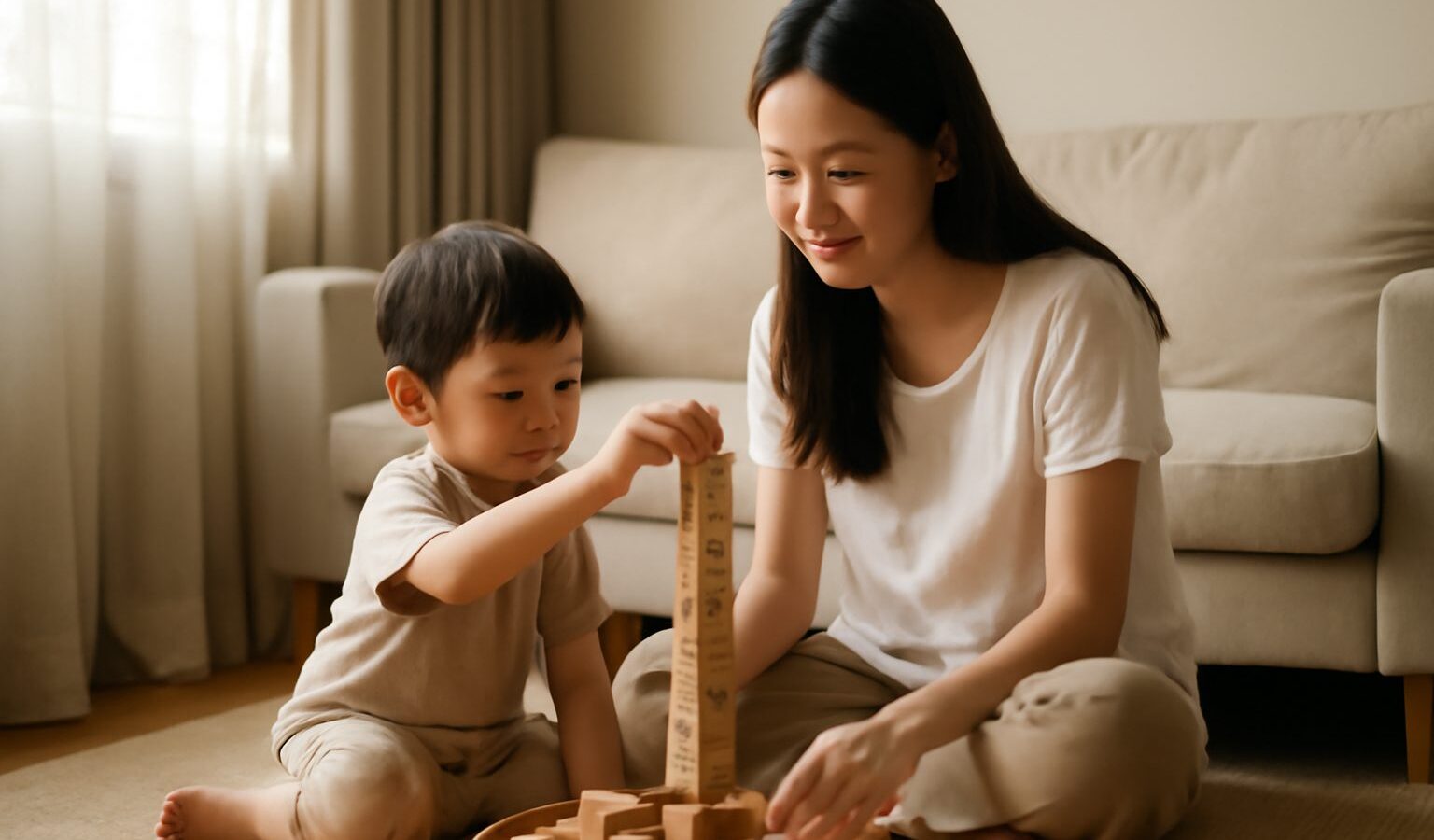
You do not need flashcards, worksheets or an expensive enrichment class to help your young child learn. Some of the richest early learning happens through ordinary play, in the kitchen, on the floor, in the bath and at the void deck. Learning through play at home means using everyday moments and simple materials to build language, thinking, movement and social skills, all while your child is having fun. This guide offers warm, practical, screen-light ideas that Singapore parents can weave into a normal day, without turning your living room into a classroom.
Why Play Is Real Learning
For young children, play is not a break from learning; it is how learning happens. When a child pours water between cups, they are exploring volume and cause and effect. When they play shop, they are practising language, numbers and taking turns. When they build and knock down a tower, they are testing balance, gravity and patience. The learning is real, even though it looks like fun.
Play-based approaches are woven through Singapore’s early childhood system for exactly this reason, and ECDA-regulated preschools build much of their curriculum around purposeful play. You can extend that at home in low-key ways. The aim is not to drill or test, but to follow your child’s curiosity and add gentle challenge and conversation along the way.
Crucially, play is most powerful when it is shared. Your interest, your questions and your language turn a simple activity into a rich learning moment, without any pressure or performance.
Everyday Moments That Teach
The best learning materials are often already in your home, and the best times are the ones you already spend together. You do not need to add activities to a packed day so much as notice the learning in what you already do.
- Cooking together: counting, measuring, naming ingredients, describing textures and smells.
- Laundry: sorting by colour and size, matching socks, learning words for clothes.
- Bath time: pouring, floating and sinking, naming body parts, water play.
- Grocery runs: spotting shapes and letters, counting fruit, weighing produce.
- Walks around the estate: naming what you see, listening for sounds, collecting leaves.
Talk is the golden thread through all of it. Describe what you are doing, ask open questions, and give your child time to answer. Rich back-and-forth conversation is one of the strongest supports for early language and thinking.
The pace matters too. Young children learn by repeating things many times, so do not worry if your child wants to pour the same cups of water or read the same book night after night. That repetition is how a skill becomes solid. Follow their lead rather than rushing to the next thing, and let them linger on whatever fascinates them. When you slow down to their pace and show that you are genuinely interested, ordinary chores become shared adventures, and your child soaks up far more than any rushed, tick-the-box activity could offer.
Simple Play Ideas By Type Of Learning
Different kinds of play stretch different skills, and a good week has a bit of each. You do not need to buy anything; household items work beautifully.
| Skill area | Easy home activity | Everyday materials |
|---|---|---|
| Language and stories | Puppet shows, making up tales | Socks, soft toys, picture books |
| Numbers and shapes | Sorting, counting, building | Buttons, cups, blocks, containers |
| Fine motor | Threading, playdough, pouring | Pasta, string, dough, spoons |
| Gross motor | Obstacle course, dancing | Cushions, tape, music |
| Imagination | Pretend shop, doctor, cooking | Boxes, old clothes, kitchen items |
Rotate the ideas so play stays fresh, and follow your child’s lead. If they are gripped by dinosaurs or buses this month, let that theme run through the counting, drawing and storytelling.
Making Reading Part Of Play
Books deserve a special mention, because shared reading is one of the most valuable things you can do for a young child. Reading together builds vocabulary, attention and a love of stories, and it costs nothing at your nearest National Library Board (NLB) branch. Make it playful rather than a lesson: use silly voices, pause to guess what happens next, point at pictures and let your child turn the pages.
You can stretch reading into play in easy ways. Act out a favourite story with toys, draw a scene together, or hunt around the house for objects that appear in the book. Bilingual families in Singapore can read and chat in more than one language; hearing and using each language in warm, everyday contexts supports both. The key is enjoyment. A child who associates books with cuddles and fun grows into a willing reader.
Keeping It Low-Pressure And Screen-Light
Learning through play works best when it feels like play, not a programme. There is no need to schedule every minute or worry that unstructured time is wasted; free, child-led play is where a lot of the magic happens. Let your child get bored sometimes, and watch what they invent. Follow their interests rather than a fixed plan, and keep sessions short and cheerful.
Screens are part of modern family life, and every household sets its own balance without any need for guilt. That said, hands-on play and real conversation give young children something a screen cannot: the chance to touch, build, move and interact. Aim to keep screens from becoming the default filler, and lean on the simple, tactile play above. For guidance on screen time and young children, HPB and HealthHub offer current, practical advice.
Above all, relax and enjoy it. Your warmth, attention and playfulness matter far more than any particular toy or activity. When learning at home feels joyful for both of you, your child learns that discovering the world is a delight, and that is the best lesson of all.
Explore more
Guided play and solo play are natural partners, so read this alongside our guide on encouraging independent play in young children. Playful routines also smooth daily hurdles: see handling preschool drop-off tears and winning the toothbrushing battle with toddlers for calm, connection-first ideas.
Related across Sky Media: Learning Through Podcasts and Videos