
If you have recently moved from mainland China with a young child, finding the right preschool Singapore for Chinese parents can feel confusing at first. The names are different, the age groups are counted differently, and the daily routine may not match what you know from a 幼儿园 at home. The good news is that Singapore’s preschool system is well regulated and many families from China settle in comfortably once they understand how it works.
This guide explains what local preschools expect from children and parents, how the language environment works, and how communication between home and school usually happens. It is general information, and details such as fees, subsidies and eligibility can change, so always confirm with the official sources named below.
How Singapore Preschools Are Organised
In China, most children attend a single kindergarten from about age three to six. In Singapore, the landscape has a few more layers.
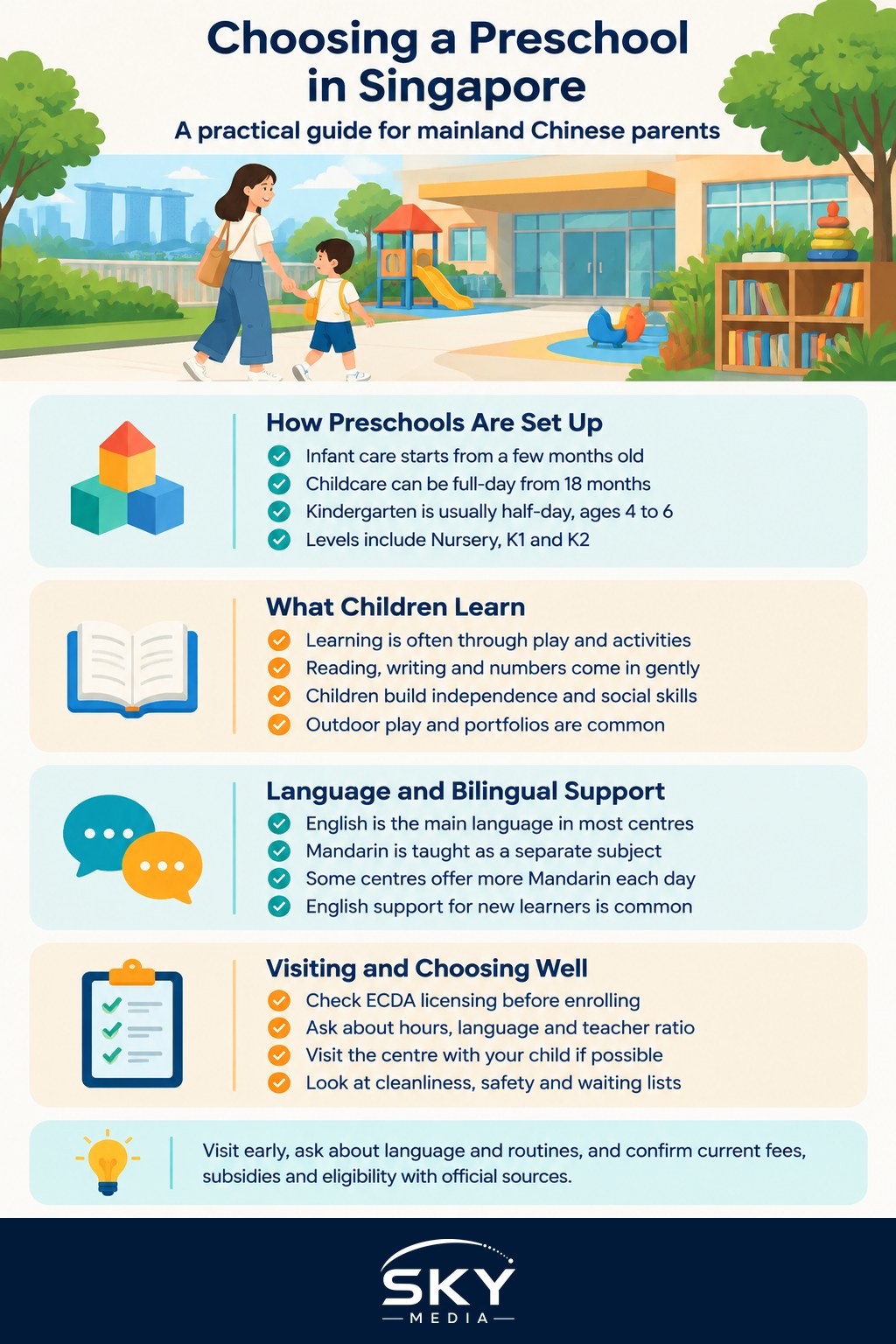
- Infant care is for babies from a few months old, usually up to 18 months.
- Childcare centres take children from 18 months and often run full-day programmes, which suit working parents.
- Kindergartens typically run shorter half-day sessions for children aged about four to six, in levels called Nursery, K1 (Kindergarten 1) and K2 (Kindergarten 2).
Preschools are licensed and regulated by ECDA, the Early Childhood Development Agency. Operators range from government-supported networks and MOE Kindergartens (run by the Ministry of Education) to community, religious and private centres. Children usually enter Primary 1 in the year they turn seven, which is similar to China, but the year runs from January to December rather than starting in September.
The ECDA website and its preschool search tool, along with the LifeSG app, are the main places to look up licensed centres, check subsidies and apply. Eligibility for government subsidies can depend on citizenship and residency status, so check the current rules before you budget.
What Local Preschools Expect From Children
Many mainland parents notice that Singapore preschools put less emphasis on early academic drilling than some Chinese kindergartens, especially private ones that teach Pinyin, arithmetic or English worksheets from an early age. The national curriculum framework focuses on learning through play, social skills, language, early numeracy, motor skills and curiosity about the world.
That does not mean children do not learn. They are introduced to reading, writing and numbers, but usually through stories, songs, projects and hands-on activities. Expect:
- Independence skills, such as packing their own bag, feeding themselves and using the toilet
- Group activities that build sharing, turn-taking and speaking up
- Outdoor play, even in hot weather, with water breaks and shade
- Show-and-tell, simple projects and portfolios of work instead of test scores
If you are used to daily homework reports, this approach can feel too relaxed. Many parents find their children grow in confidence and adapt well to Primary 1 later. If you want extra academic preparation, you can add enrichment classes, but be careful not to overload a young child who is already adjusting to a new country.
Understanding the Bilingual Environment
English is the main language of instruction in most Singapore preschools. Mother Tongue Language, which for Chinese families is Mandarin, is taught as a separate subject, often for a set number of hours each week. Some centres market themselves as bilingual or immersive and give Mandarin a larger share of the day.
For children arriving from China, English is often the bigger challenge. Teachers are used to helping new learners, and young children usually pick up everyday English quickly. You can help by reading simple English picture books together, even if your own English is not strong, and by keeping a positive attitude towards both languages.
You may also notice that the Mandarin your child hears in Singapore sounds different. Local teachers use the same simplified characters and Hanyu Pinyin as China, but some vocabulary and pronunciation follow Singapore usage. Our guide to mainland vs Singapore Chinese culture explains these everyday differences, which helps you talk them through with your child.
Comparing Preschool Types for a Newcomer Family
The table below gives a simple overview. Programmes, hours and fees vary widely between centres, so treat this as a starting point.
| Preschool type | Typical hours | Language setting | Good fit for |
|---|---|---|---|
| Full-day childcare centre | Long day, suits working parents | Mostly English, with daily Mandarin lessons | Families where both parents work |
| Half-day kindergarten | Shorter morning or afternoon session | Mostly English, with Mandarin lessons | Families with a parent or grandparent at home |
| Bilingual or Mandarin-focused centre | Varies, half or full day | More Mandarin in daily activities | Families keen to keep strong Chinese while adding English |
| International or overseas curriculum preschool | Varies | English or other languages, may follow a foreign curriculum | Families who may move again or plan for international schools |
Think about your work hours, who will do drop-off and pick-up, and whether your child is likely to attend a local primary school. If you plan to enter the local system, a preschool that builds English steadily will make the transition smoother.
How Parent and School Communication Works
In China, parents are often in a busy WeChat group with the teacher, receiving photos and updates throughout the day. In Singapore, communication tends to be more structured. Most preschools use a parent app or messaging channel for announcements, photos, attendance and fee notices, plus printed or digital newsletters.
Practical tips:
- Read every notice carefully. Many are in English only. A translation app helps, and our guide on how mainland China parents can read MOE school letters explains common terms you will see again in primary school.
- Use the right channel. For urgent matters such as illness or a change of pick-up person, call or message the centre directly rather than waiting for a reply in an app.
- Expect boundaries. Teachers usually reply during working hours and may not answer late-night messages.
- Attend parent-teacher meetings. These are your chance to ask about your child’s progress, friendships and language development.
- Share background. Tell teachers that your family has just moved and which languages you speak at home. This helps them support your child.
Teachers in Singapore value a respectful partnership. Asking questions politely is welcome, and teachers generally appreciate parents who follow up on simple requests, such as labelling items or sending spare clothes.
Questions to Ask When You Visit a Preschool
Always visit before you enrol. Bring your child if possible, and watch how teachers speak to the children. Useful questions include:
- What is the teacher to child ratio in my child’s class?
- How many hours a week are spent on Mandarin, and who teaches it?
- How do you support children who are new to English?
- What does a typical day look like, including meals, nap time and outdoor play?
- How do you communicate with parents, and in which languages?
- What are the fees, deposits, and terms for withdrawal or transfer?
- Is there a waiting list, and when should I apply?
Check whether the centre is licensed by ECDA, and look at cleanliness, safety features and whether children seem happy and engaged. Popular centres can have long waiting lists, so start looking early, ideally soon after you know where you will live.
Helping Your Child Settle In
The first weeks can be hard for any child, and more so after a big move. Keep goodbyes short and warm, stick to a steady routine, and talk positively about school at home. Some children cry for days and then settle suddenly; others take longer. Speak with teachers if you have concerns about your child’s wellbeing, and they can suggest ways to help.
Remember to sort out the related paperwork, such as your child’s pass and medical records. If you have a newborn sibling at home too, our guide to newborn admin for Chinese parents in Singapore covers the steps that come first.
Choosing a preschool is one of the first big decisions in a new country, but with clear questions and an open mind, you can find a place where your child feels safe, learns two languages and makes new friends.
Frequently Asked Questions
What age can my child start preschool in Singapore? It depends on the type of centre. Infant care takes babies from a few months old, childcare centres from about 18 months, and kindergartens usually for children around four to six. Check ECDA’s preschool search for centres near you and their age ranges.
Will my child struggle with English at a Singapore preschool? Many newly arrived children find English the biggest adjustment at first, but teachers are used to helping new learners. Young children usually pick up everyday English quickly. Reading simple picture books together at home and staying positive about both languages makes a real difference.
Do Singapore preschools have homework and tests like kindergartens in China? Generally much less than some Chinese kindergartens, especially private ones. The approach leans towards learning through play, stories, projects and portfolios of work rather than test scores. If you want extra academic practice, enrichment classes are an option, but avoid overloading a child who is still settling in.
Can foreign children get preschool subsidies? Subsidy eligibility can depend on citizenship and residency status, so it is not automatic for every family. Rules and amounts change over time. Check the current criteria with ECDA before you set your budget, and ask the centre what it can confirm for your situation.
How early should I put my child on a preschool waiting list? As early as you can, ideally soon after you know where you will live. Popular centres can have long waiting lists, and places in your preferred area may not be available at short notice. Ask each centre when and how to apply.
Official sources: Early Childhood Development Agency (ECDA)
Further reading: How to Find Chinese Books for Children in Singapore