
When you start a business, one of the first accounting decisions is how to record income and expenses. The cash vs accrual accounting choice affects when profit shows up in your books, how clearly you see your financial position and, in Singapore, whether your records meet what ACRA and IRAS expect. This guide explains both methods in plain terms, works through examples and sets out how the expectations differ between companies and sole proprietors.
It is general information, not accounting or tax advice. Requirements can change, so confirm the current position with IRAS (the Inland Revenue Authority of Singapore), ACRA (the Accounting and Corporate Regulatory Authority) or a qualified accountant.
How Cash and Accrual Accounting Work
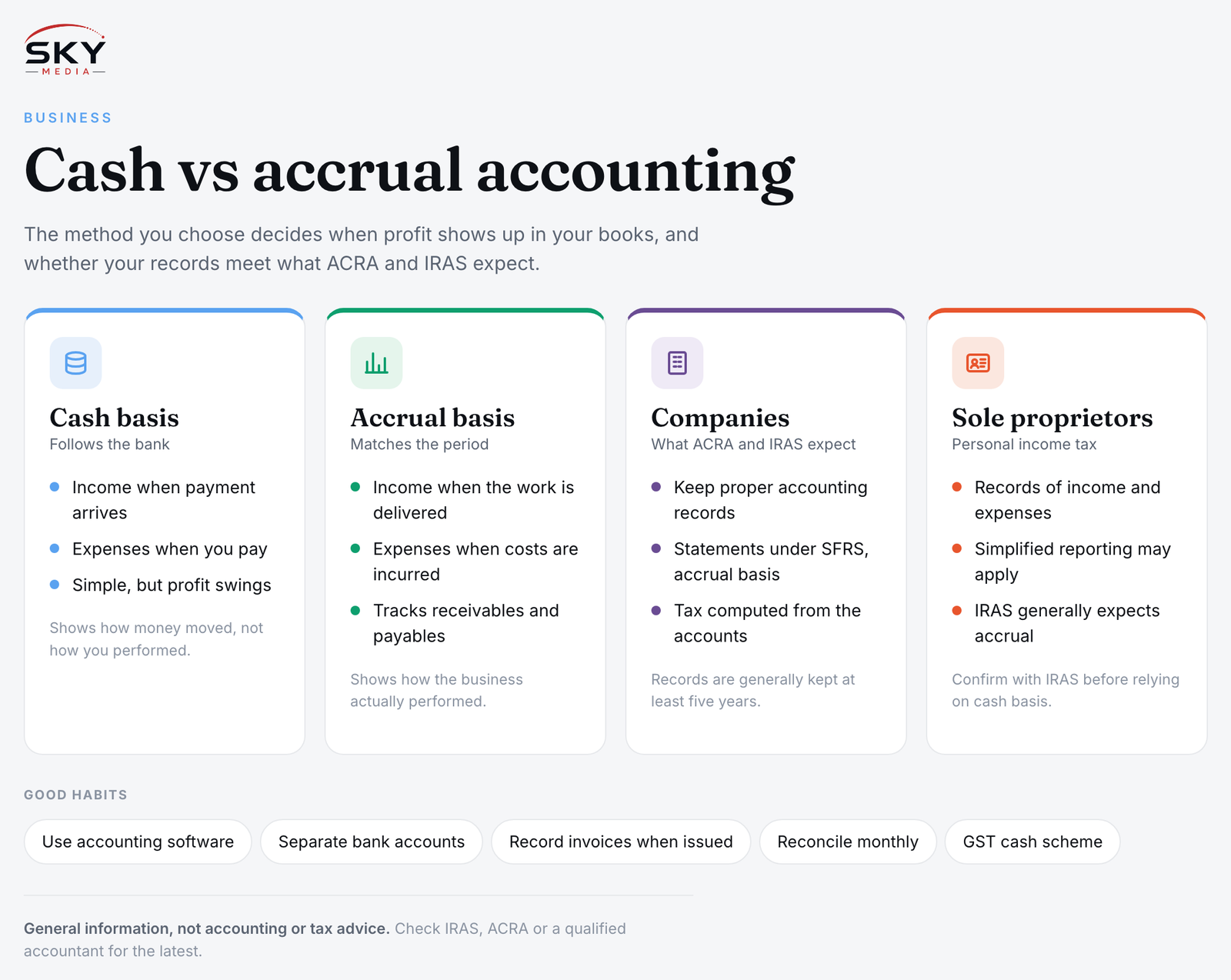
Cash accounting records income when money arrives in your bank account and expenses when money leaves. If you invoice a client in March but they pay in May, the income appears in May.
Accrual accounting records income when it is earned and expenses when they are incurred, regardless of when cash moves. The March invoice counts as March income, and the unpaid amount sits in your books as money owed to you (accounts receivable). Bills you have received but not yet paid sit as money you owe (accounts payable).
| Point of comparison | Cash accounting | Accrual accounting |
|---|---|---|
| When income is recorded | When payment is received | When the sale or service is delivered |
| When expenses are recorded | When you pay | When the cost is incurred |
| Effort to maintain | Simpler, closely follows the bank statement | More work: invoices, bills, adjustments |
| Picture of profitability | Can swing with payment timing | Matches income to the period it belongs to |
| Shows money owed to and by you | No | Yes, through receivables and payables |
| Fit with Singapore financial reporting standards | Not used for company financial statements | The basis used under the accounting standards |
A Worked Example
Imagine a small design studio.
- In November it completes a branding project and invoices the client $8,000. The client pays in January.
- In November it also buys $1,500 of software on a credit card, paid off in December.
- In December it receives $3,000 upfront for a project that will be done in February.
Under cash accounting, November looks quiet: no income, no software expense. December shows $3,000 in and $1,500 out. January shows $8,000 in. The studio’s best month of work, November, looks like its worst.
Under accrual accounting, November shows $8,000 of income and $1,500 of expense, which is a true reflection of what happened. The $3,000 received in December is recorded as a liability (income received in advance) until the work is delivered in February, when it becomes income.
The figures above are illustrative only. The point is that accrual accounting tells you how the business actually performed in each period, while cash accounting tells you how money moved.
What ACRA and IRAS Expect From Companies
If you run a private limited company registered with ACRA, the position is fairly clear:
- Proper accounting records. The Companies Act requires companies to keep accounting records that explain their transactions and financial position. Records are generally kept for at least five years.
- Financial statements on an accrual basis. Company financial statements are prepared under the Singapore Financial Reporting Standards, which use accrual accounting. Small companies may qualify for a simplified version of the standards, but the accrual basis still applies.
- Tax filing builds on those accounts. IRAS computes a company’s taxable income starting from its accounts, with tax adjustments. In practice, a company cannot simply run its books on a cash basis.
Many small company owners keep day-to-day records simply during the year, then have an accountant make year-end adjustments for receivables, payables, prepayments and accruals. That works, as long as the final accounts are prepared properly.
What Applies to Sole Proprietors and Partnerships
A sole proprietorship or partnership is not a separate legal entity, and its profit is taxed as the owner’s personal income. Owners report business income in their personal tax return to IRAS.
- Records are still required. IRAS expects self-employed people and sole proprietors to keep proper records of income and expenses, including invoices and receipts, and to keep them for the required period.
- Simplified reporting may be available. IRAS allows smaller businesses to report a simpler statement of revenue and expenses rather than full accounts, subject to conditions it sets. Check IRAS’s current guidance for the thresholds.
- The basis of accounting matters. IRAS generally expects business income to be reported on an accrual basis. Some very small businesses run day-to-day bookkeeping on a cash basis, but confirm with IRAS or an accountant whether that is acceptable for your situation before relying on it.
Our general guide to bookkeeping for small business in Singapore covers setting up a filing system and choosing software.
GST and the Cash Accounting Option
If your business is registered for GST, IRAS offers a cash accounting scheme for qualifying smaller businesses. Under it, you account for output tax when you receive payment and claim input tax when you pay suppliers. This can help cash flow if customers pay slowly.
It is important to note that this only affects when GST is accounted for. It does not change how your financial statements or income tax figures are prepared. Eligibility criteria and conditions are set by IRAS, so check the current rules before applying.
Which Method Should You Use?
For most Singapore businesses the realistic answer is a blend:
- Companies should keep accrual-based accounts, because that is what the financial reporting standards and the tax computation rely on.
- Sole proprietors with simple, immediate-payment sales, such as a hawker or a market stall where customers pay on the spot, may find there is little practical difference between the two methods.
- Any business that invoices on credit terms, holds stock or pays for things in advance benefits from accrual accounting, because cash accounting will distort its profit.
Whichever method underpins your books, keep a close eye on cash too. Profitable businesses still fail when cash runs out, which is why managing business cash flow deserves its own routine alongside your accounts.
Practical Tips for Getting It Right
- Use accounting software that supports invoicing and bills. Most packages handle accruals automatically once you record invoices rather than just bank transactions.
- Separate business and personal accounts so transactions are easy to classify.
- Record invoices when issued, not just when paid, so you can see who owes you.
- Reconcile monthly against your bank statement to catch errors early.
- Talk to an accountant before your first year-end, especially if you are converting from a sole proprietorship to a company, since the accounting expectations change.
Getting the basis right from the start saves painful clean-ups later and gives you numbers you can actually make decisions with.
Frequently Asked Questions
Can a sole proprietor in Singapore use cash accounting? Some very small businesses run day-to-day bookkeeping on a cash basis, but IRAS generally expects business income to be reported on an accrual basis. Confirm with IRAS or an accountant whether cash accounting is acceptable for your situation.
Can a small private limited company keep books on a cash basis? Not for its financial statements. Company accounts are prepared under the Singapore Financial Reporting Standards, which use accrual accounting, and tax computations start from those accounts. Many owners keep simple records and let an accountant adjust at year end.
What is the GST cash accounting scheme and who can use it? It lets qualifying smaller GST-registered businesses account for output tax when they receive payment and claim input tax when they pay suppliers. It only changes GST timing, not your financial statements, and IRAS sets the eligibility criteria.
When does accrual accounting give a clearer picture than cash accounting? When you invoice on credit terms, hold stock or pay for things in advance. Cash accounting can make a busy month look quiet because payment arrives later. Accrual matches income and costs to the period they belong to.
What accounting software features help with accrual accounting? Look for software that supports invoicing and bills, since most packages handle accruals automatically once you record invoices rather than just bank transactions. Reconcile monthly against your bank statement and keep business and personal accounts separate.
Further reading: A Small Business Compliance Calendar: Key Filing Deadlines in Singapore · Keeping a Fixed Asset Register and Depreciating Business Assets · Managing Petty Cash in a Small Business: Float, Vouchers and Controls · How to Set Up a Chart of Accounts for a Singapore SME