

Few relationship milestones make the stomach flip quite like meeting the parents. Singapore adds its own layer to the moment, because families here often carry strong ideas about respect, food, background and what a good match looks like. If you are preparing for meeting the parents Singapore style, the good news is that a little thought goes a long way. You do not need to be perfect. You need to be warm, respectful and genuinely curious about the people who raised your partner.
This guide walks you through preparing, showing respect across different cultures and faiths, handling the awkward questions, and calming your nerves so you can be your best, honest self.
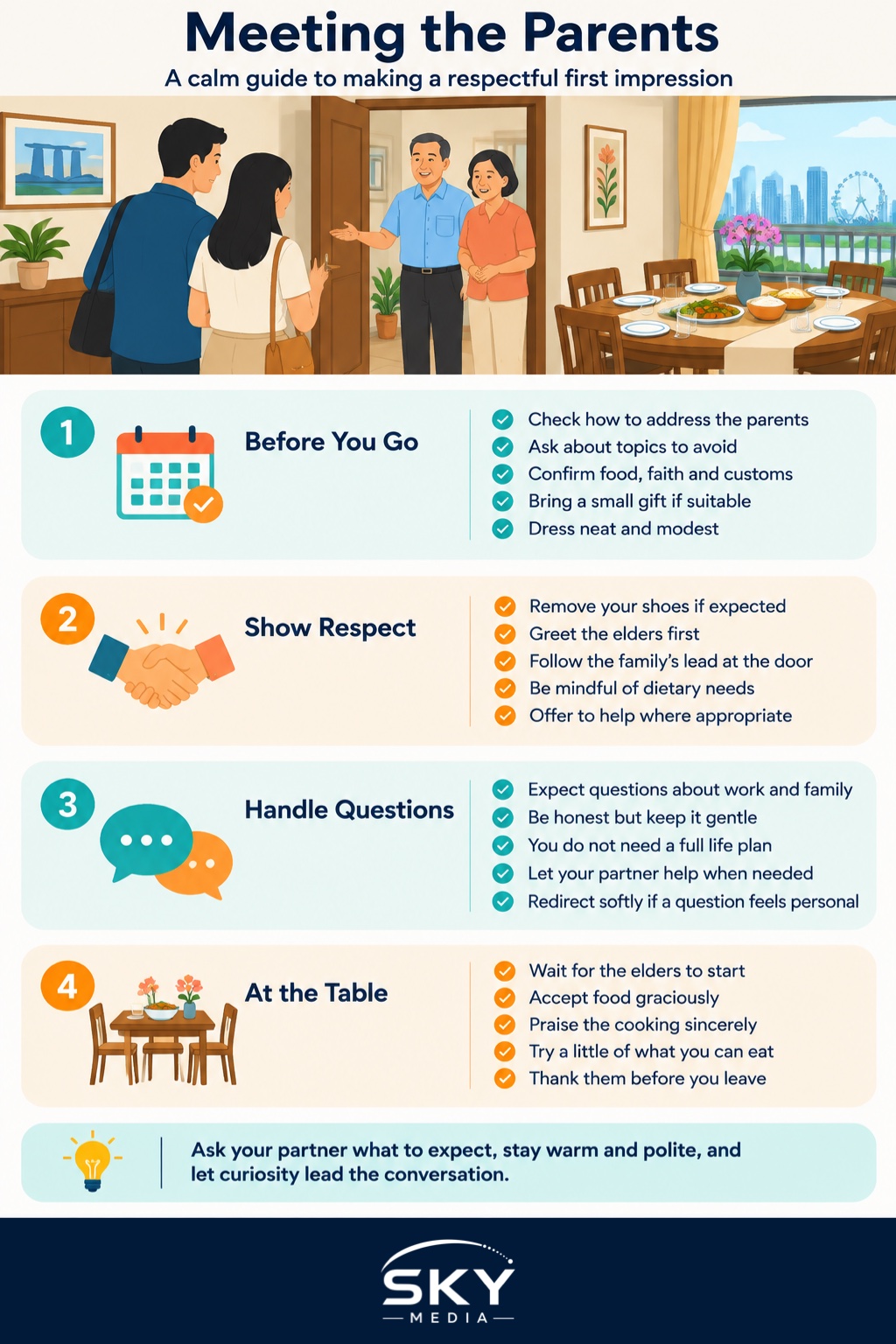
Why This Meeting Feels So High Stakes
When your partner brings you home, they are quietly saying that you matter. Parents often read the first meeting as a signal about how serious things are, especially in family-oriented Singaporean households where relationships are seen as a joining of two families rather than two individuals.
That weight is real, but it does not mean you are being judged on a single sitting. Most parents simply want to know that their child is happy, safe and treated well. If you keep that goal in mind, the pressure to impress with clever conversation eases. You are not auditioning. You are letting people see that their loved one is in kind hands.
It also helps to remember that your partner is nervous too. They want the two sides of their world to get along. Going in as a team, rather than as one person under a spotlight, changes the whole tone.
Prepare Without Over-Rehearsing
A short conversation with your partner before the visit saves a lot of guesswork. Ask them a few practical things so you walk in informed rather than blindly hoping for the best.
- What should you call their parents? Uncle and Auntie are common and warm in Singapore, but check first.
- Are there topics to avoid, such as politics, money or a family sensitivity?
- Is the family religious or culturally traditional in ways that shape the visit?
- Will there be a meal, and are there dishes you should try or dietary rules to respect?
- Is a small gift expected, and would it be welcome or awkward?
Prepare a few easy things to talk about, like how you met, your work or studies, and a genuine compliment about the home or the food. You do not need a script. You just need enough footing so a silence does not send you into a panic.
Dress a notch smarter than you think you need to. Neat and modest reads as respectful in most local homes, and you can always relax once you sense the mood.
Show Respect Across Cultures and Faiths
Singapore is beautifully multicultural and multi-faith, so meeting the parents can mean stepping into customs that differ from your own. Treat these differences as something to honour, not to fear. When you are unsure, ask your partner in advance or follow the family’s lead in the moment.
A few thoughtful habits carry across many households here:
- Remove your shoes at the door unless told otherwise.
- Greet the elders first, and greet them warmly.
- If food is offered, accepting graciously is often a sign of respect, so pace yourself.
- For Muslim families, avoid bringing alcohol or non-halal food, and dress modestly.
- For Hindu or Buddhist families, some homes are vegetarian, so do not assume.
- In many Chinese families, offering to help clear the table or bring fruit is quietly appreciated.
If you and your partner come from different backgrounds, the parents may have questions about how you will navigate that together. Answer honestly and with warmth. Showing that you respect their traditions, even while holding your own, tells them you will be a steady presence rather than a source of conflict.
Navigate the Questions With Grace
Expect some direct questions. Parents often ask about your job, your family, your plans and sometimes your intentions, all within the first hour. In Singapore, questions about career stability, housing and the future can come quickly because these things carry real weight in daily life.
You do not owe anyone a five-year plan. It is perfectly fine to be honest and gentle. Try responses like:
- “We are taking things one step at a time and really enjoying getting to know each other.”
- “I am still building my career, and I am proud of the direction it is heading.”
- “That is something we will figure out together when the time is right.”
If a question feels too personal, you can smile and redirect softly: “That is a big one, Auntie. For now I am just happy to be here.” Let your partner step in where family dynamics get tricky. They know the terrain, and a united front reassures everyone.
The table below compares habits that tend to warm a family up against ones that quietly cool the room.
| Green Flags to Lean Into | Red Flags to Avoid |
|---|---|
| Greeting elders first and warmly | Arriving late without a message |
| Accepting food and offering to help | Being glued to your phone |
| Asking about family stories and food | Dominating the conversation |
| Respecting religious and cultural customs | Making jokes at anyone’s expense |
| Thanking them sincerely before leaving | Overpromising about the future |
Handle Gifts and the Meal Gracefully
A small gift is rarely wrong when chosen with care. A box of good fruit, quality biscuits or local treats works in many homes. Match the gift to the family, and when in doubt, ask your partner. Avoid alcohol for Muslim families, and be mindful that some gifts carry meanings in certain cultures, so a quick check prevents an unlucky choice.
At the table, follow the elders’ cues on when to start. Offer to help, praise the cooking honestly, and try a bit of everything you are able to eat. If a dish does not suit your diet, decline kindly and mention why without making a fuss. People remember how you made them feel far more than what you said.
Calm Your Nerves and Be Yourself
Nerves are normal, and a few deep breaths in the car outside can settle you more than any last-minute rehearsal. Remind yourself that you are a good person your partner chose, not a candidate on trial. If your mind blanks, ask a warm question and listen. People love to talk about their children, their cooking and their younger days, so curiosity is your easiest ally.
You will not control everything. A joke may land flat, or a parent may stay reserved. That is okay. First impressions grow over time, and one quiet meeting rarely decides a relationship. If the visit stirs up real anxiety about family acceptance or clashing expectations, talk it through with your partner, and consider speaking to a counsellor or a Family Service Centre if the worry lingers. Support is a strength, not a failure.
Above all, be honest and kind. Warmth is remembered long after the words fade, and that is what turns a nervous first meeting into the start of something lasting.
Explore more
If this milestone is on your mind, you might also like our guide on meeting your partner’s friends, since both moments test how well your worlds blend. For couples from different backgrounds, dating someone from another culture offers deeper ground to cover. And if the visit has you weighing the future, knowing if you are ready to commit is a gentle next read.
Related across Sky Media: What to Wear to Meet the Parents · Meeting the Parents and Asking for a Blessing