

Two of the most talked-about senior support schemes in the country are the Pioneer Generation Package Singapore and the Merdeka Generation Package. Both were created to honour older Singaporeans and to help them with the cost of staying healthy as they age. If you are helping a parent understand their benefits, or trying to work out which package might apply to someone in your family, this guide explains how the two packages work, what kind of support they provide, and how to confirm the exact details. It focuses on principles rather than figures, because the specific amounts and criteria are set by the Government and can be updated.
At heart, both packages are the country’s way of saying thank you to earlier generations who built Singapore, while also easing a very practical worry: healthcare costs in later life. Rather than a one-off gesture, each package is a bundle of ongoing benefits that follows a person through their senior years.
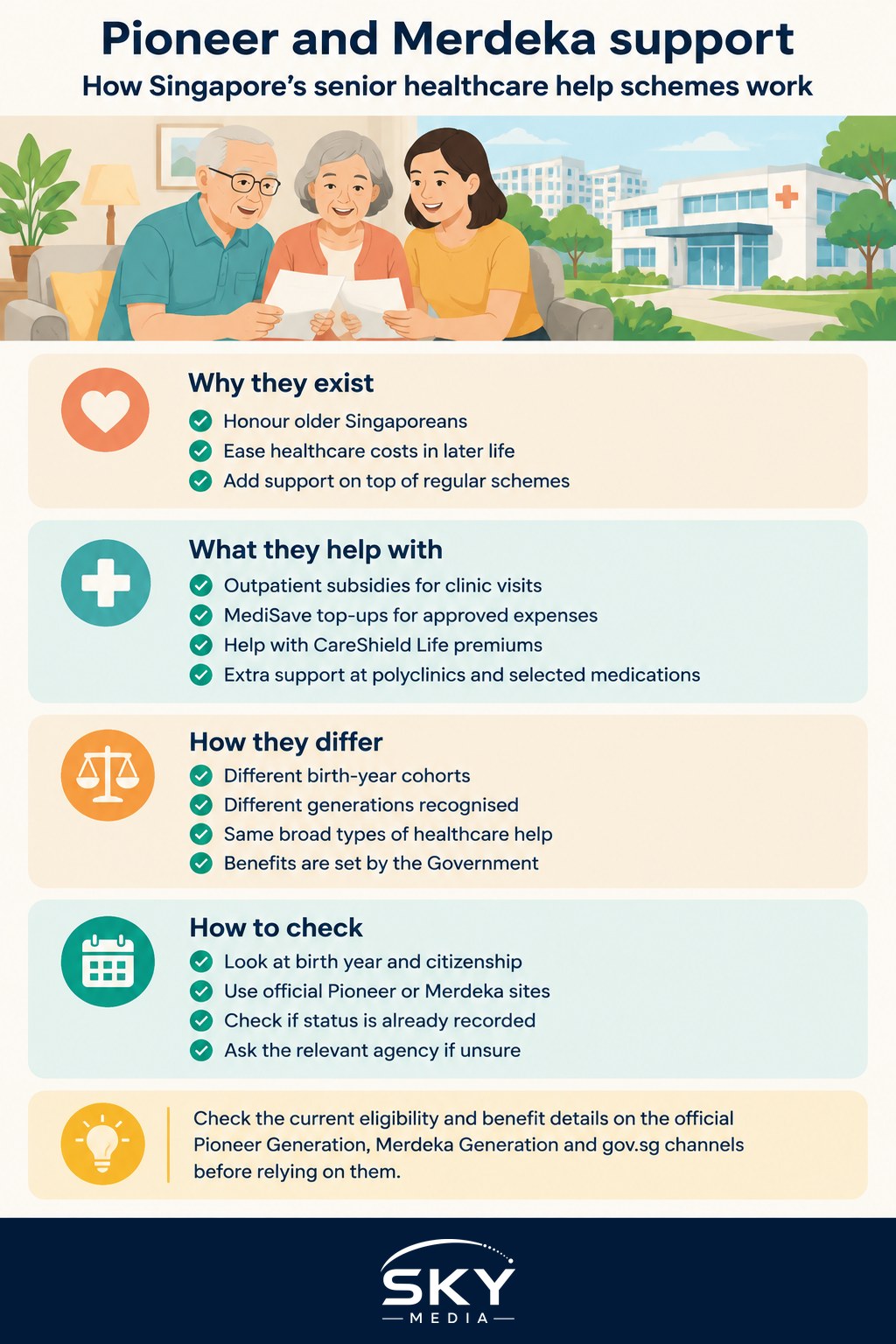
Why These Packages Exist
Singapore’s approach to social support leans on the idea that citizens, employers, and the state each play a part, with the state stepping in to help where the need is real. Older Singaporeans came of age when incomes were lower and formal savings schemes were still developing, so many entered their senior years with less set aside for medical bills.
The Pioneer Generation Package was introduced first, aimed at the oldest cohort who contributed during the country’s earliest and most uncertain years. The Merdeka Generation Package followed, extending similar recognition and support to a slightly younger group who grew up around the time the nation was finding its feet. Both sit alongside the broader healthcare financing system, adding a layer of help specifically for seniors on top of the schemes that all residents use.
The common goal is peace of mind: making routine care, medication, and long-term care insurance more affordable so that growing older does not become a source of financial stress.
What Kind Of Support They Provide
Rather than a single payout, each package is a collection of benefits that work together across a senior’s healthcare needs. The exact values differ between the two packages and are reviewed over time, so the descriptions below explain the types of help rather than the amounts.
Broadly, the support falls into a few recurring themes:
- Help with everyday medical visits. Both packages provide subsidies that make outpatient care more affordable, including visits at participating clinics and community care settings.
- Top-ups to health savings. Seniors receive contributions towards their MediSave accounts, which can be used for approved medical expenses and premiums.
- Support for long-term care insurance. The packages help with premiums for the national long-term care scheme, easing the cost of coverage against severe disability in old age.
- Additional subsidies at the point of care. Recognised seniors often enjoy extra help at polyclinics, on selected medications, and through community health programmes.
Membership is typically recognised through official records and, in the case of the Pioneer Generation, a physical card that identifies a person as a beneficiary. The benefits are designed to be largely automatic once eligibility is established, so seniors generally do not need to reapply each time they seek care.
How to use the benefits
Most benefits work automatically, without paperwork each time. MediSave top-ups are credited into the eligible person’s MediSave account, where they can be used for approved expenses in the usual way. Premium support for MediShield Life and long-term care coverage is applied when premiums fall due, reducing what the senior pays. Outpatient subsidies are applied at the point of care. At a participating polyclinic, CHAS clinic or specialist outpatient clinic, the senior simply presents their identification and the relevant subsidy is worked out at billing.
A few practical habits help families get full value. Keep the senior’s records and Singpass access in order so you can check entitlements online. Choose participating clinics where the outpatient subsidies apply, especially for managing chronic conditions over the long term. And remember that these packages sit on top of the standard subsidies and MediSave and MediShield Life coverage every Singaporean has, so an eligible senior benefits from both.
Because the details are updated periodically, the single best move is to verify the current benefits and any action needed through the official channels. If in doubt about eligibility or how a benefit is applied to a bill, ask at the clinic or check the official source rather than assuming.
How The Two Packages Compare
Both packages share the same spirit, but they target different age groups and are calibrated differently. Because eligibility is defined mainly by birth-year cohorts and residency, and because the amounts are set by the Government, the table below deliberately avoids specific figures and years. Use it to understand the shape of each package, then confirm the current criteria on the official sites.
| Feature | Pioneer Generation Package | Merdeka Generation Package |
|---|---|---|
| Who it recognises | The oldest cohort of Singaporeans who contributed in the earliest nation-building years | A slightly younger cohort who came of age around the country’s early independence |
| General basis of eligibility | Birth-year cohort plus citizenship criteria set by the Government | Birth-year cohort plus citizenship criteria set by the Government |
| Type of help | Outpatient subsidies, MediSave top-ups, long-term care premium support, extra point-of-care subsidies | Outpatient subsidies, MediSave top-ups, long-term care premium support, extra point-of-care subsidies |
| How benefits are recognised | Beneficiary status with a Pioneer Generation card | Beneficiary status recorded officially for the cohort |
| Where to verify | Official Pioneer Generation resources | Official Merdeka Generation resources |
The key takeaway is that the two packages are complementary rather than competing. A person belongs to one cohort or the other based on when they were born and their citizenship, and the authorities determine which package applies. Nobody needs to choose between them.
Who Qualifies And How To Find Out
Eligibility is decided by the Government and rests mainly on a person’s birth-year cohort together with citizenship. Because these cut-offs are specific and can be adjusted, this guide does not state them; instead, the reliable approach is to check the official Pioneer Generation and Merdeka Generation sites, or the gov.sg channels, where the current criteria are published.
If you are helping a family member work out their status, a practical sequence is:
- Note the senior’s year of birth and citizenship history, since these are the main factors.
- Visit the official Pioneer or Merdeka Generation resources and compare against the stated cohort criteria.
- Check whether they already hold a Pioneer Generation card or have been notified of their status.
- If anything is unclear, contact the relevant agency or a nearby community touchpoint for confirmation.
Because benefits are applied largely through the healthcare system, a senior often sees the effect simply as lower bills at participating clinics and support towards their premiums, without needing to manage anything complicated themselves.
A Note On Accuracy And Advice
This article is general information to explain how the packages work, and it is not personalised financial advice. The specific amounts, subsidy levels, birth-year cohorts, and eligibility rules are set by the Government and are reviewed and updated from time to time. Details you read informally, or figures quoted from a few years ago, may no longer be current.
Before making any decision that depends on the exact benefits, confirm the current details on the official Pioneer Generation and Merdeka Generation sites, or through gov.sg and the relevant agencies. Treating those official sources as the final word ensures you are working with accurate, up-to-date information rather than an approximation.
Explore More
To see how these senior packages fit within the wider system of health coverage, read our explainer on healthcare financing and the 3Ms in Singapore, and for a closer look at long-term care insurance see CareShield Life explained. If you are supporting an older relative on a tight budget, our guide to Silver Support and ComCare in Singapore covers complementary help that may apply.
Frequently Asked Questions
Do Pioneer Generation benefits apply at private hospitals? The outpatient and point-of-care subsidies mainly apply at polyclinics, participating CHAS clinics and public specialist outpatient clinics, so a private hospital bill is not discounted in the same way. MediSave top-ups received under the package can still be used for approved expenses there, subject to the usual MediSave rules.
What should a senior do if they lose their Pioneer Generation card? Benefits are tied to official records, so presenting NRIC at a participating clinic is usually enough to have subsidies applied. A replacement card can be requested through the official Pioneer Generation channels or a community touchpoint. Be wary of anyone offering to replace it for a fee.
Can someone who became a citizen later in life qualify for these packages? Possibly, but citizenship is assessed against a specific cut-off set by the Government, alongside the birth-year cohort. Someone who became a citizen after that point may not qualify even if their age fits. Check the stated criteria on the official Pioneer or Merdeka Generation pages for a definite answer.
Can family members use a senior’s Pioneer or Merdeka Generation subsidies? No, the benefits are personal to the eligible senior and apply only to their own medical visits, premiums and MediSave account. Relatives can, however, help by booking appointments at participating clinics, keeping records in order and checking entitlements online with the senior’s consent.
Do eligible seniors still pay MediShield Life premiums? They usually still have a premium, but the packages provide support that reduces what they pay, and the balance can generally be paid from MediSave. The net amount varies by age and package, so check the senior’s premium notice or CPF statement to see exactly what is due.
Official sources: CPF Board
Further reading: Pioneer Generation Disability Assistance Scheme and IDAPE Explained · The Assurance Package, Explained