

By the end of June, the year is half gone, and so is half of whatever budget you set in January. A mid-year financial review is a calm, once-a-year look at the last six months: where the money actually went, whether your savings are on track, whether your insurance still fits your life, and how to use any mid-year bonus or extra income sensibly. It is different from a year-end review because you still have six months left to change course.
This guide walks you through a practical half-year audit you can complete over a weekend, either alone or with your partner or family. It is general information, not financial advice. For decisions about CPF, tax or investments, check the official sources named below or speak to a licensed adviser.
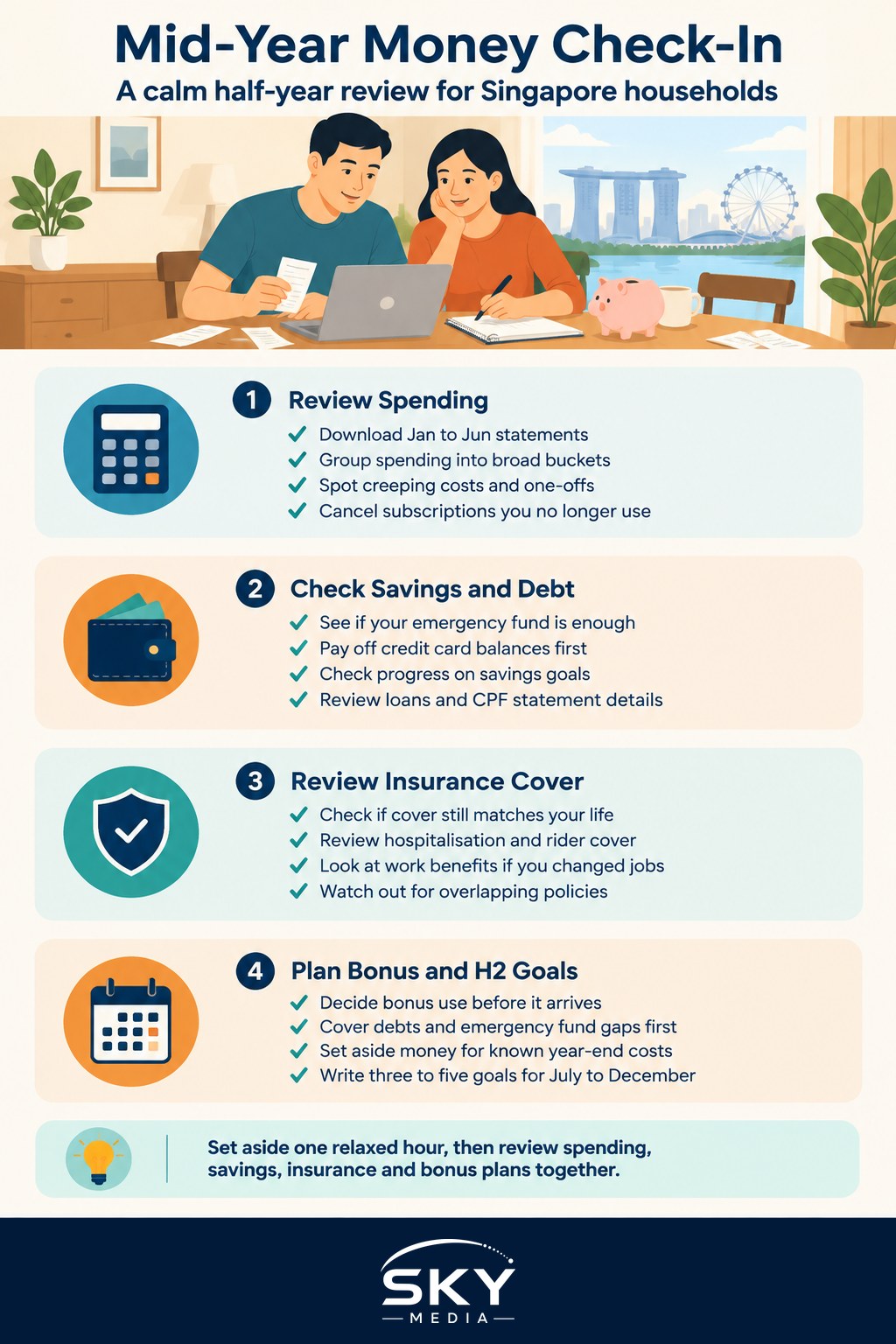
Why June Is a Good Time to Review
Several things line up in the middle of the year in Singapore:
- Many employers pay mid-year bonuses or variable pay, so extra cash may arrive and needs a plan.
- School holidays and travel season have just passed, which often means a spending spike worth looking at honestly.
- Tax season is behind you. Your income tax assessment from IRAS (the Inland Revenue Authority of Singapore) has usually arrived by mid-year, so you know what you owe and whether your instalment plan works.
- Year-end festivities and bonus season are still far enough away that you can save for them on purpose rather than scramble.
If you already do a short monthly money review, the mid-year check-in is the bigger-picture version: fewer transactions, more direction.
Step 1: Audit Six Months of Spending
Start with facts. Download statements from your bank accounts, credit cards and any e-wallets you use for January to June. You do not need perfect categories; broad buckets are enough:
- Housing (mortgage or rent, conservancy or maintenance fees, utilities)
- Food (groceries, hawker and food delivery, dining out)
- Transport (MRT and bus fares, private hire rides, car costs)
- Family (childcare, school fees, tuition, allowances to parents)
- Insurance premiums
- Travel and leisure
- Subscriptions and miscellaneous
Add up each bucket and compare it with what you expected. Look for three things:
- Creep: categories that rose steadily month by month, such as food delivery or rides.
- One-offs: large expenses like a holiday or a new appliance. Note whether you saved for them or put them on a card.
- Forgotten subscriptions: streaming, apps, gym memberships or cloud storage you no longer use.
Cancel what you do not need straight away; the saving is instant.
Step 2: Check Savings, Debt and Your Emergency Fund
Next, look at where your money is sitting, not just where it went.
| Area to check | Question to ask | Possible action for the second half |
|---|---|---|
| Emergency fund | Could we cover several months of essential expenses if income stopped? | Top up gradually with a fixed monthly transfer |
| Credit card balances | Are we paying the full statement amount every month? | Clear revolving balances first, since card interest is usually high |
| Savings goals | Are we on pace for this year’s targets, such as a holiday or renovation? | Adjust the monthly amount or the target date |
| Loans | Are home or car loan repayments comfortable at current rates? | Review terms with the bank if repayments feel stretched |
| CPF statement | Do the contributions and balances look right? | Log in to the CPF Board website to check and raise any discrepancies |
If you carry credit card debt, paying it down is usually the most valuable thing any extra cash can do. If you are debt-free and your emergency fund is healthy, you have more room to save for longer-term goals.
For CPF, avoid assumptions about rates or limits. The CPF Board website shows your own statement and explains current schemes, such as voluntary top-ups, in plain terms.
Step 3: Review Insurance Against Your Current Life
Insurance is easy to buy and easy to forget. Use the mid-year check-in to ask whether your cover still matches your situation. Life events in the first half of the year, such as a new baby, a new job, a home purchase or a parent moving in, often change what you need.
Things to look at:
- Hospitalisation cover: MediShield Life covers all Singapore Citizens and Permanent Residents. Many people add an Integrated Shield Plan. Check what your plan and any rider cover, and whether premiums are still comfortable.
- Work benefits: if you changed jobs, your new employer’s group insurance may differ from the old one. Your HR department can explain it.
- Life and critical illness cover: consider whether the amount still fits your dependants and loans.
- Overlap: two policies covering the same thing may mean you are paying twice.
Read the policy documents themselves and ask your insurer or adviser about anything unclear. Do not cancel a policy before you understand what you would lose, especially if your health has changed.
Step 4: Decide What to Do With a Mid-Year Bonus
If you receive a mid-year bonus, decide its jobs before it lands in your account. A simple split many households find helpful:
- First, debts and gaps: clear credit card balances and fill any shortfall in the emergency fund.
- Second, planned expenses: set aside money for known costs in the next six months, such as school fees, insurance premiums due later in the year, festive spending or a year-end trip.
- Third, longer-term goals: extra savings, a CPF top-up if it suits you, or investments you understand.
- Finally, a small reward: spending a modest portion on something you enjoy makes the plan easier to stick to.
The exact split depends on your circumstances. What matters is deciding in advance, so the bonus does not quietly disappear into everyday spending. If you are self-employed or your income is irregular, treat strong months the same way: assign the extra before spending it.
Step 5: Set Goals for July to December
Finish the check-in by writing down three to five concrete goals for the rest of the year. Good mid-year goals are specific and small enough to track:
- “Cut food delivery spending back to our January level.”
- “Add a fixed amount each month to the emergency fund until it covers six months.”
- “Pay off the remaining credit card balance by October.”
- “Book a review with our insurer before the policy renews.”
Put a reminder in your calendar for the end of the year. When December comes, your end-of-year money review will be faster because you will be comparing against goals you already set. If you prefer a quarterly rhythm, our Q2 money reset checklist pairs well with this half-year audit.
Doing the Review as a Household
Money conversations go more smoothly when everyone involved has a voice. If you share finances with a partner, set aside a relaxed hour, bring the numbers, and agree on goals together rather than assigning blame for past spending. In multi-generation homes, it helps to be clear about who covers which shared costs, such as utilities, groceries or a helper’s salary. Keep the tone practical: the aim is a clearer second half of the year, not a perfect first half.
Frequently Asked Questions
Is topping up my CPF with a mid-year bonus a good idea? It can suit some people, but it is not automatically the best use of cash. First clear credit card balances and fill any emergency fund gap, then consider longer-term goals. Check the CPF Board website for current rules on voluntary top-ups, or speak to a licensed adviser.
What should I do if I overspent badly in the first half of the year? Start with the facts rather than blame. Sort the spending into broad buckets, spot creep and one-offs, and cancel forgotten subscriptions straight away. Then set a few small, specific goals for July to December, such as bringing food delivery spending back to your January level.
When should I talk to a licensed adviser instead of doing this myself? For decisions about CPF, tax or investments, or if your insurance needs have changed after events like a new baby or home purchase, a licensed adviser or the official bodies are the right source. A weekend self-audit is a good start, but it does not replace personalised advice.
How do I save for year-end festivities and travel instead of scrambling? Work out roughly what you spent last time, then set aside a fixed monthly amount from July so the cost is spread out. Putting it in a separate account helps keep it apart from everyday spending. Include insurance premiums or school fees due later in the year.
Official sources: MoneySense
Further reading: How to Set and Keep Financial Resolutions