

December is a natural point to pause. Bonuses land for many workers, the festive season tests your budget, and a new year of goals is around the corner. An end of year money review is a single, focused session where you look back at the past twelve months and set up the next twelve. It is bigger than a monthly check in, but it does not need a spreadsheet wizard or a financial adviser. This guide gives you a practical framework covering cash flow, savings, CPF, insurance, debt and goals, written for people living and working in Singapore.
This is general information, not financial advice. For decisions specific to your situation, speak to a licensed adviser, and check official rules with CPF Board, IRAS and the relevant agencies.
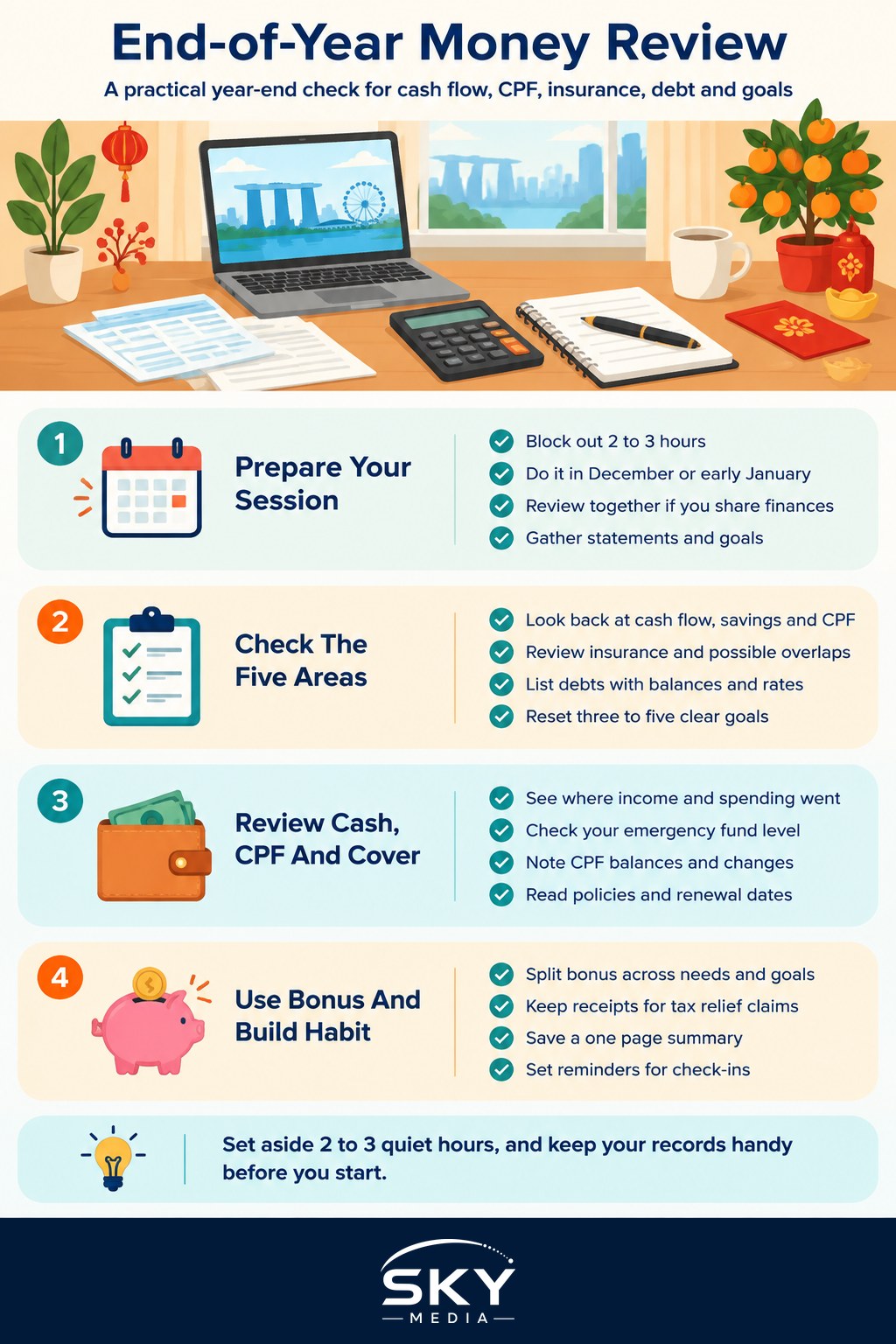
Set Up Your Review Session
Block out two to three hours on a quiet weekend, ideally in December or early January. If you share finances with a partner, do it together. Before you start, gather:
– Bank and credit card statements, or exports from your banking apps
– Your CPF statement, which you can view through the CPF website or app using Singpass
– A list of your insurance policies, including any provided by your employer
– Loan statements for housing, car, education or personal loans
– Last year’s goals, if you wrote any down
If you already do a short monthly money review, this annual session will be much faster because the raw numbers are already organised.
The Five Areas of an End of Year Money Review
Work through these areas in order. Each one has a backward looking question and a forward looking action.
| Area | Look back | Decide for next year |
|---|---|---|
| Cash flow | What did I earn and spend, and where did money leak? | A realistic monthly budget and savings rate |
| Savings and CPF | Did my emergency fund and savings grow as planned? | Target amounts and whether any CPF top ups suit me |
| Insurance | Are my policies still right for my life stage? | Gaps to fill, overlaps to remove, renewal dates |
| Debt | What did I owe at the start and end of the year? | A repayment order and timeline |
| Goals | Which goals did I hit or miss, and why? | Three to five clear goals with deadlines |
1. Cash flow: where did the year’s money go?
Add up your total take home income for the year, including bonuses and side income. Then look at your spending in broad categories: housing, transport, food, family support, insurance, subscriptions, travel and leisure. You do not need to track every cent. The goal is to see the shape of your spending.
Look especially for:
– Subscriptions you no longer use
– Months where spending spiked, and what caused it
– Recurring costs that crept up, like mobile plans, food delivery or ride hailing
– Large one off costs that may repeat, such as travel or festive spending
Then set a monthly budget for next year based on what really happened, not on what you wish had happened. If December and Chinese New Year are always expensive for your family, build that into the plan. Our guide on budgeting for the year end festive season can help with that part.
2. Savings, emergency fund and CPF
Check the balance of your emergency fund. A common rule of thumb is to hold several months of essential expenses in cash, though the right amount depends on your job stability and dependants. If you drew on it this year, make topping it back up an early priority.
Next, look at your CPF statement. Note your Ordinary, Special or Retirement, and MediSave account balances and how they changed. If you are considering voluntary top ups, for example for tax relief or retirement adequacy, check the current schemes, limits and conditions directly with CPF Board and IRAS, as these can change. Remember that CPF top ups are generally locked in for the long term, so make sure your cash needs are covered first.
If you invest, record the value of your portfolio, but focus less on the year’s returns and more on whether your asset mix still matches your timeline and risk comfort.
3. Insurance: still the right cover?
Life changes quickly. Marriage, a new baby, buying a flat, changing jobs or caring for parents can all change what cover you need. List each policy, what it covers, the premium and the renewal date. Ask yourself:
– Do I still have hospitalisation coverage I understand, including any Integrated Shield Plan on top of MediShield Life?
– If I could not work, would my family manage?
– Did my employer’s group insurance change, or will it end if I change jobs?
– Am I paying for overlapping cover?
Read the policy documents rather than relying on memory, and direct specific questions to your insurer or HR. Do not cancel an existing policy before replacement cover is confirmed.
4. Debt: what you owe and in what order
List every debt with its balance, interest rate and monthly repayment. Compare the totals with this time last year. Credit card balances that roll over and personal loans typically carry the highest interest, so paying those down usually comes before extra payments on lower rate loans such as a housing loan. If you are struggling with repayments, contact your bank early to discuss options, or approach Credit Counselling Singapore for free, independent help.
5. Goals: review and reset
Look at last year’s goals honestly. Which ones did you achieve? Which slipped, and was it because the goal was unrealistic or because life got in the way? Then set three to five goals for the new year. Make them specific, for example “save $X for a wedding by September” or “clear credit card balance by June”, and decide which account each goal’s money will sit in.
Use Your Year End Cash Wisely
Many employees in Singapore receive a year end bonus or AWS (Annual Wage Supplement) around December. Decide in advance how you will split it between your emergency fund, debts, goals and some guilt free spending. Doing this as part of your review stops the money from quietly disappearing into festive shopping.
It is also a good time to note tax matters. IRAS typically opens individual income tax filing in the first half of the year, so keep receipts and records of donations, course fees or other reliefs you may claim. Check the IRAS website for what applies to you.
Turn the Review Into a Habit
An annual review works best when it is easy to repeat. After your session:
– Save a one page summary with your key numbers: net worth, emergency fund, debts and goals
– Set calendar reminders for insurance renewals and any planned top ups
– Schedule short monthly or quarterly check ins to stay on track
– Pair it with a broader personal routine like the weekly review habit if you like structure
Next December, you will have this year’s summary to compare against, which is where the review becomes really powerful. Seeing your progress over two or three years is often the best motivation to keep going.
Official sources: MoneySense