

It happens to more people than you might think. A busy week, a GIRO arrangement that lapsed after you changed banks, or a statement that landed in a forgotten email folder, and suddenly the due date has passed. A missed credit card payment is stressful, but one slip is usually fixable if you act quickly.
This guide explains what typically happens after the due date, how it can show up on your Credit Bureau Singapore record, and the practical steps to recover. It is general information, not financial advice. Each bank sets its own fees and terms, so your cardholder agreement and statement are the final word.
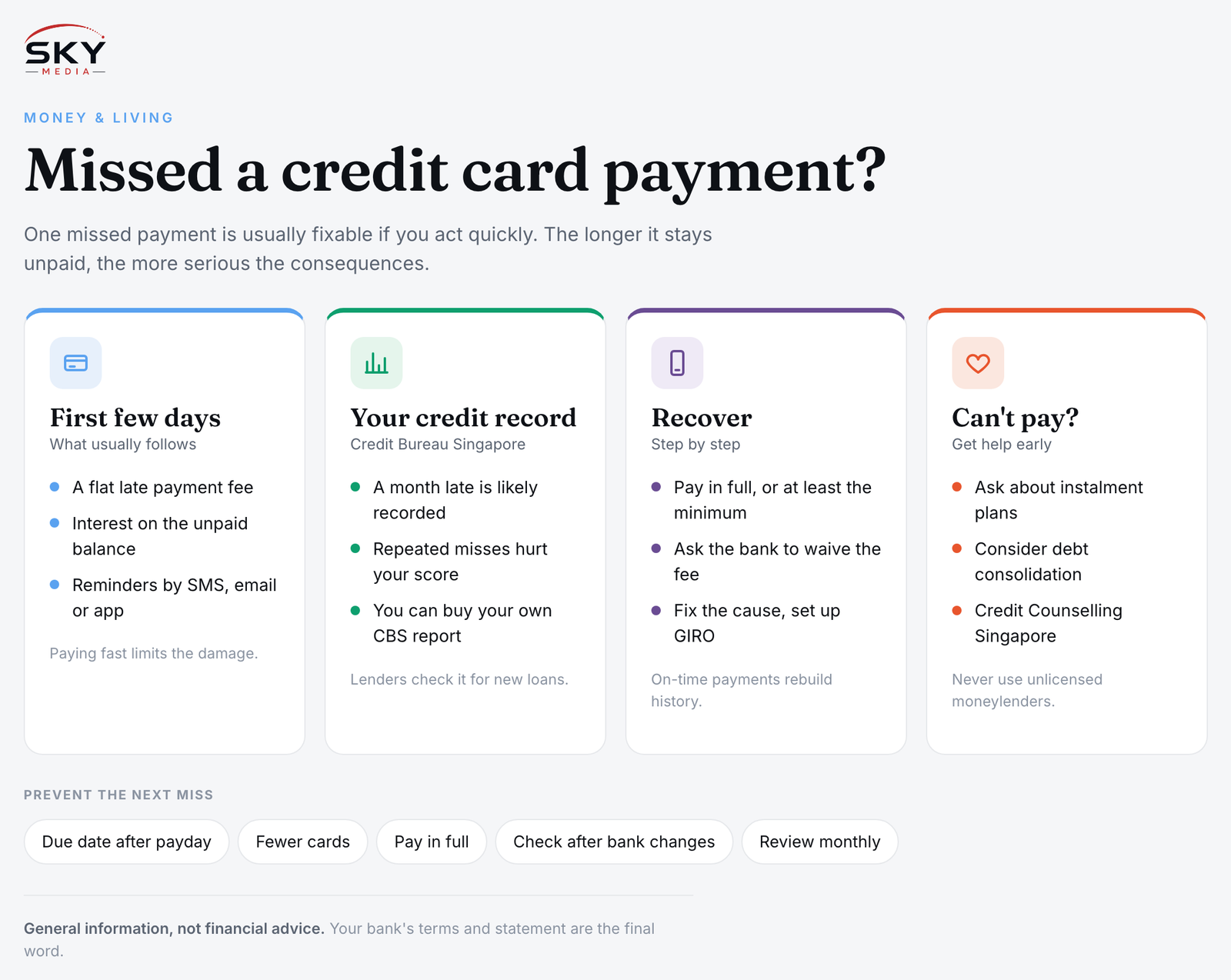
The First Few Days After the Due Date
Your monthly statement shows two important figures: the minimum payment and the full statement balance. Missing the due date means you did not pay at least the minimum by that date. Paying something, but less than the minimum, is usually treated the same way.
In most cases, here is what follows:
- A late payment fee. Banks charge a flat late fee when the minimum is not received on time. The amount is set out in your card’s fee schedule and can change, so check your bank’s current terms.
- Finance charges (interest). Once you do not pay the full balance, interest is usually charged on the outstanding amount, and you typically lose the interest-free period on new purchases until the balance is cleared. Effective rates on cards are high, which is why a missed month can be expensive. Our guide to credit card interest and minimum payments explains how this is calculated.
- Reminders. Expect SMS, email or app notifications, and possibly a call from the bank.
If you pay within a few days, the damage is often limited to the fee and some interest. The longer the balance stays unpaid, the more serious the consequences become.
How Late Payments Reach the Credit Bureau
Singapore banks share repayment information with credit bureaus, the main one for consumers being Credit Bureau Singapore (CBS). Your CBS report shows your credit accounts and a history of whether payments were made on time. Lenders check this when you apply for a new card, a personal loan, a car loan or a home loan.
A payment that is a few days late may or may not be reported, depending on how your bank reports and when it updates the bureau. A payment that is a full month or more overdue is much more likely to appear as a late payment in your history. Repeated missed months, or an account that is eventually charged off or sent to collections, will weigh heavily on your credit score.
You can buy a copy of your own credit report from CBS to see exactly what has been recorded. If something looks wrong, CBS has a process for raising a dispute, which goes back to the reporting bank to check.
There is also a regulatory rule worth knowing. Under Monetary Authority of Singapore (MAS) rules, if your total unsecured debt across all financial institutions stays above a set multiple of your monthly income for a sustained period, banks will suspend your unsecured credit facilities until it comes down. The thresholds are set by MAS and can be updated, so check the current rule if you are carrying large balances.
What It Costs at Each Stage
The table below gives a general picture. Exact fees, rates and timing depend on your bank and card.
| How late | What usually happens | Effect on your credit |
|---|---|---|
| A few days | Late fee charged, interest on unpaid balance, reminders | Often limited if paid quickly, depends on bank reporting |
| About one month | Further interest, possible second late fee, card may be restricted | Likely recorded as late on your CBS report |
| Two to three months | Card often suspended, calls from the bank’s collections team | Serious negative marks, harder to get new credit |
| Several months or more | Account may be terminated and passed to collections or legal action | Long-lasting damage to your credit history |
Step by Step: Recovering From a Missed Payment
1. Pay as soon as you can. Ideally pay the full statement balance. If that is not possible, pay at least the minimum to bring the account back to current status, then plan to clear the rest.
2. Call your bank and ask about the fee. Many banks will consider waiving a late fee or the associated interest as a goodwill gesture, especially if you have a good track record and this is a first slip. There is no guarantee, but asking politely costs nothing. Most banks let you request this through the app, chat or phone banking.
3. Find out why it happened. Was it a GIRO that did not transfer when you switched accounts, an expired card on an auto-payment, or a cash flow crunch? The fix depends on the cause.
4. Set up a safety net. Arrange a GIRO or standing instruction to pay at least the minimum automatically from your savings account each month, then pay the rest manually. Turn on due date reminders in your banking app.
5. Keep the account in good standing from now on. Credit history improves over time with consistent on-time payments. One late month followed by a long run of punctual payments looks very different from a pattern of arrears.
If You Cannot Pay the Balance
Sometimes the missed payment is a symptom of a bigger problem: income has dropped, or several cards and loans have built up. Avoid the trap of taking a new loan simply to pay off an old one without a plan.
- Talk to your bank early. Banks are usually more flexible before an account goes into serious arrears. Ask about instalment plans or balance conversion options, and read the terms carefully.
- Consider a debt consolidation plan. Participating banks in Singapore offer debt consolidation plans that combine unsecured balances into a single loan with one repayment schedule. Eligibility rules apply, so check with the banks directly.
- Get free, independent help. Credit Counselling Singapore (CCS) is a non-profit that helps people manage unsecured debt, including arranging repayment plans with banks. It is a good first stop if you feel overwhelmed.
- Never borrow from unlicensed moneylenders. If someone offers fast cash by SMS or social media, it is almost certainly illegal. Licensed moneylenders are listed by the Ministry of Law.
If you also have a home loan, prioritise housing payments. Our guide on falling behind on HDB loan payments covers what to do if that is part of the picture.
Habits That Prevent the Next Miss
- Align due dates with payday. Many banks let you request a change to your statement cycle so the due date falls after your salary arrives.
- Use fewer cards. Each extra card is another due date to remember. If you hold several for rewards, consider whether the rewards outweigh the risk. Our guide on how to choose a credit card can help you trim down to the ones that suit your spending.
- Pay in full whenever possible. Treat the minimum payment as a safety floor, not a target.
- Check after any banking change. Switching salary accounts, renewing a card or changing phone numbers can quietly break auto-payments and alerts.
- Review your statement monthly. It takes two minutes and also helps you spot unauthorised charges early.
The Bottom Line
A single missed credit card payment usually means a late fee, some interest and a nervous few days. It becomes a real problem when it is ignored. Pay quickly, call the bank, fix the cause and put an automatic payment in place. If the issue is bigger than one month’s slip, reach out to your bank or Credit Counselling Singapore early, while you still have the most options.
Further reading: How Credit Card Instalment Plans Really Work · How to Request a Credit Limit Increase or Decrease in Singapore